King Faisal Prize laureates honored at ceremony in Riyadh

1 / 5
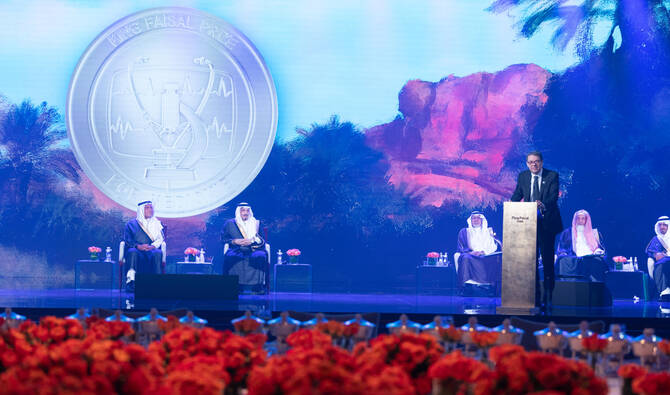
King Faisal Prize ceremony honored six distinguished laureates whose contributions have significantly advanced their fields and enriched humanity. (Supplied)
2 / 5
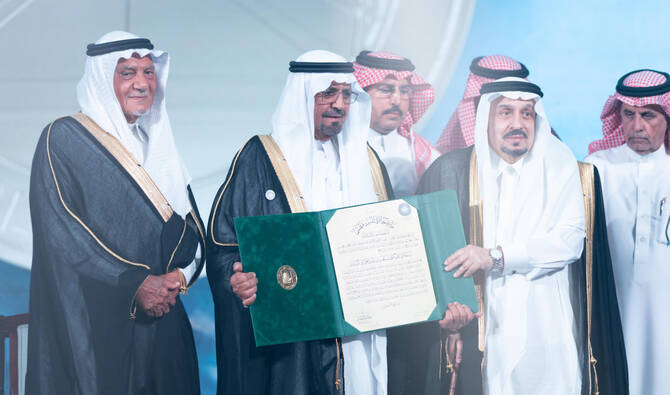
King Faisal Prize ceremony honored six distinguished laureates whose contributions have significantly advanced their fields and enriched humanity. (Supplied)
3 / 5
King Faisal Prize ceremony honored six distinguished laureates whose contributions have significantly advanced their fields and enriched humanity. (Supplied)
4 / 5
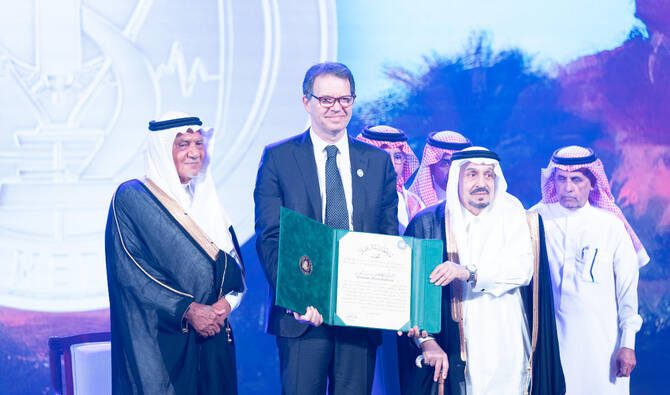
King Faisal Prize ceremony honored six distinguished laureates whose contributions have significantly advanced their fields and enriched humanity. (Supplied)
5 / 5
King Faisal Prize ceremony honored six distinguished laureates whose contributions have significantly advanced their fields and enriched humanity. (Supplied)
Short Url
Updated 15 April 2025
Follow

King Faisal Prize laureates honored at ceremony in Riyadh

  • Awards, most prestigious in Muslim world, recognize outstanding achievements in science, medicine, Islamic studies, Arabic language and literature, service to Islam

RIYADH: The King Faisal Prize ceremony, held on Monday night under the patronage of King Salman in Riyadh, honored six distinguished laureates whose contributions have significantly advanced their fields and enriched humanity.

Held under the auspices of King Salman, Riyadh Gov. Prince Faisal bin Bandar handed over the awards to laureates at the event’s 47th edition.

Several princes, senior government officials, academics and scientists attended the ceremony at Prince Sultan’s Grand Hall at the Al-Faisaliah Center.

Prince Turki Al-Faisal, the chairman of the King Faisal Center for Research and Islamic Studies, thanked the dignitaries for attending and congratulated the laureates.

Scholars and experts in service to Islam, Islamic studies, medicine, and science gathered in the Saudi capital to celebrate excellence, knowledge, and service.

This year’s Service to Islam Prize was awarded jointly to two laureates from Saudi Arabia. The Tebyan Qur’an Project by Liajlehum Association for Serving People with Disabilities was recognized for developing the world’s first complete Qur’anic interpretation in sign language, making the sacred text accessible to the deaf community and promoting inclusivity in Islamic education.

The second laureate, Sami Abdullah Almaqlouth, was honored for his outstanding efforts in mapping and preserving historic Islamic sites through his work at the General Authority for Survey and Geospatial Information. His documentation supports cultural preservation and public awareness of Islamic heritage.

The Islamic Studies Prize, awarded for archaeological studies in the Arabian Peninsula, was also shared between two scholars. Prof. Saad Abdulaziz Alrashid, a leading Saudi archaeologist, was recognized for his foundational contributions to the study of Islamic inscriptions and archaeological heritage. His work has laid the groundwork for a new generation of scholars and brought international attention to the region’s historic richness.

Prof. Said Faiz Alsaid, another prominent Saudi figure in the field, was honored for his comparative studies of Arabian epigraphy and his contributions to decoding the ancient civilizations of the peninsula, bridging pre-Islamic history with Islamic archaeology.

The Arabic Language and Literature Prize on the topic of studies of identity in Arabic literature was withheld this year as the works nominated did not meet the standards of the selection committee.

The Medicine Prize, awarded for cellular therapy, went to Prof. Michel Sadelain, director of the Center for Cell Engineering at Memorial Sloan Kettering Cancer Center.

He was recognized for his pioneering work in CAR-T cell therapy, a breakthrough cancer treatment that involves genetically modifying immune cells to target and destroy tumors. His research has opened new possibilities in treating leukemia and other previously incurable diseases, marking a milestone in medical innovation.

The Science Prize, focusing on physics this year, was awarded to Prof. Sumio Iijima of Japan. Known as the father of carbon nanotubes, his 1991 discovery of these cylindrical nanostructures revolutionized the field of nanotechnology.

Carbon nanotubes are now used in cutting-edge applications across electronics, materials science, energy storage, and even biomedicine. His discovery laid the foundation for countless technological innovations in the 21st century.

The KFP was established in 1977, and was awarded for the first time in 1979 in three categories — service to Islam, Islamic studies, and Arabic language and literature. Two additional categories were introduced in 1981 — medicine and science. The first medicine prize was awarded in 1982, and in science two years later.

Since its inception in 1977 and its first awards in 1979, the KFP has recognized 301 laureates from 45 nationalities who have made outstanding contributions to Islam, knowledge, and humanity.

Each of the five prize categories is endowed with SR750,000 ($200,000), a 24-carat gold medal and a certificate signed by Prince Khalid Al-Faisal.


Japan consulate in Jeddah celebrates cinema with Red Sea Film Festival guests

Updated 13 sec ago
Follow

Japan consulate in Jeddah celebrates cinema with Red Sea Film Festival guests

JEDDAH: As part of the celebrations marking 70 years of diplomatic relations between Japan and Saudi Arabia, the Consulate General of Japan in Jeddah hosted a special reception on Sunday evening for guests of the Red Sea International Film Festival.

The gathering, held at the consul general’s residence, highlighted the strengthening cultural ties between the two nations and Japan’s growing presence at the festival.

Speaking to Arab News on the sidelines of the event, Daisuke Yamamoto, consul general of Japan in Jeddah, said: “We are happy to have a gathering today. This is the first time Japan has held this kind of event related to the Red Sea Film Festival. Although it is the festival’s fifth edition, Japanese representation in previous years was limited. I encouraged our film industry to engage more, and I am happy that five Japanese films are being screened this year.”

While noting the absence of Japanese actors at the festival, he said the presence of producers and directors marks an important step forward. “There are already discussions about potential collaborations, and this reception is an excellent opportunity to build on the proposal we received from the Red Sea organizers.”

Yamamoto highlighted the longstanding partnership between Japan and Saudi Arabia in key sectors such as petrochemicals and the automotive industry, and expressed hope that cinema will become a new bridge for cooperation.

“I have known Saudi Arabia for many years and have seen remarkable, positive changes. We hope the Japanese film industry can be part of this dynamic transformation as well,” he added.

The event, organized in cooperation with the Red Sea Film Foundation, brought together about 50 attendees, including government officials, several consuls general, representatives from the Jeddah Historic District Program, festival guests and Saudi cultural figures.

Welcoming the guests, Yamamoto expressed his appreciation to the Ministry of Culture, the Jeddah Historic District authorities, and the Red Sea Film Foundation for their close cooperation throughout the year.

He noted the increasing cultural engagement between the two countries, including the hosting of several Japanese cultural programs in the historic district.

“Cinema is a noble art and a global cultural window that connects peoples and fosters cultural exchange, thus promoting openness to cultural diversity,” Yamamoto said in his address.

This aligns with the goals of Saudi Vision 2030, he added. “Our two friendly countries are collaborating to achieve this vision through the ‘Saudi-Japanese Vision 2030’ Committee, and the Ministry of Culture, through its Jeddah Historical District, is implementing it with insightful and open leadership to the fullest extent.”

Well-known Saudi actor, writer and producer Abdullah Al-Sadhan, who attended the reception, praised both the festival and the Japanese Consulate for their hospitality.

“It’s always a pleasure to return to the Red Sea International Film Festival and see how it continues to grow,” he said, adding: “This gathering by the Japanese consulate reflects a genuine interest in building bridges with our film community. Events like this open the door for stronger cooperation between Saudi and Japanese creators, which can only enrich the industry on both sides.”

Maiyada Mahdaly, secretary of the consul general, said: “Through this event, we celebrated the vibrant spirit of cinema and the growing cultural connection between our countries. We also welcomed talents from Saudi Arabia, Japan and beyond to honor creativity, collaboration and the power of storytelling that transcends borders.”