

Nigeria embraces AI in education to equip youth for global economy

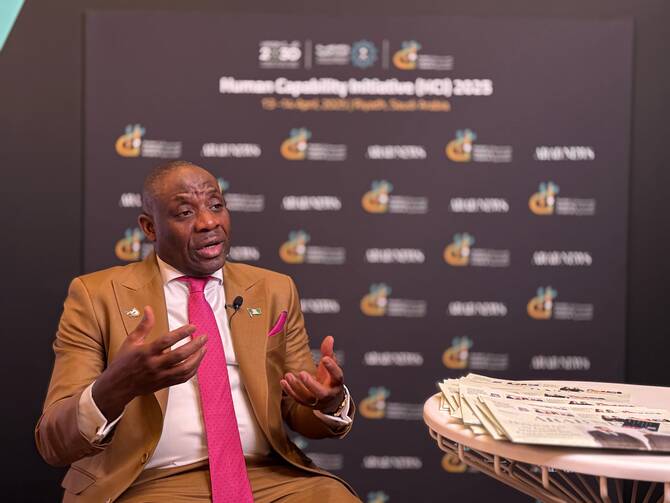
Nigeria’s Minister of State for Education Maruf Tunji Alausa during an interview with Arab News. AN photo by Huda Bashatah
Short Url
Updated 14 April 2025
Follow

Nigeria embraces AI in education to equip youth for global economy

RIYADH: Nigeria is integrating artificial intelligence into its education system as part of a broader strategy to train its vast youth population for the global tech economy, according to Minister of State for Education Maruf Tunji Alausa.  

Speaking to Arab News on the sidelines of the Human Capability Initiative in Riyadh, Alausa said African nations must embrace AI in education while ensuring that students retain critical social skills. 

“The basic outcome was that we don’t have a choice now, AI has come to stay. We need to now use AI as part of our learning,” Alausa said. “Countries need to infuse AI to help augment and improve education delivery.” 

However, he cautioned against over-reliance on technology, warning that it must not erode children’s social skills. “We have to be sure that it doesn’t leave deficiencies in the skill set, in the social skills of our children,” he added.   

With over 60 percent of Africa’s 1.2 billion people under 30 — and Nigeria’s 220 million population being 70 percent youth — Alausa argued that the continent is uniquely positioned to supply skilled labor to aging economies like Europe, Japan, and the US. 

“Today, Nigeria has 65 million people between 15 and 29, with 5 million entering the workforce yearly,” he said. “We need to train this youthful population in tech skills — software development, cybersecurity, AI, cloud computing — so they can service companies worldwide while staying in Nigeria.”  

Nigeria has launched a digital training academy to upskill university graduates in high-demand tech fields, enabling them to earn online certifications and work remotely for international firms. Alausa urged other African nations to adopt similar models.   

During his visit to Saudi Arabia, Alausa toured several academic institutions alongside Education Minister Yousef Al-Benyan and praised the Kingdom’s dual-track approach to higher education. 

“Saudi Arabia has gotten it right,” he said. 

He also announced forthcoming collaborations between Nigeria and Saudi Arabia in education and skills development. 

“As we learn from Saudi Arabia, Saudi Arabia can also learn from us,” Alausa added.  

Held under the patronage of Crown Prince Mohammed bin Salman, the Human Capability Initiative convened more than 12,000 experts from over 100 countries to address the intersection of education, workforce transformation, and emerging technologies. 

This year’s theme, “Beyond Readiness,” focused on AI, inclusive development, and global equity in skills training.   

With Nigeria positioning itself as a hub for global tech talent, Alausa’s vision aligns with HCI’s goal of fostering cross-border partnerships to future-proof economies.


Closing Bell: Saudi main index extends gains as market opens wider to foreign investment

Updated 02 February 2026
Follow

Closing Bell: Saudi main index extends gains as market opens wider to foreign investment

RIYADH: Saudi Arabia’s Tadawul All Share Index rose on Monday, gaining 153.61 points, or 1.38 percent, to close at 11,321.09.

The total trading turnover of the benchmark index was SR5.85 billion ($1.56 billion), as 207 of the listed stocks advanced, while 55 retreated.

The MSCI Tadawul Index increased, up 21.20 points or 1.41 percent, to close at 1,524.18.

The Kingdom’s parallel market Nomu gained 278.13 points, or 1.17 percent, to close at 24,013.03. This comes as 43 of the listed stocks advanced, while 29 retreated.

The best-performing stock was Saudi Pharmaceutical Industries and Medical Appliances Corp., with its share price surging by 7.26 percent to SR28.94.

Other top performers included Rasan Information Technology Co., which saw its share price rise by 6.51 percent to SR144, and Knowledge Economic City, which saw a 6.25 percent increase to SR13.09.

On the downside, the worst performer of the day was Najran Cement Co., whose share price fell by 2.11 percent to SR6.49.

Almasane Alkobra Mining Co. and Saudi Cable Co. also saw declines, with their shares dropping by 2 percent and 1.88 percent to SR103.10 and SR166.80, respectively.

On the announcement front, Riyad Bank has announced its annual financial results for 2025, with the total income from special commission of financing reaching SR24.1 billion, while net income from special commission of financing amounted to SR12 billion.

In a statement on Tadawul, the bank said: “Net income increased by 11.7 percent mainly due to an increase in total operating income and a decrease in total operating expenses.”

The bank further noted that the rise in total operating income was primarily driven by increased revenue from fees and commissions, trading activities, special commissions, gains on non-trading investments, and other operating sources. This growth was partially tempered by declines in exchange and dividend income.

“Net provision of expected credit losses and other losses decreased by 15.8 percent due to a decrease in impairment charge of credit losses and impairment charge for other financial assets, partially offset by an increase in impairment charge for investments,” it added.

RIBL’s share price closed at SR18.18 on the main market, marking a 1.43 percent increase.