

No intention of responding to tariffs imposed by Trump administration — Pakistan finance minister

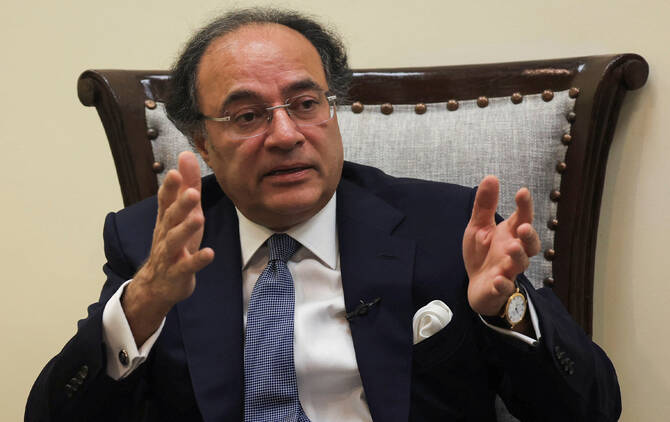
Pakistan’s Finance Minister Muhammad Aurangzeb speaks during an interview at his office in Islamabad, Pakistan on July 19, 2024. (Reuters/File)
Short Url
Updated 14 April 2025
Follow

No intention of responding to tariffs imposed by Trump administration — Pakistan finance minister

  • Islamabad was slapped with 29% tariff rate before Trump’s 90-day temporary pause 
  • 10% blanket duty on almost all US imports will remain in effect, the White House has said

ISLAMABAD: Pakistani Finance Minister Muhammad Aurangzeb has said Islamabad was concerned about new tariffs imposed by the US administration of President Donald Trump but had no intentions of imposing reciprocal taxes, BBC reported on Sunday.

Islamabad would have been slapped with a 29% tariff rate before Trump’s temporary suspension announcement on Wednesday. A 10% blanket duty on almost all US imports will remain in effect, the White House has said.

“There is a minimum tariff of 10% and then there is an additional tariff, I think we need to talk about this issue,” Aurangzeb said in an interview to the BBC. 

In response to a question about reciprocal tariffs, he said: “If your question is whether we are going to give any response [to the US] in return, the answer is no.”

“There is a situation of uncertainty, and we all have to think about how to move forward with this new world order,” the finance minister added. 

When asked if he felt Pakistan was losing out in the tug-of-war between the US and China, he said Washington had been a “strategic partner” of Pakistan for a long time, not just in trade but also in other sectors, while relations with China were important in their own right. 

A study by the Pakistan Institute of Development Economics (PIDE) entitled ‘Impact of Unilateral Tariff Increase by United States on Pakistani Exports’ said this month when added to the existing 8.6% Most Favored Nation (MFN) tariff, the total duty after the imposition of the 29% tariff could reach 37.6%. This would likely result in a 20-25% decline in Pakistani exports to the US, translating into an annual loss of $1.1-1.4 billion, with the textile sector bearing the brunt of the blow.

The textile sector in Pakistan generates about $17 billion in exports and is the largest employer in the country, according to the Pakistan Textile Council. The industry is expected to face significant challenges from the tariffs, with potential losses of up to $2 billion in textile exports estimated by experts if the 29% tariff rate is reinstated after Trump’s 90-day pause ends.

Despite the risks, the PIDE reports also view the tariffs crisis as an “opportunity for strategic transformation.” 

In the short term, it recommended that Pakistan engage in high-level diplomatic efforts to highlight the mutual costs of the tariffs and preserve long-standing trade relations. In the long term, it called for the need to diversify both export products and markets, seeing destinations such as the European Union, China, Asean nations, Africa and the Middle East as offering growth potential in sectors like IT, halal food, processed foods and sports goods.


Saudi Arabia, Japan trade rises 38% between 2016 and 2024, minister says

Updated 11 January 2026
Follow

Saudi Arabia, Japan trade rises 38% between 2016 and 2024, minister says

RIYADH: Trade between Saudi Arabia and Japan has increased by 38 percent between 2016 and 2024 to reach SR138 billion ($36 billion), the Kingdom’s investment minister revealed.

Speaking at the Saudi-Japanese Ministerial Investment Forum 2026, Khalid Al-Falih explained that this makes the Asian country the Kingdom’s third-largest trading partner, according to Asharq Bloomberg.

This falls in line with the fact that Saudi Arabia has been a very important country for Japan from the viewpoint of its energy security, having been a stable supplier of crude oil for many years.

It also aligns well with how Japan is fully committed to supporting Vision 2030 by sharing its knowledge and advanced technologies.

“This trade is dominated by the Kingdom's exports of energy products, specifically oil, gas, and their derivatives. We certainly look forward to the Saudi private sector increasing trade with Japan, particularly in high-tech Japanese products,” Al-Falih said.

He added: “As for investment, Japanese investment in the Kingdom is good and strong, but we look forward to raising the level of Japanese investments in the Kingdom. Today, the Kingdom offers promising opportunities for Japanese companies in several fields, including the traditional sector that links the two economies: energy.”

The minister went on to note that additional sectors that both countries can also collaborate in include green and blue hydrogen, investments in advanced industries, health, food security, innovation, entrepreneurship, among others.

During his speech, Al-Falih shed light on how the Kingdom’s pavilion at Expo 2025 in Osaka achieved remarkable success, with the exhibition receiving more than 3 million visitors, reflecting the Japanese public’s interest in Saudi Arabia.

“The pavilion also organized approximately 700 new business events, several each day, including 88 major investment events led by the Ministry of Investment. Today, as we prepare for the upcoming Expo 2030, we look forward to building upon Japan’s achievements,” he said.

The minister added: “During our visit to Japan, we agreed to establish a partnership to transfer the remarkable Japanese experience from Expo Osaka 2025 to Expo Riyadh 2030. I am certain that the Japanese pavilion at Expo Riyadh will rival the Saudi pavilion at Expo Osaka in terms of organization, innovation, and visitor turnout.”

Al-Falih also shed light on how Saudi-Japanese relations celebrated their 70th anniversary last year, and today marks the 71st year of these relations as well as how they have flourished over the decades, moving from one strategic level to an even higher one.