SAN JOSE, California: Like many in the tech industry, Jeremy Lyons used to think of himself as a relatively apolitical guy.
The only time he had participated in a demonstration before now was in the opening days of Donald Trump’s first presidential term, when he joined fellow Google workers walking out of the company’s Silicon Valley campus to protest immigration restrictions. Google’s co-founder and its chief executive officer joined them.
Last weekend was Lyons’ second, also against Trump, but it had a very different feel.
The man directing thousands of marchers with a bullhorn in downtown San Jose on April 5 was another tech worker who would not give his full name for fear of being identified by Trump backers. Marchers were urged not to harass drivers of Tesla vehicles, which have gone from a symbol of Silicon Valley’s environmental futurism to a pro-Trump icon. And no tech executives were anywhere to be seen, only months after several had joined Trump at his January inauguration.
To Lyons, 54, the change says as much about what’s happened to Silicon Valley over the past quarter-century as it does about the atmosphere of fear surrounding many Trump critics nowadays.
“One of the things I’ve seen over that time is a shift from a nerdy utopia to a money first, move fast and break things,” Lyons said.
Political gap seen between tech leaders and their workforce
The tech industry’s political allegiances remain divided. But as some in the upper echelons of Silicon Valley began shifting to the right politically, many of the tech industry’s everyday workers have remained liberal — but also increasingly nervous and disillusioned. Their mood is in stark contrast to the prominent tech leaders who have embraced a conservative populist ideology.
“I think you’re seeing a real gap between the leadership elite here in Silicon Valley and their workforce,” said Ann Skeet, who helps run a center at Santa Clara University studying the ethics of the tech industry.
“The shift hasn’t been for a lot of people,” said Lenny Siegel, a former mayor of Mountain View and longtime liberal activist in the valley. “It’s a handful of people who’ve gotten the attention.”
The biggest example of that is Elon Musk, the world’s richest person and CEO of the world’s best-known electric car company who has taken on a prominent role slashing federal agencies in Trump’s administration. Musk has been joined by several tech billionaires, including investor David Sacks, who helped fundraise for Trump’s campaign and became the White House’s artificial intelligence and cryptocurrency czar, and venture capitalist Marc Andreesen. Google CEO Sundar Pichai and Meta CEO Mark Zuckerberg also attended Trump’s inauguration in Washington.
Zuckerberg began praising Trump after the then-candidate, angered over money Zuckerberg steered toward local election offices in some states in 2020 during the coronavirus pandemic, threatened last summer to imprison him. Zuckerberg also donated $1 million to the president’s inauguration fund and co-hosted an inauguration reception for billionaire Republican donors.
Trump has filled a number of his administration’s posts with billionaires and his support from wealthy tech leaders led Democratic President Joe Biden to warn that the United States risked becoming an oligarchy ruled by elites. During Trump’s first term, the valley and its leaders were a bulwark of resistance to the Republican, especially over immigration, given that the industry draws its workforce from around the globe.
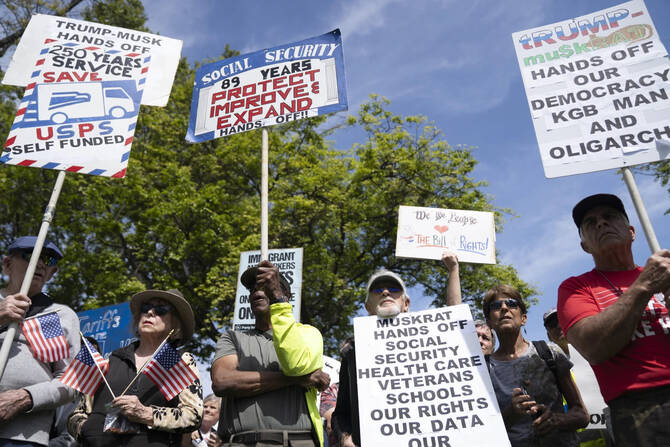
It’s against that backdrop that thousands of people attended the recent rally at a downtown San Jose park to protest the actions of Trump and Musk.
Even as tech industry has changed, Silicon Valley has leaned Democratic
Santa Clara County, which comprises most of Silicon Valley, swung 8 percentage points toward Trump in November election against Democrat Kamala Harris, matching the shift across California. Even with that swing, the county voted 68 percent to 28 percent for the then-vice president and remains a Democratic stronghold.
“We’re still in the belly of the beast,” said Dave Johnson, the new executive director of the Santa Clara GOP, who said the party has gained some new members in the county but few from the tech industry. “If the lake was frozen, there’s a little glimmer on top. I would not say there are cracks in the ice.”
The valley has long leaned Democratic, but with an unusual political mix: a general dislike of getting too involved in Washington’s business coupled with an at-times contradictory mix of libertarian individualism, Bay Area activism and belief in the ability of science to solve the world’s problems.
That has persisted even as the tech industry has changed.
The tech boom was fueled by scrappy startups that catered to their workers’ dreams of changing the world for the better. Google’s motto was “don’t be evil,” a phrase it removed from its code of conduct by 2018, when it and other companies such as Meta, which owns Facebook and Instagram, had grown into multinational behemoths. The companies have had layoffs in recent years, a shock to an industry that not long ago seemed poised for unlimited growth.
Entrepreneurs once dreamed of building startups that would change the world, said Jan English-Lueck, a San Jose State University professor who has been studying Silicon Valley culture for more than 20 years.
“Now,” she said, “if you’re part of a startup, you’re hoping you’ll be absorbed in a way that’s profitable.”
Discontent among some in the tech industry about where it’s headed
Even before some prominent tech leaders shifted toward Trump, there was mounting discontent among some in the industry over its direction. IdaRose Sylvester runs a business promoting a Silicon Valley-style approach to entrepreneurs in other countries.
“I feel sick to my stomach now,” she said.
Sylvester was already disenchanted with the growing inequality in the valley and the environmental cost of all the energy needed to power crypto, AI and data centers. She took part in protests against Trump in 2017, but felt that energy fade once he lost the 2020 election to Biden.
“I saw a lot of people get out of politics once Biden won. There was a feeling it was all OK,” Sylvester said. “It was not all OK.”
It is worse now, she said. She helped organize one of several demonstrations across the valley last weekend during a national day of protests against the new administration.
At first glance, the one in downtown San Jose could have been a typical anti-Trump protest anywhere. A large crowd of largely middle-age and older people carried signs against the president and Musk while chanting against oligarchs.
But it was clearly a Silicon Valley crowd, one still reeling not only from Trump’s challenges to the country’s system of checks and balances but also from the actions of the valley’s top executives.
“The money is all shifting to the wealthiest, and that terrifies me,” said Dianne Wood, who works at a startup. “Unfortunately, you’ve got the Zuckerbergs and Elon Musks of the world who are taking that over.”
“Just coming here, everyone’s saying turn off the facial recognition on your phone,” Wood added. “We’re all scared.”
Kamal Ali, who works in AI, said he felt betrayed by that shift.
“The trust is broken. A lot of employees are very upset by what’s going on,” he said. “It’s going to be different forever.”


![]()

Billionaire tech leaders’ move toward Trump has created a split with workers in Silicon Valley
Short Url
https://arab.news/8ctms
Billionaire tech leaders’ move toward Trump has created a split with workers in Silicon Valley
- Trump has filled a number of his administration’s posts with billionaires and his support from wealthy tech leaders led Democratic President Joe Biden to warn that the US risked becoming an oligarchy ruled by elite


Latest updates


Recommended


© 2026 SAUDI RESEARCH & PUBLISHING COMPANY, All Rights Reserved And subject to Terms of Use Agreement.