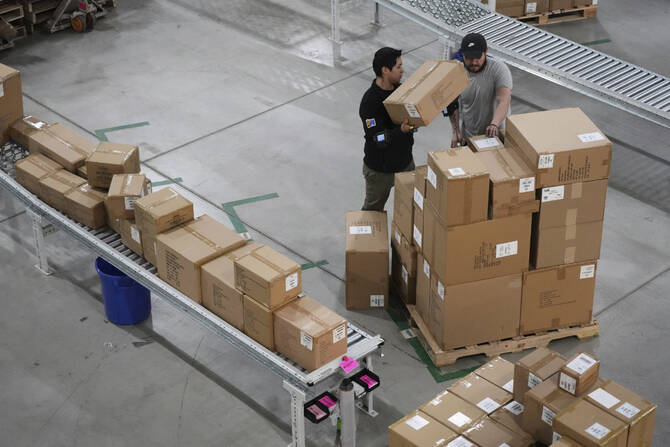


WASHINGTON: Rick Woldenberg thought he had come up with a sure-fire plan to protect his Chicago-area educational toy company from President Donald Trump’s massive new taxes on Chinese imports.
“When he announced a 20 percent tariff, I made a plan to survive 40 percent, and I thought I was being very clever,” said Woldenberg, CEO of Learning Resources, a third-generation family business that has been manufacturing in China for four decades. “I had worked out that for a very modest price increase, we could withstand 40 percent tariffs, which was an unthinkable increase in costs.”
His worst-case scenario wasn’t worst-case enough. Not even close.
The American president quickly upped the ante with China, raising the levy to 54 percent to offset what he said were China’s unfair trade practices. Then, enraged when China retaliated with tariffs of its own, he upped the levies to a staggering 145 percent.
Woldenberg reckons that will push Learning Resource’s tariff bill from $2.3 million last year to $100.2 million in 2025. “I wish I had $100 million,” he said. “Honest to God, no exaggeration: It feels like the end of days.”
‘Addicted’ to low-price Chinese goods
It might at least be the end of an era of inexpensive consumer goods in America. For four decades, and especially since China joined the World Trade Organization in 2001, Americans have relied on Chinese factories for everything from smartphones to Christmas ornaments.
As tensions between the world’s two biggest economies — and geopolitical rivals — have risen over the past decade, Mexico and Canada have supplanted China as America’s top source of imported goods and services. But China is still No. 3 — and second behind Mexico in goods alone — and continues to dominate in many categories.
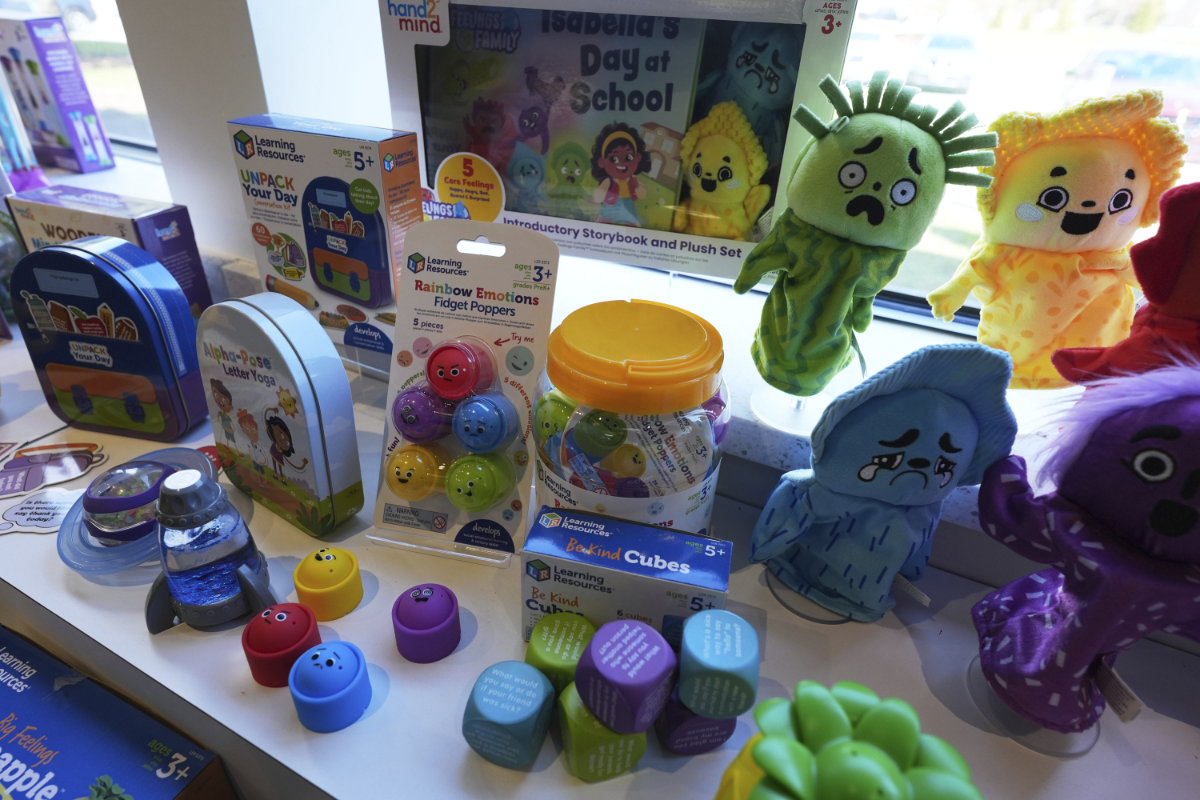
Products of Learning Resources, an educational toy company whose products are manufactured in China, are shown at a showroom in Vernon Hills, Illinois, on April 11, 2025. (AP Photo)
China produces 97 percent of America’s imported baby carriages, 96 percent of its artificial flowers and umbrellas, 95 percent of its fireworks, 93 percent of its children’s coloring books and 90 percent of its combs, according to a report from the Macquarie investment bank.
Over the years, American companies have set up supply chains that depend on thousands of Chinese factories. Low tariffs greased the system. As recently as January 2018, US tariffs on China averaged just over 3 percent, according to Chad Bown of the Peterson Institute for International Economics.
“American consumers created China,” said Joe Jurken, founder of the ABC Group in Milwaukee, which helps US businesses manage supply chains in Asia. “American buyers, the consumers, got addicted to cheap pricing. And the brands and the retailers got addicted to the ease of buying from China.”
Slower growth and higher prices
Now Trump, demanding that manufacturers return production to America, is swinging a tariff sledgehammer at the American importers and the Chinese factories they rely on.
“The consequences of tariffs at this scale could be apocalyptic at many levels,” said David French, senior vice president of government affairs at the National Retail Foundation.
The Yale University Budget Lab estimates that the tariffs that Trump has announced globally since taking office would lower US economic growth by 1.1 percentage points in 2025.
The tariffs are also likely to push up prices. The University of Michigan’s survey of consumer sentiment, out Friday, found that Americans expect long-term inflation to reach 4.4 percent, up from 4.1 percent last month.
“Inflation’s going up in the United States,” said Stephen Roach, former chairman of Morgan Stanley Asia and now at Yale Law School’s China Center. “Consumers have figured this out as well.”
“No business can run on uncertainty”
It’s not just the size of Trump’s tariffs that has businesses bewildered and scrambling; it’s the speed and the unpredictability with which the president is rolling them out.
On Wednesday, the White House said the tariffs on China would hit 125 percent. A day later, it corrected that: No, the tariffs would be 145 percent, including a previously announced 20 percent to pressure China to do more to stop the flow of fentanyl into the United States.
China in turn has imposed a 125 percent tariff on the US effective Saturday.
“There is so much uncertainty,” said Isaac Larian, the founder of MGA Entertainment, which makes L.O.L. and Bratz dolls, among other toys. “And no business can run on uncertainty.”
His company gets 65 percent of its product from Chinese factories, a share he is trying to winnow down to 40 percent by the end of the year. MGA also manufactures in India, Vietnam and Cambodia, but Trump is threatening to levy heavy tariffs on those countries, too, after delaying them for 90 days.
Larian estimates that the price of Bratz dolls could go from $15 to $40 and that of L.O.L. dolls could double to $20 by this year’s holiday season.
Even his Little Tikes brand, which is made in Ohio, is not immune. Little Tikes depends on screws and other parts from China. Larian figures the price for its toy cars could rise to $90 from a suggested retail price of $65.
He said MGA would likely cut orders for the fourth quarter because he is worried that higher prices will scare off consumers.
Calling off China production plans
Marc Rosenberg, founder and CEO of The Edge Desk in Deerfield, Illinois, invested millions of dollars of his own money to develop $1,000 ergonomic chairs, which were to start production in China next month.
Now’s he’s delaying production while exploring markets outside the US, including Germany and Italy, where his chairs wouldn’t face Trump’s triple-digit tariffs.He said he wants to see how the situation plays out.

The US flag flutters at the US consulate general in Shanghai on April 12, 2025. (AFP)
He had looked for ways to make the chairs in the United States and had discussions with potential suppliers in Michigan, but the costs would have been 25 percent to 30 percent higher.
“They didn’t have the skilled labor to do this stuff, and they didn’t have the desire to do it,” Rosenberg said.
Making Chinese imports go ‘kaput’
Woldenberg’s company in Vernon Hills, Illinois, has been in the family since 1916. It was started by his grandfather as a laboratory supply company and evolved over the years into Learning Resources.
The company specializes in educational toys such as Botley: The Coding Robot and the brainteaser Kanoodle. It employs about 500 people — 90 percent in the United States — and makes about 2,400 products in China.
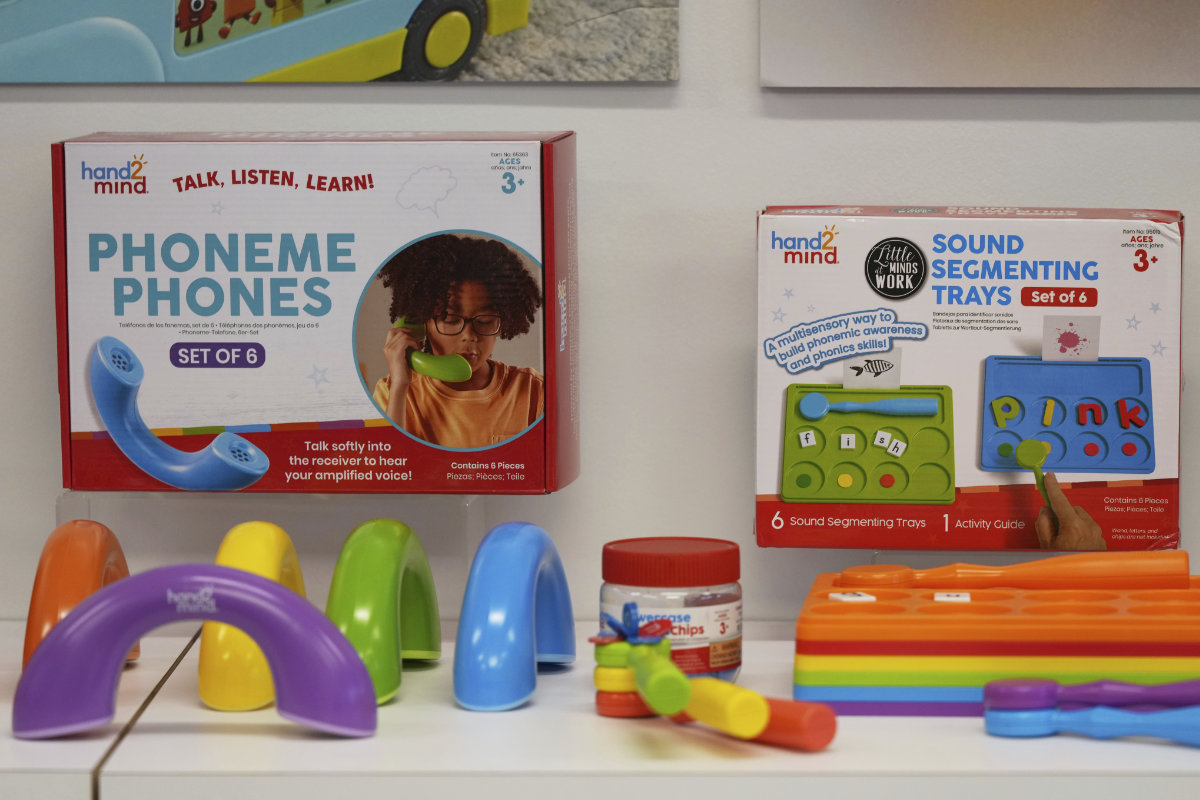
Products of Learning Resources, an educational toy company whose products are manufactured in China, are shown at a showroom in Vernon Hills, Illinois, on April 11, 2025. (AP Photo)
Woldenberg is reeling from the size and suddenness of Trump’s tariffs.
“The products I make in China, about 60 percent of what I do, become economically unviable overnight,” he said. “In an instant, snap of a finger, they’re kaput.”
He described Trump’s call for factories to return to the United States as “a joke.”
“I have been looking for American manufacturers for a long time ... and I have come up with zero companies to partner with,” he said.
The tariffs, unless they’re reduced or eliminated, will wipe out thousands of small Chinese suppliers, Woldenberg predicted.
That would spell disaster for companies like his that have installed expensive tools and molds in Chinese factories, he said. The stand to lose not only their manufacturing base but also possibly their tools, which could get caught up in bankruptcies in China.
Learning Resources has about 10,000 molds, weighing collectively more than 5 million pounds, in China.
“It’s not like you just bring in a canvas bag, zip it up and walk out,” Woldenberg said. “There is no idle manufacturing hub standing fully equipped, full of engineers and qualified people waiting for me to show up with 10,000 molds to make 2,000 products.”