



ALKHOBAR: As Saudi Arabia accelerates its journey toward becoming a global hub for innovation under Vision 2030, a new frontier is emerging in the Kingdom’s digital transformation: the university classroom. While many Western economies grapple with “AI anxiety,” Saudi Arabia is witnessing a wave of unprecedented optimism.
In an interview with Arab News, Anthony Salcito, general manager of Enterprise at Coursera, revealed that the Kingdom is outpacing global peers in AI enthusiasm, technical upskilling, and adoption of industry-aligned micro-credentials.

Anthony Salcito
Coursera’s latest data underscores Saudi Arabia’s unique position. When asked about the impact of artificial intelligence on the future of learning, students in the Kingdom responded overwhelmingly positively.
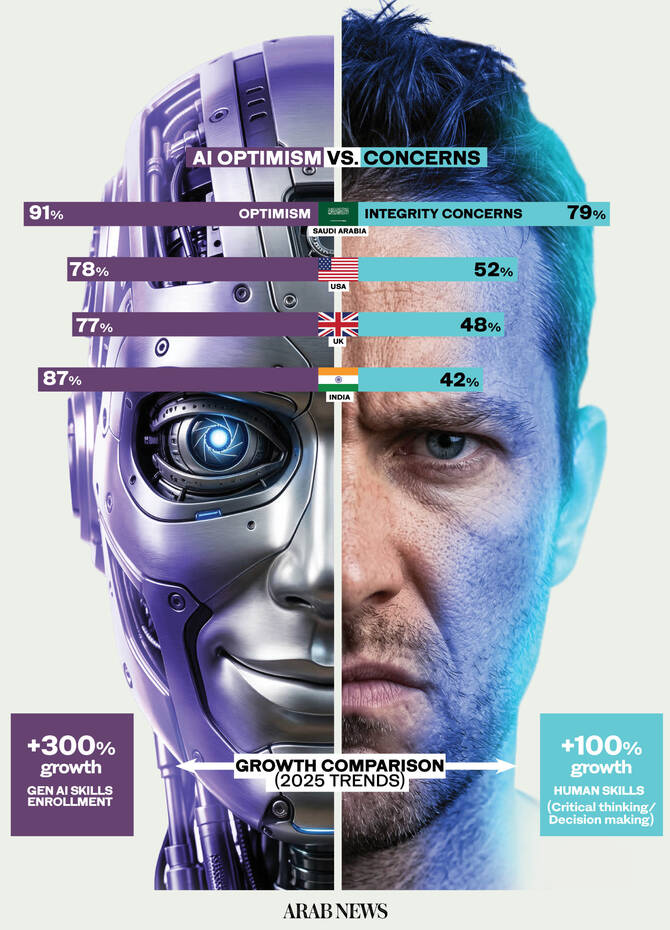
“Certainly I think one of the things that comes across the survey is the importance and value on AI with 91 percent of students seeing AI’s impact on higher education as positive. It’s a huge testament to the impact that we’re seeing,” Salcito stated.
This optimism is not just a regional trend; it sharply contrasts with figures from major Western and emerging markets. Salcito highlighted the “fairly significant lift” between Saudi Arabia and other nations.
“I would say the biggest area is huge optimism from Saudi Arabia compared to the other countries surveyed on AI. If you think about the sort of what I highlighted earlier with regards to the view on higher education in AI, 91 percent in Saudi Arabia compared to others who are not as strong. So 77 percent positive in the UK, 87 percent in India, 73 percent in Mexico, and 78 percent in the US,” he explained.
FASTFACTS
• Students believe AI may make a four-year degree obsolete within a decade.
• Saudi universities are blending traditional degrees with industry-led micro-credentials.
• The Kingdom is preparing learners to use AI as a tool, not a crutch.
Yet this enthusiasm comes with a strong sense of responsibility. Saudi students are not just users of AI—they are vocal critics regarding ethics and academic honesty.
The study identified a “fundamental concern on academic integrity where Saudi Arabia shared more concern on integrity than other countries even by a greater margin,” Salcito said. The numbers are striking: “Seventy-nine percent believe AI for university work raises academic integrity concerns in Saudi Arabia compared to 48 percent in the UK, 42 percent in India, 50 percent in Mexico, and 52 percent in the US.”
This “Integrity Paradox” reflects a cultural drive to innovate without compromising educational rigor. Salcito highlighted another notable finding: “Twenty-five percent of submissions said that submitting AI generative work without disclosure is something that they’ve done.”

Illustration image by Gemini (Google AI)
A pressing question for the Ministry of Education and local universities is whether traditional degrees retain their value in the era of automation. With many students predicting that AI could render a four-year degree obsolete within a decade, Salcito emphasizes that universities must “align to the changing workforce dynamics.”
“Micro-credentials are really just an indicator of a lifelong learning shift,” Salcito told Arab News. “There was a time where you would build a four-year study and degree to fuel you through a world of work that was fairly stagnant or wasn’t changing as rapidly as the current world of work we're in now.”
To remain relevant, Saudi institutions are increasingly embracing blended academic models. Faculty members are partnering with Coursera to embed content from industry leaders directly into curricula.
Opinion
This section contains relevant reference points, placed in (Opinion field)
“What I think we're starting to see is universities increasingly embrace micro-credentials and industry content within the context of a four-year degree or university curriculum,” Salcito said. “This is something Coursera is doing a lot of work with, both providing micro-credentials across our platform, but working with faculty members to embed content from leading industry providers like Microsoft, OpenAI, Anthropic, Google within the context of a university course.”
While technical AI skills dominate headlines, the data also reveals a surge in human-centric skills among Saudi learners.
“If you look at the data from Saudi that we’ve seen just with regards to our course enrollments in 2025, there was a 300 percent year-over-year growth in the students enrolling in generative AI courses,” Salcito noted. “But we’ve also seen over 100 percent growth in human skills like decision making and critical thinking.”

As Saudi Arabia integrates industry-led AI credentials into higher education, the focus remains on enhancing human critical thinking alongside machine intelligence. (Creativecommons)
This trend highlights a key understanding among Saudi students: AI can handle data, but humans must handle judgment. Salcito addressed concerns about job displacement: “There's always fear on AI as it relates to displacing humanity. What we've seen with AI is human skills are even more valued in a world of AI from employers. Thinking about the human skills on leadership, collaborative work, creative thinking, etc., becomes even more important in the future."
As AI tools become more prevalent, universities face the challenge of ensuring they enhance learning rather than serve as a “crutch.” Salcito stressed the need for innovative assessment models:
“I think it’s all of the above,” he said. “Obviously, making sure that assessments are locked and controlled so students have greater protection and guardrails against the use or misuse of AI. Thinking differently about how assessments are done, whether we’re doing verbal assessments and direct engagement to assess students' work, doing more project-based work that is much more focused on output than testing specifically.”

Saudi Arabia is leading global AI optimism, but data shows students are equally committed to mastering human-centric skills like leadership and ethical decision-making. (easy-peasy.ai)
The goal, he explained, is to “train the next generation of learners to rightfully use AI as a tool, but not misuse it as a crutch.”
The overarching message from Coursera’s research is one of preparation. Saudi youth are not waiting for the future — they are actively reskilling to lead it. By prioritizing both technical AI skills and timeless human competencies like leadership and ethics, the Kingdom is building a talent pipeline that is not only “AI-ready,” but “future-proof.”
“It’s clear that there is enthusiasm in the Kingdom, but also much work to do to both do the right things on academic integrity, but also continue to ready institutions to take best advantage,” Salcito concluded. “We’re excited about the progress that’s been made, and certainly from the survey, we see tremendous enthusiasm in Saudi Arabia that hopefully will be a catalyst for innovation and growth.”


