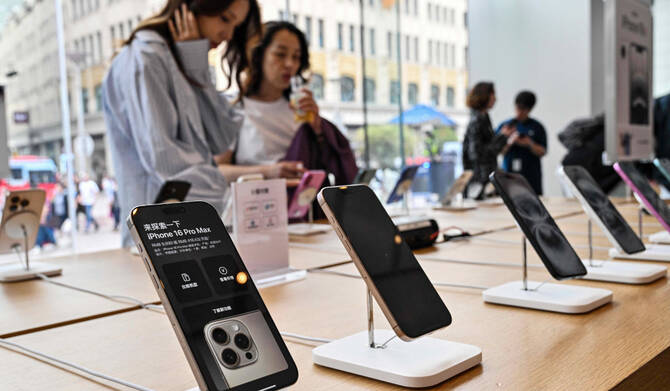

WASHINGTON/WEST PALM BEACH, Florida: US President Donald Trump on Sunday bore down on his administration’s latest message that the exclusion of smartphones and computers from his reciprocal tariffs on China will be short-lived, pledging a national security trade investigation into the semiconductor sector.
Those electronics “are just moving to a different Tariff ‘bucket,’” Trump said in a social media post. “We are taking a look at Semiconductors and the WHOLE ELECTRONICS SUPPLY CHAIN in the upcoming National Security Tariff Investigations.”
The White House had announced the exclusions from steep reciprocal tariffs on Friday.
Trump’s commerce secretary, Howard Lutnick, earlier on Sunday said that critical technology products from China would face separate new duties along with semiconductors within the next two months.
The exclusions announced on Friday were seen as a big break for technology firms such as Apple and Dell Technologies that rely on imports from China.
Trump’s back-and-forth on tariffs last week triggered the wildest swings on Wall Street since the COVID pandemic of 2020. The benchmark Standard & Poor’s 500 index is down more than 10 percent since Trump took office on January 20.
Lutnick said Trump would enact “a special focus-type of tariff” on smartphones, computers and other electronics products in a month or two, alongside sectoral tariffs targeting semiconductors and pharmaceuticals. The new duties would fall outside Trump’s so-called reciprocal tariffs, under which levies on Chinese imports climbed to 125 percent last week, he said.
“He’s saying they’re exempt from the reciprocal tariffs, but they’re included in the semiconductor tariffs, which are coming in probably a month or two,” Lutnick said in an interview on ABC’s “This Week,” predicting that the levies would bring production of those products to the United States. “These are things that are national security, that we need to be made in America.”
Beijing increased its own tariffs on US imports to 125 percent on Friday in response. On Sunday, before Lutnick’s comments, China said it was evaluating the impact of the exclusions for the technology products implemented late on Friday.
“The bell on a tiger’s neck can only be untied by the person who tied it,” China’s Ministry of Commerce said.
Billionaire investor Bill Ackman, who endorsed Trump’s run for president but who has criticized the tariffs, on Sunday called on him to pause the broad and steep reciprocal tariffs on China for three months, as Trump did for most countries last week.
If Trump paused Chinese tariffs for 90 days and cut them to 10 percent temporarily, “he would achieve the same objective in causing US businesses to relocate their supply chains from China without the disruption and risk,” Ackman wrote on X.
’CHANGES EVERY DAY’
Sven Henrich, founder and lead market strategist for NorthmanTrader, was harshly critical of how the tariff issue was being handled on Sunday. “Sentiment check: The biggest rally of the year would come on the day Lutnick gets fired,” Henrich wrote on X. “I suggest the administration figures out who controls the message, whatever it is, as it changes every day. US business can’t plan or invest with the constant back and forth.”
US Senator Elizabeth Warren, a Democrat, criticized the latest revision to Trump’s tariff plan, which economists have warned could dent economic growth and fuel inflation.
“There is no tariff policy — only chaos and corruption,” Warren said on ABC’s “This Week,” speaking before Trump’s latest post on social media.
In a notice to shippers late on Friday, the US Customs and Border Protection agency published a list of tariff codes excluded from the import taxes. It featured 20 product categories, including computers, laptops, disc drives, semiconductor devices, memory chips and flat panel displays.
In an interview on NBC’s “Meet the Press,” White House trade adviser Peter Navarro said the US has opened an invitation to China to negotiate, but he criticized China’s connection to the lethal fentanyl supply chain and did not include it on a list of seven entities — the United Kingdom, the European Union, India, Japan, South Korea, Indonesia and Israel — with which he said the administration was in talks.
Trade Representative Jamieson Greer said on CBS’s “Face the Nation” that there were no plans yet for Trump to speak to Chinese President Xi Jinping on tariffs, accusing China of creating trade friction by responding with levies of its own. But he expressed hopes for some non-Chinese deals.
“My goal is to get meaningful deals before 90 days, and I think we’re going to be there with several countries in the next few weeks,” Greer said.
Ray Dalio, the billionaire founder of the world’s biggest hedge fund, told NBC’s “Meet the Press” that he was worried about the United States sliding into recession, or worse, as a result of the tariffs.
“Right now we are at a decision-making point and very close to a recession,” Dalio said on Sunday. “And I’m worried about something worse than a recession if this isn’t handled well.”