

UN warns US aid cuts threaten millions of Afghans with famine

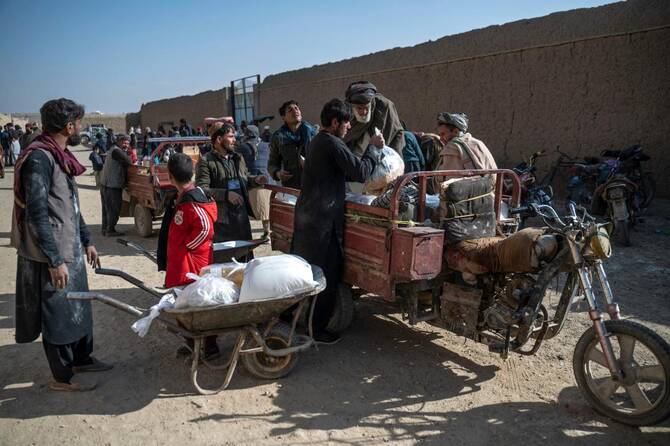
Fresh US cuts to food assistance risk worsening already widespread hunger in Afghanistan, according to the World Food Programme. (AFP)
Short Url
Updated 12 April 2025
Follow

UN warns US aid cuts threaten millions of Afghans with famine

  • Fresh US cuts to food assistance risk worsening already widespread hunger in Afghanistan, according to the World Food Programme

KABUL: Fresh US cuts to food assistance risk worsening already widespread hunger in Afghanistan, according to the World Food Programme, which warned it can support just half the people in need — and only with half rations.
In an interview with AFP, WFP’s acting country director Mutinta Chimuka urged donors to step up to support Afghanistan, which faces the world’s second-largest humanitarian crisis.
A third of the population of around 45 million people needs food assistance, with 3.1 million people on the brink of famine, the UN says.
“With what resources we have now barely eight million people will get assistance across the year and that’s only if we get everything else that we are expecting from other donors,” Chimuka said.
The agency already has been “giving a half ration to stretch the resources that we have,” she added.
In the coming months, WFP usually would be assisting two million people “to prevent famine, so that’s already a huge number that we’re really worried about,” Chimuka said.
Already grappling with a 40 percent drop in funding for this year globally, and seeing a decline in funding for Afghanistan in recent years, WFP has had to split the standard ration — designed to meet the daily minimum recommended 2,100 kilocalories per person.
“It’s a basic package, but it’s really life-saving,” said Chimuka. “And we should, as a global community, be able to provide that.”
WFP, like other aid agencies, has been caught in the crosshairs of funding cuts by US President Donald Trump, who signed an executive order freezing all foreign aid for three months shortly after his inauguration in January.
Emergency food aid was meant to be exempt, but this week WFP said the United States had announced it was cutting emergency food aid for 14 countries, including Afghanistan, amounting to “a death sentence for millions of people” if implemented.
Washington quickly backtracked on the cuts for six countries, but Afghanistan — run by Taliban authorities who fought US-led troops for decades — was not one of them.
If additional funding doesn’t come through, “Then there’s the possibility that we may have to go to communities and tell them we’re not able to support them. And how do they survive?“
She highlighted the high levels of unemployment and poverty in the country, one of the world’s poorest where thousands of Afghans are currently being repatriated from Pakistan, many without most of their belongings or homes to go to.

The UN Assistance Mission in Afghanistan, UNAMA, this week urged international donors to keep supporting Afghanistan, saying 22.9 million needed assistance this year.
“If we want to help the Afghan people escape the vicious cycle of poverty and suffering, we must continue to have the means to address urgent needs while simultaneously laying the groundwork for long-term resilience and stability,” said Indrika Ratwatte, the UN’s resident and humanitarian coordinator in Afghanistan, in a statement.
The statement warned that lack of international aid in Afghanistan could lead to increased migration and strain on the broader region.
The call for funding comes as other countries including Germany and Britain have also made large cuts to overseas aid.
But the Trump administration cut has been the deepest. The United Sates was traditionally the world’s largest donor, with the biggest portion in Afghanistan — $280 million — going to WFP last fiscal year, according to US State Department figures.
But other UN agencies, as well as local and international NGOs are being squeezed or having to shut down completely, straining the network of organizations providing aid in Afghanistan.
The Trump administration also ended two programs — one in Afghanistan — with the UN Population Fund, an agency dedicated to promoting sexual and reproductive health, the agency said Monday.
And other organizations working on agriculture — on which some 80 percent of Afghans depend to survive — and malnutrition are impacted.
“We all need to work together,” said Chimuka. “And if all of us are cut at the knees... it doesn’t work.”


San Francisco parents scramble as teachers strike leaves 50,000 students out of school

Updated 3 sec ago
Follow

San Francisco parents scramble as teachers strike leaves 50,000 students out of school

  • On Tuesday, the San Francisco Unified School District’s 120 schools remained closed for a second day
  • About 6,000 teachers are striking over wages, health benefits, and resources for special needs students
SAN FRANCISCO: Connor Haught has been juggling virtual work meetings and arts and crafts projects for his two daughters as his family tries to navigate a teachers strike in San Francisco with no end date in sight.
Haught’s job in the construction industry allows him to work from home but, like many parents in the city, he and his wife were scrambling to plan activities for their children amid the uncertainty of a strike that has left nearly 50,000 students out of the classroom.
“The big concern for parents is really the timeline of it all and trying to prepare for how long this could go on,” Haught said.
The San Francisco Unified School District’s 120 schools were set to remain closed for a third day Wednesday, after about 6,000 public schoolteachers went on strike over higher wages, health benefits, and more resources for students with special needs.
Some parents are taking advantage of after-school programs offering full-day programming during the strike, while others are relying on relatives and each other for help with child care.
Haught said he and his wife, who works evenings at a restaurant, planned to have their 8- and 9-year-old daughters at home the first week of the strike. They hope to organize play dates and local excursions with other families. They have not yet figured out what they will do if the strike goes on a second week.
“We didn’t try to jump on all the camps and things right away because they can be pricey, and we may be a little more fortunate with our schedule than some of the other people that are being impacted,” Haught said.
The United Educators of San Francisco and the district have been negotiating for nearly a year, with teachers demanding fully funded family health care, salary raises and the filling of vacant positions impacting special education and services.
Teachers on the picket lines said they know the strike is hard on students but that they walked out to offer children stability in the future.
“This is for the betterment of our students. We believe our students deserve to learn safely in schools and that means having fully staffed schools. That means retaining teachers by offering them competitive wage packages and health care and it means to fully fund all of the programs we know the student need the most,” said Lily Perales, a history teacher at Mission High School.
Superintendent Maria Su said Tuesday there was some progress in the negotiations Monday, including support for homeless families, AI training for teachers and establishing best practices for the use of AI tools.
But the two sides have yet to agree on a wage increase and family health benefits. The union initially asked for a 9 percent raise over two years, which they said could help offset the cost of living in San Francisco, one of the most expensive cities in the country. The district, which faces a $100 million deficit and is under state oversight because of a long-standing financial crisis, rejected the idea. Officials countered with a 6 percent wage increase paid over three years.
On Tuesday, Sonia Sanabria took her 5-year-old daughter and 11-year-old nephew to a church in the Mission District neighborhood that offered free lunch to children out of school.
Sanabria, who works as a cook at a restaurant, said she stayed home from work to take care of the children.
“If the strike continues, I’ll have to ask my job for a leave of absence, but it will affect me because if I don’t work, I don’t earn,” Sanabria said.
She said her elderly mother helps with school drop off and pick up but leaving the children with her all day is not an option. Sanabria said she has given them reading and writing assignments and worked with them on math problems. Sanabria said she is making plans for the children day-by-day and expressed support for the striking teachers.
“They are asking for better wages and better health insurance, and I think they deserve that because they teach our children, they take care of them and are helping them to have a better future,” she said, adding, “I just hope they reach agreement soon.”