San Francisco parents scramble as teachers strike leaves 50,000 students out of school

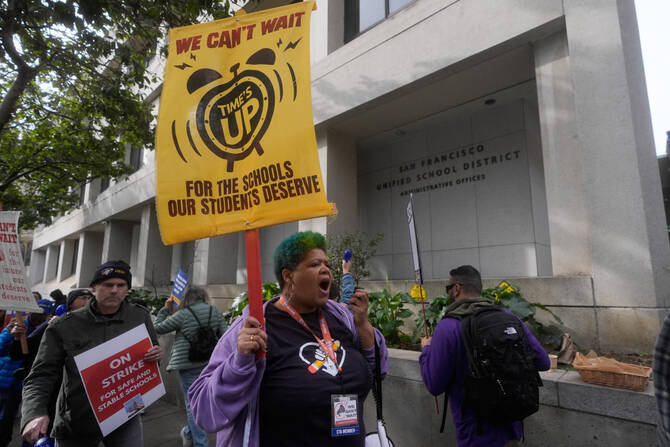
About 6,000 teachers are striking over wages, health benefits, and resources for special needs students. (AP)
Short Url
Updated 11 February 2026
Follow

San Francisco parents scramble as teachers strike leaves 50,000 students out of school

  • On Tuesday, the San Francisco Unified School District’s 120 schools remained closed for a second day
  • About 6,000 teachers are striking over wages, health benefits, and resources for special needs students

SAN FRANCISCO: Connor Haught has been juggling virtual work meetings and arts and crafts projects for his two daughters as his family tries to navigate a teachers strike in San Francisco with no end date in sight.
Haught’s job in the construction industry allows him to work from home but, like many parents in the city, he and his wife were scrambling to plan activities for their children amid the uncertainty of a strike that has left nearly 50,000 students out of the classroom.
“The big concern for parents is really the timeline of it all and trying to prepare for how long this could go on,” Haught said.
The San Francisco Unified School District’s 120 schools were set to remain closed for a third day Wednesday, after about 6,000 public schoolteachers went on strike over higher wages, health benefits, and more resources for students with special needs.
Some parents are taking advantage of after-school programs offering full-day programming during the strike, while others are relying on relatives and each other for help with child care.
Haught said he and his wife, who works evenings at a restaurant, planned to have their 8- and 9-year-old daughters at home the first week of the strike. They hope to organize play dates and local excursions with other families. They have not yet figured out what they will do if the strike goes on a second week.
“We didn’t try to jump on all the camps and things right away because they can be pricey, and we may be a little more fortunate with our schedule than some of the other people that are being impacted,” Haught said.
The United Educators of San Francisco and the district have been negotiating for nearly a year, with teachers demanding fully funded family health care, salary raises and the filling of vacant positions impacting special education and services.
Teachers on the picket lines said they know the strike is hard on students but that they walked out to offer children stability in the future.
“This is for the betterment of our students. We believe our students deserve to learn safely in schools and that means having fully staffed schools. That means retaining teachers by offering them competitive wage packages and health care and it means to fully fund all of the programs we know the student need the most,” said Lily Perales, a history teacher at Mission High School.
Superintendent Maria Su said Tuesday there was some progress in the negotiations Monday, including support for homeless families, AI training for teachers and establishing best practices for the use of AI tools.
But the two sides have yet to agree on a wage increase and family health benefits. The union initially asked for a 9 percent raise over two years, which they said could help offset the cost of living in San Francisco, one of the most expensive cities in the country. The district, which faces a $100 million deficit and is under state oversight because of a long-standing financial crisis, rejected the idea. Officials countered with a 6 percent wage increase paid over three years.
On Tuesday, Sonia Sanabria took her 5-year-old daughter and 11-year-old nephew to a church in the Mission District neighborhood that offered free lunch to children out of school.
Sanabria, who works as a cook at a restaurant, said she stayed home from work to take care of the children.
“If the strike continues, I’ll have to ask my job for a leave of absence, but it will affect me because if I don’t work, I don’t earn,” Sanabria said.
She said her elderly mother helps with school drop off and pick up but leaving the children with her all day is not an option. Sanabria said she has given them reading and writing assignments and worked with them on math problems. Sanabria said she is making plans for the children day-by-day and expressed support for the striking teachers.
“They are asking for better wages and better health insurance, and I think they deserve that because they teach our children, they take care of them and are helping them to have a better future,” she said, adding, “I just hope they reach agreement soon.”


Columbia student detained by ICE is abruptly released after Mamdani meets with Trump

Updated 27 February 2026
Follow

Columbia student detained by ICE is abruptly released after Mamdani meets with Trump

  • Ellie Aghayeva, an Azerbaijani, hasn’t been publicly linked to any of the pro-Palestinian demonstrations
  • Mamdani asked Trump to drop cases against other students facing deportation for their roles in protests against Israel
NEW YORK: Federal immigration authorities arrested a Columbia University student early Thursday, triggering protests on campus along with allegations that agents had entered the university-owned residence under false pretenses.
Just hours after detaining student Ellie Aghayeva, though, the federal government abruptly reversed course, permitting her to walk free after an apparent intervention by President Donald Trump.
In a social media post Thursday afternoon, Mayor Zohran Mamdani said he expressed concerns about the arrest during an unrelated meeting with Trump, who then agreed to release her immediately.
“I am safe and okay,” Aghayeva wrote on Instagram, minutes after Mamdani’s post, adding she was in “complete shock” from the experience.
The head-spinning series of events marked the latest development to emerge from the Republican president’s unlikely relationship with a democratic socialist mayor he once threatened to have deported.
On Thursday, while pitching Trump on a massive housing project, Mamdani also called on the president to drop cases against several other current and former students facing deportation for their roles in protests against Israel.
Aghayeva, a senior from Azerbaijan studying neuroscience and politics, hasn’t been publicly linked to any of the pro-Palestinian demonstrations that roiled Columbia’s campus. A self-described content creator, she has amassed a large social media following by sharing day-in-the-life videos and tips for navigating college as an immigrant.
Early Thursday, federal agents gained entry to her apartment by claiming they were searching for a missing person, according to a petition from her lawyers and a statement released by Columbia. She quickly dashed off a message to her more than 100,000 followers on Instagram: “DHS illegally arrested me. Please help.” A photo accompanying the post appeared to show her legs in the backseat of a vehicle.
A Department of Homeland Security spokesperson said Aghayeva’s student visa had been terminated in 2016 for failing to attend classes. Inquiries to Columbia about her visa status and how long she had been enrolled in the university were not returned.
In their petition, attorneys for Aghayeva said she had entered the country on a visa in or around 2016. They declined to provide additional comment, including details about her immigration status.
A spokesperson for DHS, Tricia McLaughlin, denied allegations levied by some state officials that agents had gained entry to her apartment by posing as New York City police officers. She didn’t respond to questions about whether they had claimed to be seeking a missing person.
The use of disguises or other misrepresentations by immigration authorities has drawn attention in recent months, after federal agents were seen posing as utility workers and other service employees in Minneapolis and elsewhere.
The practice is legal, in most cases. But immigration attorneys say such ruses are becoming increasingly common, adding to concerns about the Trump administration’s dramatic reshaping of immigration enforcement tactics nationwide.
In recent weeks, Trump has once again intensified his attacks on several universities, including Harvard and UCLA. The arrest would seem to mark the first federal enforcement action against at Columbia since the university agreed to pay more than $220 million to the administration over the summer.
“It’s a horrifying sign that the roving eye of the administration is turning back to Columbia,” said Michael Thaddeus, a mathematics professor at Columbia and vice president of the university’s chapter of the American Association of University Professors, which has sued Trump. “The idea that secret police would abduct and imprison students in our midst is something we’d expect from an authoritarian regime.”
Many students and faculty called on Columbia to increase protections for international students following the arrest last March of Mahmoud Khalil, a former graduate student and pro-Palestinian activist, whose deportation case remains ongoing.
In an email to the Columbia community Thursday, acting president Claire Shipman said that residential staff had been reminded not to allow federal law enforcement into university buildings without a subpoena or warrant.
“If you encounter or observe DHS/ICE agents conducting enforcement activities on or near campus, immediately contact Public Safety,” Shipman wrote. “Do not allow them to enter non-public areas or accept service of a warrant or subpoena.”