


ISLAMABAD: Major international companies from the US, Australia, South Africa and other nations have praised a global minerals summit hosted by Pakistan this week for opening up opportunities for investment in the country’s vast natural reserves, estimated to be worth $6 trillion.
The Pakistan Minerals Summit, aimed at attracting foreign investment in the country’s mining sector, saw participation from major international companies including Canada-based Barrick Gold and government officials from the United States, Saudi Arabia, China, Turkiye, the United Kingdom, Azerbaijan and other nations.
Pakistan is home to one of the world’s largest porphyry copper-gold mineral zones, while the Reko Diq mine in southwestern Balochistan province has an estimated 5.9 billion tons of ore. Barrick Gold, which owns a 50 percent stake in the Reko Diq mines, considers them one of the world’s largest underdeveloped copper-gold areas, and their development is expected to have a significant impact on Pakistan’s struggling economy.
But despite rich reserves of salt, copper, gold and coal, Pakistan’s mineral sector contributes only 3.2 percent to GDP and 0.1 percent to global exports. The country is now aiming to tap into this underutilized potential.
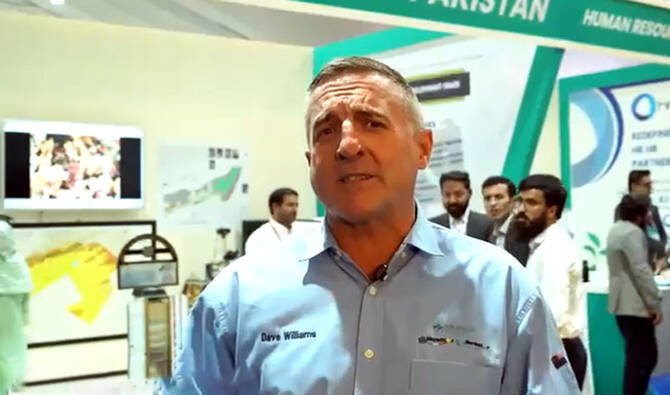
“This is really a great event so far for me. I’m meeting some great people, learning about the culture and the event is probably one of the best events we’ve been to recently,” Dave Williams, the CEO of Mudex, an Australian drilling fluids company, said in an interview to Radio Pakistan.
Mudex is based in Perth, specializing in the production and supply of environmentally friendly drilling fluids for industries such as mining, civil construction, water wells and horizontal directional drilling. Founded in 2014, Mudex offers a wide range of drilling fluid products including viscosifiers, lubricants, foaming agents and lost circulation materials.
“The networking and all has been really good … Being able to understand the immensity of the work that is happening in Pakistan at the moment,” the Mudex CEO said about the minerals summit.
Sohail Kiani, president of Canada’s SARF, said he was pleased to see Pakistani “finally recognizing its potential” in the minerals sector.
“Pakistan is a copper country and in the coming years, copper is going to become very important,” he said.
Pakistan’s copper reserves are estimated to be around 6.5 billion tons.
“The geology of this country is very conducive to taking out minerals which the world needs but obviously they’ve been in the ground for millions of years so we need to have a robust policy,” Kiani added.
Leah Boyer Saifullah, Senior Policy Adviser for the Critical Minerals Forum in Washington DC, described the minerals summit as “incredible.”
“I’m so glad to see Pakistan coming to the table, being part of this discussion,” she said. “I think this is going to be incredible for the country and for Pak-US relations.”
Tabassum Qadir, the CEO of Uprise Commodities Africa, said she was attending the mineral summit to explore opportunities at the Thar coal mines, located in southern Pakistan. They represent a significant source of lignite coal reserves in the country and are being developed for power generation.
“There is a gasification feasibility done in South Africa, which I want to implement in Pakistan,” Qadir said.
The businesswoman’s investment signals a renewed effort to harness Pakistan’s Thar coal reserves through gasification technology, which converts coal into synthetic gas for industrial use.
The initiative can reduce energy costs, alleviate the country’s growing fuel import bill and provide a domestic alternative to costly liquefied natural gas.


