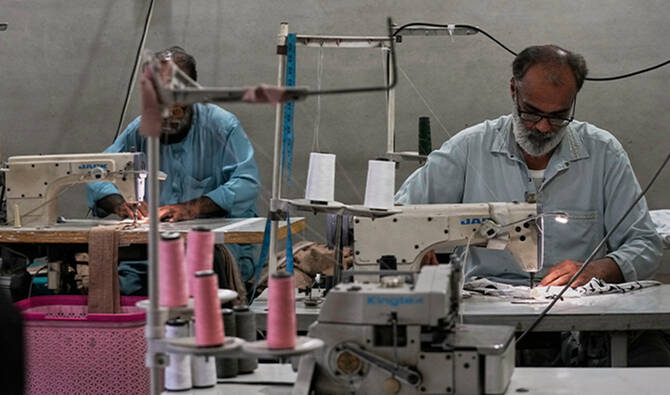
ISLAMABAD: Pakistan’s textile sector is looking at opportunities to “grab business” as the US and China steadily hiked tariffs amid an escalating trade war, the head of the country’s textile council said this week.
The textile sector in Pakistan generates about $17 billion in exports and is the largest employer in the country, according to Fawad Anwar, Chairman of the Pakistan Textile Council.
“There is an opportunity to grab (business) from China. How well we can do that, that depends on how well we can sit on the table and negotiate,” said Anwar, who spoke to Reuters hours before US President Donald Trump temporarily paused hefty tariffs on dozens of countries for 90 days, except for China.
Pakistan would have been slapped with a 29 percent tariff rate before Trump’s turnabout on Wednesday. A 10 percent blanket duty on almost all US imports will remain in effect, the White House said.
Trump also hiked the tariff on Chinese imports to 125 percent from the 104 percent level that kicked in on Wednesday.
Previously, Beijing had slapped 84 percent tariffs on US imports to match an earlier tariff salvo from Trump and had vowed to “fight to the end” in an escalating tit-for-tat trade dispute between the world’s top two economies.
“This is a war between the two giants, and everything else is a collateral damage,” said Anwar.
Pakistan’s textile industry is expected to face significant challenges from the tariffs with potential losses of up to $2 billion in textile exports estimated by experts, if the 29 percent tariff rate is reinstated after Trump’s 90-day pause ends.
For Pakistan’s textile industry’s Anwar, the levy hike is a short term issue which ‘has to be resolved’.
“They cannot sustain this 29 percent, the US retailer or the US consumer… nobody can sustain this big of a percentage increase,” said Anwar.


Pakistan’s textile industry looks to ‘grab business’ amid US-China tariff escalation
https://arab.news/c7yh2
Pakistan’s textile industry looks to ‘grab business’ amid US-China tariff escalation

- Textile sector in Pakistan generates about $17 billion in exports and is the largest employer in the country
- Pakistan’s textile industry is expected to face potential losses of up to $2 billion in textile exports under new tariffs


Pakistan PM orders action against fuel hoarding amid Iran conflict supply fears
- Sharif asks authorities to shut down petrol pumps involved in any attempt to create artificial shortages
- Government says it holds adequate fuel stocks despite shipping risks as Strait of Hormuz tensions rise
ISLAMABAD: Prime Minister Shehbaz Sharif on Friday ordered authorities to take strict action against fuel hoarders and shut down petrol pumps involved in any attempt to create artificial shortages, as anxiety grows over potential supply disruptions from the widening conflict involving Iran.
Sharif issued the directive during a high-level meeting on petroleum supplies, where officials briefed him that Pakistan currently holds sufficient fuel reserves to meet domestic demand despite the volatile regional situation.
The move comes as Pakistan steps up contingency measures following fears of supply disruptions linked to the escalating conflict involving Iran, the United States and Israel.
The concerns stem partly from disruptions in tanker traffic after the Strait of Hormuz — a key global oil chokepoint between Iran and Oman through which much of Pakistan’s imported crude typically transits — was shut following rising hostilities in the Gulf.
“The prime minister directed provincial governments to take strict legal action against hoarders of petroleum products,” Sharif’s office said in a statement after the meeting.
“Any petrol pump involved in the reprehensible practice of creating artificial shortages should be immediately shut down, its license revoked and legal action initiated,” it added.
Earlier this week, Pakistan’s Oil and Gas Regulatory Authority (OGRA) allowed oil marketing companies to temporarily regulate supplies to retail outlets to discourage hoarding and maintain stability in fuel distribution.
Sharif instructed the petroleum minister to visit provinces and coordinate with their administrations to develop a strategy for conserving petroleum products and ensuring their uninterrupted supply to the public.
The prime minister further ordered the creation of a digital dashboard to monitor the movement of petroleum products and share real-time data with provincial authorities to improve oversight of fuel transportation and distribution.


