Pakistan to approve new textile policy to increase exports to $21 billion

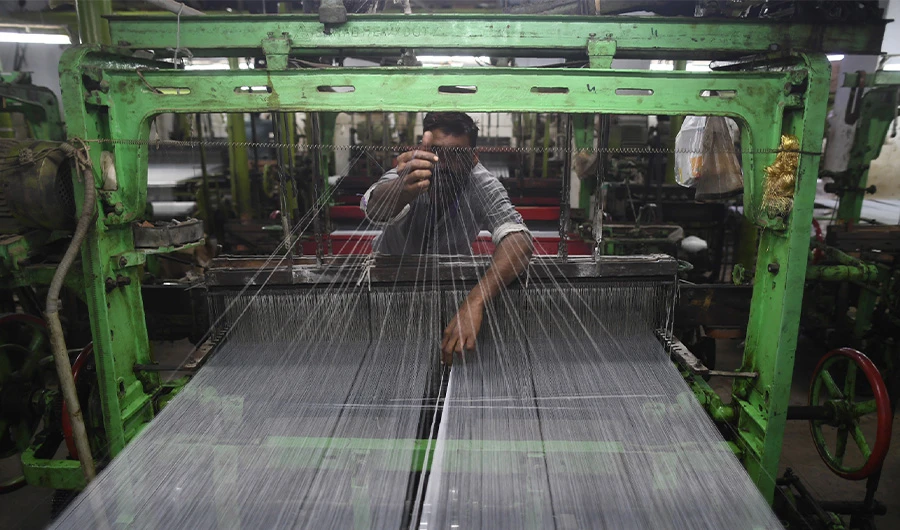
A Pakistan textile labourer fixes broken threads at a power loom in Karachi, on January 25, 2019, the financial capital and the largest industrial city of Pakistan. (AFP)
Short Url
Updated 28 December 2020
Follow

Pakistan to approve new textile policy to increase exports to $21 billion

  • Economic Coordination Committee to finalize five-year policy this week with incentives worth over $5.6 billion
  • Textiles seeing “unprecedented” revival as international orders diverted to Pakistan after it lifted its comprehensive lockdown in May

KARACHI: Pakistan’s top economic decision-making body, the Economic Coordination Committee (ECC), is expected to approve a new five-year textile policy this week, with incentives worth more than Rs900 billion ($5.6 billion) for the industry and an aim to increase exports to $21 billion in five years, officials have said.
Textiles make up more than half of Pakistan’s exports, but have lost ground to South Asian neighbors in recent years, hurt by chronic energy shortages and underinvestment in machinery.
But this year, after Pakistan lifted its comprehensive coronavirus lockdown in May while other countries in the neighborhood kept their economies closed, international textile orders have been diverted to Pakistan, leading to a nine-year record in exports. The South Asian nation has now drafted a new policy to augment the gains, officials say.
“The textile policy has already been approved by the prime minister, which will be presented in the ECC next week,” Aliya Hamza Malik, parliamentary secretary for commerce, told Arab News. “After ECC approval, the policy would be a pubic document,” she added, saying the government of the ruling Pakistan Tehreek-e-Insaf (PTI) party had granted Rs900 billion ($5.6 billion) in incentives to the textile sector in the new policy, the country’s third.
The textile industry, which comprises 46 percent of the total manufacturing sector and provides employment to around 25 million Pakistanis, contributes 8.5 percent to the GDP, according to the Pakistan Board of Investment. It also contributes 60 percent to overall exports and is one of the major earners of foreign exchange for Pakistan.
Despite a global economic slowdown due to COVID-19, Pakistan’s textile sector reached $6 billion exports in the first five months of current fiscal year (July-November 2020), which is 62 percent of total exports (worth $9.7 billion) and almost 5 percent higher compared to the same period last year, official data shows.
“Incentives and export facilitations have played a big role in making Pakistan a competitive exporting country,” Malik said.
The new measures aim to increase textile exports from $12.86 billion to $21 billion in the next five years, with a major focus on value addition, a draft of the policy seen by Arab News said. The document said electricity would be provided to the industry at the rate of US cents 7.5/kWh, RLNG at $6.5/MMBtu and system gas at Rs 786/MMBtu under the new policy.
The last two textile policies, for 2009-14 and 2014-19, had aimed to up exports to $25 billion and $26 billion respectively but the targets were not achieved. The third policy was approved in March this year but still awaits official announcement. 
“Approval of the new policy will give clarity to entrepreneurs and the industry to attract further investment,” said Khurram Mukhtar, patron-in-chief of the Pakistan Textile Exporters Association (PTEA). “Pakistan needs minimum investment of $7 billion to enhance production capacity in the next 5 years and double our textile exports.”
He added: “Currently investment of more than Rs100 billion ($623 million) is in the pipeline in spinning, weaving, finishing, knitting and garments. Many companies are enhancing their capacities.”
Made in Pakistan textiles, woven and knitted apparel, socks and towels are currently being supplied to major brands around the world, including Puma , Nike, Ralph Lauren, Dorma, Warner Bros, Next, M&S , Bed Bath & Beyond, Macy’s, Zara , Mango, Levies and Hugo Boss.
Pakistan, global crypto exchange discuss modernizing digital payments, creating job prospects 

Updated 05 December 2025
Follow

Pakistan, global crypto exchange discuss modernizing digital payments, creating job prospects 

  • Pakistani officials, Binance team discuss coordination between Islamabad, local banks and global exchanges
  • Pakistan has attempted to tap into growing crypto market to curb illicit transactions, improve oversight

ISLAMABAD: Pakistan’s finance officials and the team of a global cryptocurrency exchange on Friday held discussions aimed at modernizing the country’s digital payments system and building local talent pipelines to meet rising demand for blockchain and Web3 skills, the finance ministry said.

The development took place during a high-level meeting between Finance Minister Muhammad Aurangzeb, Pakistan Virtual Assets Regulatory Authority (PVARA) Chairman Bilal bin Saqib, domestic bank presidents and a Binance team led by Global CEO Richard Teng. The meeting was held to advance work on Pakistan’s National Digital Asset Framework, a regulatory setup to govern Pakistan’s digital assets.

Pakistan has been moving to regulate its fast-growing crypto and digital assets market by bringing virtual asset service providers (VASPs) under a formal licensing regime. Officials say the push is aimed at curbing illicit transactions, improving oversight, and encouraging innovation in blockchain-based financial services.

“Participants reviewed opportunities to modernize Pakistan’s digital payments landscape, noting that blockchain-based systems could significantly reduce costs from the country’s $38 billion annual remittance flows,” the finance ministry said in a statement. 

“Discussions also emphasized building local talent pipelines to meet rising global demand for blockchain and Web3 skills, creating high-value employment prospects for Pakistani youth.”

Blockchain is a type of digital database that is shared, transparent and tamper-resistant. Instead of being stored on one computer, the data is kept on a distributed network of computers, making it very hard to alter or hack.

Web3 refers to the next generation of the Internet built using blockchain, focusing on giving users more control over their data, identity and digital assets rather than big tech companies controlling it.

Participants of the meeting also discussed sovereign debt tokenization, which is the process of converting a country’s debt such as government bonds, into digital tokens on a blockchain, the ministry said. 

Aurangzeb called for close coordination between the government, domestic banks and global exchanges to modernize Pakistan’s payment landscape.

Participants of the meeting also discussed considering a “time-bound amnesty” to encourage users to move assets onto regulated platforms, stressing the need for stronger verifications and a risk-mitigation system.

Pakistan has attempted in recent months to tap into the country’s growing crypto market, crack down on money laundering and terror financing, and promote responsible innovation — a move analysts say could bring an estimated $25 billion in virtual assets into the tax net.

In September, Islamabad invited international crypto exchanges and other VASPs to apply for licenses to operate in the country, a step aimed at formalizing and regulating its fast-growing digital market.