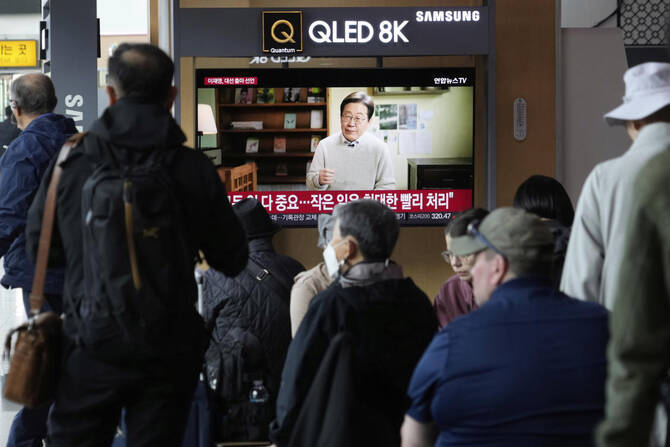
SEOUL: South Korean opposition leader Lee Jae-myung, widely seen as the frontrunner in a presidential by-election triggered by the removal of President Yoon Suk Yeol last week, officially announced a presidential bid on Thursday, vowing to heal a starkly divided nation through economic growth.
Lee, who narrowly lost the 2022 election to Yoon, led the liberal Democratic Party’s campaign to oust the former president over his December declaration of martial law.
Lee recently stepped down as the party’s chairman to focus on campaigning for the June 3 election. He is considered the clear frontrunner in party’s primary. Kim Dong-yeon, the Democratic governor of Gyeonggi province and a longtime financial policymaker, also told reporters Wednesday that he intends to run for president.
Yoon’s downfall has left the conservative People Power Party in disarray, with roughly 10 politicians expected to seek the nomination, reflecting a split between Yoon loyalists, who still control the party’s leadership, and reformists calling for a fresh start.
In a video message, Lee said that Yoon’s martial law saga exposed the country’s deep divisions and social conflicts, and argued that the root cause was a widening rich-poor gap. He promised aggressive government spending to jolt economic growth and ease income polarization.
“We have more than we did in the past, but wealth is too concentrated in certain areas,” Lee said. “With economic growth rates declining worldwide, it has become difficult to maintain and develop an economy solely on the strength of the private sector. However, with government-led talent development and extensive investments in technological research and development, we can revive the economy.”
Lee said it was crucial to maintain a robust alliance with the United States and to pursue three-way cooperation with Japan, but he stressed that South Korea’s national interest should come first in “every decision.”
Lee, who has served as a lawmaker, provincial governor and city mayor, is adored by supporters for his outspoken style and has long positioned himself as an anti-elitist. His critics view him as a populist who stokes division and demonizes conservative opponents while failing to offer realistic funding plans to achieve his ambitious goals.
Kweon Seong-dong, floor leader of the People Power Party and a staunch Yoon loyalist, said that if Lee becomes president, he will “ruthlessly wield the sword of dogmatism and retribution” and further deepen the country’s divisions.
Lee also has his own set of legal troubles, facing five different trials for corruption and other criminal charges.
Earlier this month, the Constitutional Court upheld Yoon’s impeachment by the legislature and formally removed him from office over the martial law decree, triggering a presidential by-election within 60 days. The next president will serve a full 5-year term.
Former PPP leader Han Dong-hoon, who heads the party’s anti-Yoon faction, was expected to announce his presidential bid on Thursday. Among the conservatives’ presidential hopefuls, former Labor Minister Kim Moon Soo is considered to be the most pro-Yoon.
Kim, Daegu Mayor Hong Joon-pyo and senior PPP lawmaker Ahn Cheol-soo – a former computer software entrepreneur and three-time presidential candidate – have declared their intentions to run for president. Seoul Mayor Oh Se-hoon is expected to enter the race later.

South Korean opposition leader opens presidential bid following Yoon’s ouster
Short Url
https://arab.news/j29u3
South Korean opposition leader opens presidential bid following Yoon’s ouster
- Lee Jae-myung is widely seen as the frontrunner in the presidential by-election
- South Korean opposition leader narrowly lost the 2022 election to ousted president
India says accomplice of Delhi car blast ‘suicide bomber’ arrested
NEW DELHI: Indian authorities said on Sunday that a deadly car blast in New Delhi earlier this week was an attack carried out by a “suicide bomber,” announcing the arrest of an accomplice.
The National Investigation Agency (NIA), the country’s counter-terrorism law enforcement body, said the alleged attacker and the second suspect were both from Indian-administered Kashmir, where police have carried out sweeping raids in recent days.
Announcing “a breakthrough” in the investigation, the NIA said in a statement it had arrested Amir Rashid Ali, “in whose name the car involved in the attack was registered.”
He had “conspired with the alleged suicide bomber, Umar Un Nabi, to unleash the terror attack,” it added, without specifying any possible motive.
Nabi, a resident of Kashmir, was an assistant professor in general medicine at a university in the northern state of Haryana, according to the counter-terrorism agency, which said it had seized a vehicle belonging to him.
Ali had come to Delhi to “facilitate the purchase of the car which was eventually used as a vehicle-borne Improvised Explosive Device (IED) to trigger the blast,” the NIA said.
The explosion on Monday took place near a busy metro station close to the landmark Red Fort in the capital’s Old Delhi quarter, where the prime minister delivers the annual Independence Day address.
A hospital official has said the blast killed 12 people. It was unclear whether the toll included Nabi.
The NIA’s statement said the attack “claimed 10 innocent lives and left 32 others injured.”
Prime Minister Narendra Modi has called the attack a “conspiracy,” and his government vowed to bring the “perpetrators, their collaborators and their sponsors” to justice.
It was the most significant security incident since April 22, when 26 mainly Hindu civilians were killed at the tourist site of Pahalgam in Indian-administered Kashmir, triggering clashes with Pakistan.
Kashmir has been divided between India and Pakistan since their independence from British rule in 1947, and both claim the Himalayan territory in full. Tensions remain high between New Delhi and Islamabad.
On Friday, nine people were killed when confiscated explosives blew up at a police station in Indian-administered Kashmir, in what authorities said was an accident.
Local media reported that a militant organization had claimed responsibility for it, which police dismissed.
The explosives had been recovered from Haryana state just before the powerful car blast in Delhi, according to the police.
Indian media have widely connected the Delhi blast with a string of arrests just hours prior.
Police said those arrested were linked with Jaish-e-Mohammed (JeM), a Pakistan-based and Al-Qaeda-linked group, as well as a Kashmiri offshoot linked to it.
The group that claimed the police station blast is considered close to JeM.
The National Investigation Agency (NIA), the country’s counter-terrorism law enforcement body, said the alleged attacker and the second suspect were both from Indian-administered Kashmir, where police have carried out sweeping raids in recent days.
Announcing “a breakthrough” in the investigation, the NIA said in a statement it had arrested Amir Rashid Ali, “in whose name the car involved in the attack was registered.”
He had “conspired with the alleged suicide bomber, Umar Un Nabi, to unleash the terror attack,” it added, without specifying any possible motive.
Nabi, a resident of Kashmir, was an assistant professor in general medicine at a university in the northern state of Haryana, according to the counter-terrorism agency, which said it had seized a vehicle belonging to him.
Ali had come to Delhi to “facilitate the purchase of the car which was eventually used as a vehicle-borne Improvised Explosive Device (IED) to trigger the blast,” the NIA said.
The explosion on Monday took place near a busy metro station close to the landmark Red Fort in the capital’s Old Delhi quarter, where the prime minister delivers the annual Independence Day address.
A hospital official has said the blast killed 12 people. It was unclear whether the toll included Nabi.
The NIA’s statement said the attack “claimed 10 innocent lives and left 32 others injured.”
Prime Minister Narendra Modi has called the attack a “conspiracy,” and his government vowed to bring the “perpetrators, their collaborators and their sponsors” to justice.
It was the most significant security incident since April 22, when 26 mainly Hindu civilians were killed at the tourist site of Pahalgam in Indian-administered Kashmir, triggering clashes with Pakistan.
Kashmir has been divided between India and Pakistan since their independence from British rule in 1947, and both claim the Himalayan territory in full. Tensions remain high between New Delhi and Islamabad.
On Friday, nine people were killed when confiscated explosives blew up at a police station in Indian-administered Kashmir, in what authorities said was an accident.
Local media reported that a militant organization had claimed responsibility for it, which police dismissed.
The explosives had been recovered from Haryana state just before the powerful car blast in Delhi, according to the police.
Indian media have widely connected the Delhi blast with a string of arrests just hours prior.
Police said those arrested were linked with Jaish-e-Mohammed (JeM), a Pakistan-based and Al-Qaeda-linked group, as well as a Kashmiri offshoot linked to it.
The group that claimed the police station blast is considered close to JeM.
© 2025 SAUDI RESEARCH & PUBLISHING COMPANY, All Rights Reserved And subject to Terms of Use Agreement.



