

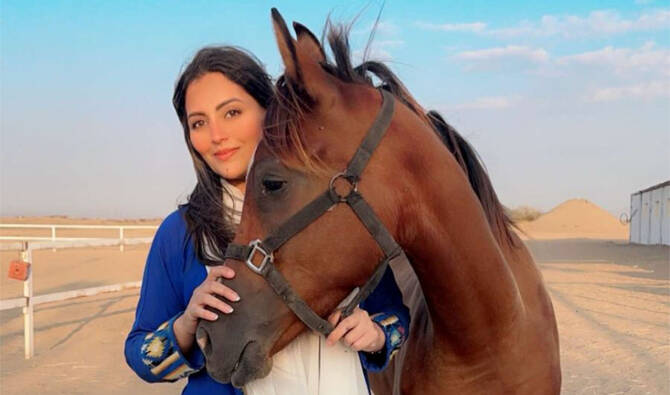


MAKKAH: In Jeddah, where the desert meets the sea, Sultana Al-Harbi is a trailblazing Saudi woman pursuing her dream — establishing a stable for horses.
In a traditionally male dominated field, the horse breeder’s story begins with a love of both all things equine and nature.
“Horses aren’t just animals,” she told Arab News with a smile. “They’re reflections of the soul and, without them, mine feels incomplete.”
Horses, Al-Harbi believes, “win hearts effortlessly.”
She recalled: “From the very first moment I approached a horse, I felt something stir inside me, as if we were old friends. It wasn’t the beginning of something new, but the awakening of something that had always been there, quietly waiting.”
The realization set her on a path that has been far from easy, requiring determination, resilience and patience.
Lacking experience and initial support, she encountered many obstacles but committed to learning on her own, embracing a path of trial and error despite moments of fear and hesitation.
And no matter what the setbacks, she always found her way back to horses.
She fondly recalls the first mare she ever cared for. “Her name was Araska. She was strong-willed and resistant at first, but I loved her from the moment we met,” said Al-Harbi.
“With her, I learned that patience is not just a virtue, it’s a necessity; and that love, when it’s real, is the most powerful key to unlocking the hearts of these noble creatures.”
Al-Harbi also reflected on the deep bond she shares with horses.
“Horses give me a comfort I’ve never found anywhere else. Just looking into their eyes and listening to their movements is enough to make the weight of the world disappear,” she said.
Her day begins only after a visit to the stables, where she checks on each horse’s well-being and observes their behavior, greeting each mare like an old friend.
Every horse has a distinct personality, she explained, and treating each one with respect and sensitivity is not just important — it is essential.
When it comes to training, Al-Harbi insists cruelty has no place in her philosophy. She believes each horse has its own language, emotions and needs. Understanding them requires patience, empathy and a foundation of trust.
“When a horse feels safe and confident with you, it gives you everything it has. Nervous horses don’t frighten me — they challenge me to listen more closely, to uncover the source of their unease. I respond with time, space, and tenderness,” she added.
When speaking of her dream to establish a stud farm, her voice carries a quiet conviction: “I dream of a place that’s not just for housing horses, but a fully integrated learning environment where people can truly connect with horses on a deeper level.”
Al-Harbi believes a meaningful bond with a horse requires more than expertise; it calls for an intentional space, a compassionate team, and a philosophy founded on love. This is necessary long before any commercial or competitive ambitions come into play.
While horses occupy a special place in her heart, the sea is an equally powerful presence in her life, offering a sense of calm.
“The sea grounds me and horses empower me. Between the two, I find myself,” she said.
She is appreciative of the Kingdom’s support of the equestrian world, highlighting the hosting of world-class festivals and races in recent years.
Such developments have opened new doors for Saudi women, she feels, paving the way for greater inclusion and inspiring a new generation of girls to pursue their passion for horses with confidence and purpose.
Al-Harbi’s message is that this is not a path for anyone chasing glory, but for those who lead with patience, dedication and genuine love.
“Horses are incredibly sensitive beings,” she explained. “When they trust you, they give a love that’s pure and beyond description. That bond is the greatest reward a horse breeder can ever receive.”


