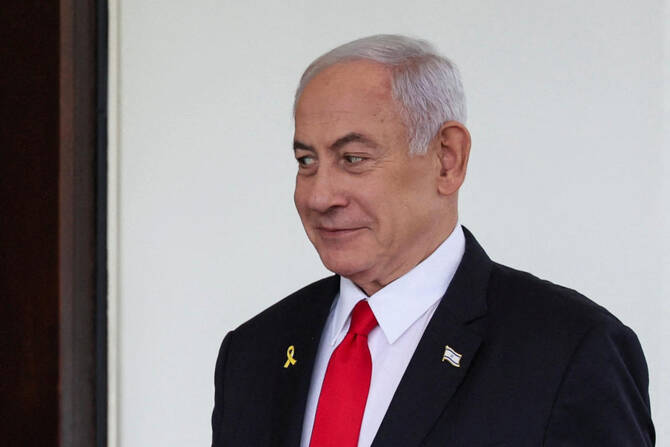
JERUSALEM: Israeli Prime Minister Benjamin Netanyahu met on Wednesday with CIA chief John Ratcliffe in Jerusalem, a statement from the premier’s office said.
“Prime Minister Benjamin Netanyahu met Wednesday evening with the head of the American Central Intelligence Agency John Ratcliffe, along with the head of the Mossad, Dadi (David) Barnea,” the statement said, days before the US is due to hold nuclear talks with Iran and amid continued attempts to revive a Gaza ceasefire.
Netanyahu returned from Washington on Wednesday morning following a meeting in the White House where President Donald Trump made a shock announcement that the US was starting direct, high-level talks with Iran over its nuclear program this coming Saturday.
Following the announcement, however, Netanyahu said that “the military option” would become “inevitable” if talks between Washington and Tehran dragged on.
“We agree that Iran will not have nuclear weapons,” Netanyahu said in a video statement ahead of his return to Israel.
“This can be done in an agreement, but only if... they go in, blow up (Iran’s) facilities, dismantle all the equipment, under American supervision,” he said, adding that if talks drag on, “then the military option becomes inevitable.”
Also during their meeting, the two leaders said that new negotiations were in the works aimed at getting more hostages released from captivity in Gaza.
The United States, Qatar and Egypt brokered a fragile ceasefire whose first phase took effect on January 19.
The ceasefire lasted until March 18, with Israel resuming intense air strikes on Gaza.
The truce had allowed the return of 33 Israeli hostages, eight of whom were dead, in exchange for the release of some 1,800 Palestinians held in Israeli jails.

Israel’s Netanyahu meets new CIA chief in Jerusalem
Short Url
https://arab.news/rhsr9
Israel’s Netanyahu meets new CIA chief in Jerusalem
- “Netanyahu met Wednesday evening with the head of the American Central Intelligence Agency John Ratcliffe, along with the head of the Mossad,” the statement said
Jailed Turkish Kurd leader calls on government to broker deal for Syrian Kurds
- Clashes between Syrian forces and the SDF have cast doubt over a deal to integrate the group’s fighters into the army
ANKARA: Jailed Turkish Kurd leader Abdullah Ocalan said Tuesday that it was “crucial” for Turkiye’s government to broker a peace deal between the Kurdish-led Syrian Democratic Forces (SDF) and the Damascus government.
Clashes between Syrian forces and the SDF have cast doubt over a deal to integrate the group’s fighters into the army, which was due to take effect by the end of the year.
Ocalan, founder of the Kurdistan Workers’ Party (PKK) militant group, called on Turkiye to help ensure implementation of the deal announced in March between the SDF and the Syrian government, led by former jihadist Ahmed Al-Sharaa, whose forces ousted longtime ruler Bashar Assad last year.
“It is essential for Turkiye to play a role of facilitator, constructively and aimed at dialogue,” he said in a message released by Turkiye’s pro-Kurdish DEM party.
“This is crucial for both regional peace and to strengthen its own internal peace,” Ocalan, who has been jailed for 26 years, added.
“The fundamental demand made in the agreement signed on March 10 between the SDF and the government in Damascus is for a democratic political model permitting (Syria’s) peoples to govern together,” he added.
“This approach also includes the principle of democratic integration, negotiable with the central authorities. The implementation of the March 10 agreement will facilitate and accelerate that process.”
The backbone of the US-backed SDF is the YPG, a Kurdish militant group seen by Turkiye as an extension of the PKK.
Turkiye and Syria both face long-running unrest in their Kurdish-majority regions, which span their shared border.
In Turkiye, the PKK agreed this year at Ocalan’s urging to end its four-decade armed struggle.
In Syria, Sharaa has agreed to merge the Kurds’ semi-autonomous administration into the central government, but deadly clashes and a series of differences have held up implementation of the deal.
The SDF is calling for a decentralized government, which Sharaa rejects.
Turkish Foreign Minister Hakan Fidan, whose country sees Kurdish fighters across the border as a threat, urged the SDF last week not to be an “obstacle” to stability.
Syrian Kurdish leader Mazloum Abdi said Thursday that “all efforts” were being made to prevent the collapse of talks.
Clashes between Syrian forces and the SDF have cast doubt over a deal to integrate the group’s fighters into the army, which was due to take effect by the end of the year.
Ocalan, founder of the Kurdistan Workers’ Party (PKK) militant group, called on Turkiye to help ensure implementation of the deal announced in March between the SDF and the Syrian government, led by former jihadist Ahmed Al-Sharaa, whose forces ousted longtime ruler Bashar Assad last year.
“It is essential for Turkiye to play a role of facilitator, constructively and aimed at dialogue,” he said in a message released by Turkiye’s pro-Kurdish DEM party.
“This is crucial for both regional peace and to strengthen its own internal peace,” Ocalan, who has been jailed for 26 years, added.
“The fundamental demand made in the agreement signed on March 10 between the SDF and the government in Damascus is for a democratic political model permitting (Syria’s) peoples to govern together,” he added.
“This approach also includes the principle of democratic integration, negotiable with the central authorities. The implementation of the March 10 agreement will facilitate and accelerate that process.”
The backbone of the US-backed SDF is the YPG, a Kurdish militant group seen by Turkiye as an extension of the PKK.
Turkiye and Syria both face long-running unrest in their Kurdish-majority regions, which span their shared border.
In Turkiye, the PKK agreed this year at Ocalan’s urging to end its four-decade armed struggle.
In Syria, Sharaa has agreed to merge the Kurds’ semi-autonomous administration into the central government, but deadly clashes and a series of differences have held up implementation of the deal.
The SDF is calling for a decentralized government, which Sharaa rejects.
Turkish Foreign Minister Hakan Fidan, whose country sees Kurdish fighters across the border as a threat, urged the SDF last week not to be an “obstacle” to stability.
Syrian Kurdish leader Mazloum Abdi said Thursday that “all efforts” were being made to prevent the collapse of talks.
© 2025 SAUDI RESEARCH & PUBLISHING COMPANY, All Rights Reserved And subject to Terms of Use Agreement.


