Pressure builds on Afghans fearing arrest in Pakistan

1 / 3
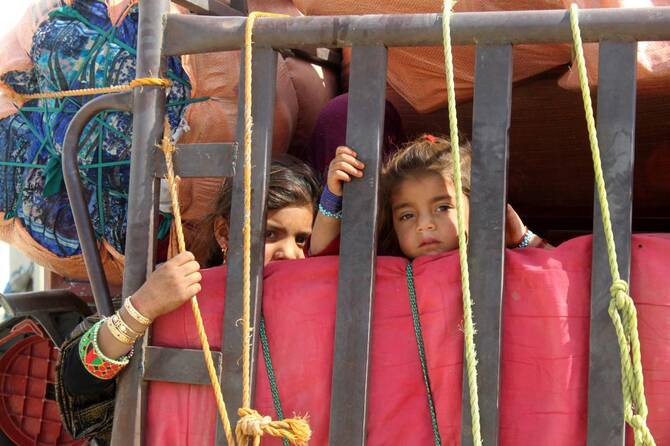
Afghan refugees sit on a loaden vehicle at a holding centre ahead of their departure for Afghanistan, near the Pakistan-Afghanistan border in Chaman on April 9, 2025. (AFP)
2 / 3
Afghan refugees wait for clearance to leave for homeland Afghanistan at a transit station setup to facilitate Afghan refugees' deportations, on outskirt of Chaman, Wednesday, April 9, 2025. (AP)
3 / 3
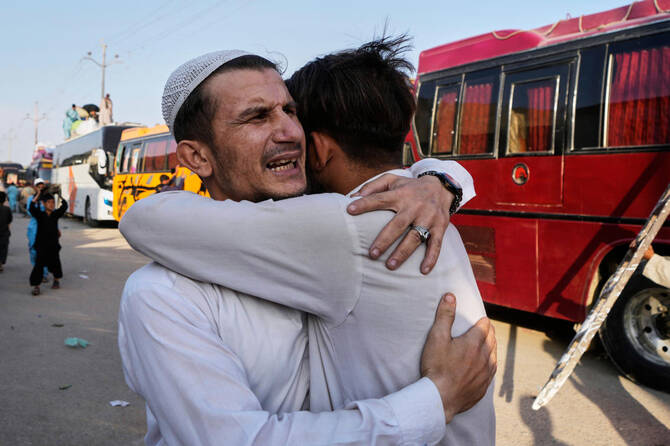
An Afghan refugee hugs with his relative before boarding a bus to leave for his homeland Afghanistan, at a terminal in Karachi, Pakistan, Wednesday, April 9, 2025. (AP)
Short Url
Updated 09 April 2025
Follow

Pressure builds on Afghans fearing arrest in Pakistan

  • According to the UN refugee agency, more than 24,665 Afghans have left Pakistan since April 1, 10,741 of whom were deported

KARACHI: Convoys of Afghans pressured to leave Pakistan are driving to the border, fearing the “humiliation” of arrest, as the government’s crackdown on migrants sees widespread public support.
Islamabad wants to deport 800,000 Afghans after canceling their residence permits — the second phase of a deportation program which has already pushed out around 800,000 undocumented Afghans since 2023.
According to the UN refugee agency, more than 24,665 Afghans have left Pakistan since April 1, 10,741 of whom were deported.
“People say the police will come and carry out raids. That is the fear. Everyone is worried about that,” Rahmat Ullah, an Afghan migrant in the megacity Karachi told AFP.
“For a man with a family, nothing is worse than seeing the police take his women from his home. Can anything be more humiliating than this? It would be better if they just killed us instead,” added Nizam Gull, as he backed his belongings and prepared to return to Afghanistan.
Abdul Shah Bukhari, a community leader in one of the largest informal Afghan settlements in the coastal city, has watched multiple buses leave daily for the Afghan border, about 700 kilometers away.
The maze of makeshift homes has grown over decades with the arrival of families fleeing successive wars in Afghanistan. But now, he said “people are leaving voluntarily.”
“What is the need to cause distress or harassment?” said Bukhari.
Ghulam Hazrat, a truck driver, said he reached the Chaman border crossing with Afghanistan after days of police harassment in Karachi.
“We had to leave behind our home. We were being harassed every day.”
In Peshawar, the capital of Khyber Pakhtunkhwa, on the Afghan border, police climb mosque minarets to order Afghans to leave: “The stay of Afghan nationals in Pakistan has expired. They are requested to return to Afghanistan voluntarily.”
Police warnings are not only aimed at Afghans, but also at Pakistani landlords.
“Two police officers came to my house on Sunday and told me that if there are any Afghan nationals living here they should be evicted,” Farhan Ahmad told AFP.
Human Rights Watch has slammed “abusive tactics” used to pressure Afghans to return to their country, “where they risk persecution by the Taliban and face dire economic conditions.”
In September 2023, hundreds of thousands of undocumented Afghans poured across the border into Afghanistan in the days leading up to a deadline to leave, after weeks of police raids and the demolition of homes.
After decades of hosting millions of Afghan refugees, there is widespread support among the Pakistani public for the deportations.
“They eat here, live here, but are against us. Terrorism is coming from there (Afghanistan), and they should leave; that is their country. We did a lot for them,” Pervaiz Akhtar, a university teacher, told AFP at a market in the capital Islamabad.
“Come with a valid visa, and then come and do business with us,” said Muhammad Shafiq, a 55-year-old businessman.
His views echo the Pakistani government, which for months has blamed rising violence in the border regions on “Afghan-backed perpetrators” and argued that the country can no longer support such a large migrant population.
However, analysts have said the deportation drive is political.
Relations between Kabul and Islamabad have soured since the Taliban returned to power in 2021.
“The timing and manner of their deportation indicates it is part of Pakistan’s policy of mounting pressure on the Taliban,” Maleeha Lodhi, the former permanent representative of Pakistan to the UN told AFP.
“This should have been done in a humane, voluntary and gradual way.”


Trump targets non-white immigrants in renewed xenophobic rants

Updated 43 min 38 sec ago
Follow

Trump targets non-white immigrants in renewed xenophobic rants

  • During a rally in Pennsylvania on Wednesday,  Trump doubled down on his tirade against Somali migrants
  • "Why is it we only take people from shithole countries,’ right? Trump told his cheering audience

WASHINGTON: Back in 2018, President Donald Trump disputed having used the epithet “shithole” to describe some countries whose citizens emigrated to the United States.
Nowadays, he embraces it and pushes his anti-immigrant and xenophobic tirades even further.
Case in point: during a rally in the northeastern state of Pennsylvania on Wednesday that was supposed to focus on his economic policy, the 79-year-old Republican openly ranted and reused the phrase that had sparked an outcry during his first term.
“We had a meeting and I said, ‘Why is it we only take people from shithole countries,’ right? ‘Why can’t we have some people from Norway, Sweden?’” Trump told his cheering audience.
“But we always take people from Somalia,” he continued. “Places that are a disaster. Filthy, dirty, disgusting, ridden with crime.”
Recently, he called Somali immigrants “trash.”
These comments are “more proof of his racist, anti-immigrant agenda,” Massachusetts Senator Ed Markey responded on X.

The Trump megaphone

Florida Republican lawmaker Randy Fine, on the other hand, defended Trump.
“Not all cultures are equal and not all countries are equal,” he said on CNN, adding “the president speaks in language that Americans understand, he is blunt.”
University of Albany history professor Carl Bon Tempo told AFP this type of anti-immigrant rhetoric has long thrived on the far-right.
“The difference is now it’s coming directly out of the White House,” he said, adding “there’s no bigger megaphone” in American politics.
On the campaign trail in 2023, Trump told a rally in New Hampshire that immigrants were “poisoning the blood of our country” — a remark that drew comparisons to Nazi dictator Adolf Hitler.
Now back in power, Trump’s administration has launched a sweeping and brutal deportation campaign and suspended immigration applications from nationals of 19 of the poorest countries on the planet.
Simultaneously, the president ordered white South African farmers to be admitted to the US, claiming their persecution.

No filter left

“Any filter he might have had is gone,” Terri Givens, a professor at the University of British Columbia in Canada and immigration policy expert, told AFP.
For Trump, it doesn’t matter whether an immigrant obeys the law, or owns a business, or has been here for decades, according to Syracuse University political science professor Mark Brockway.
“They are caught in the middle of Trump’s fight against an invented evil enemy,” Brockway told AFP.
By describing some immigrants as “killers, leeches, and entitlement junkies” — as Secretary of Homeland Security Kristi Noem did earlier this month — the White House is designating a target other than itself for American economic ire at a time when the cost of living has gone up and fears are growing over job security and loss of federal benefits.
But, Bon Tempo noted, “when immigration spikes as an issue, it spikes because of economics sometimes, but it also spikes because of these larger sort of foundational questions about what it means to be an American.”
On November 28, after an Afghan national attacked two National Guard soldiers in Washington, Trump took to his Truth Social network to call for “REVERSE MIGRATION.”
This notion, developed by European far-right theorists such as French writer Renaud Camus, refers to the mass expulsion of foreigners deemed incapable of assimilation.
Digging into the “Make America Great Again” belief system, many experts have noted echoes of the “nativist” current of politics from the 1920s in the US, which held that white, Anglo-Saxon, Protestant culture was the true American identity.
That stance led to immigration policies favoring Northern and Western Europe.
As White House senior adviser Stephen Miller recently wrote on X: “This is the great lie of mass migration. You are not just importing individuals. You are importing societies...At scale, migrants and their descendants recreate the conditions, and terrors, of their broken homelands.”