

Lebanon nears approval of banking secrecy law, finance minister confirms

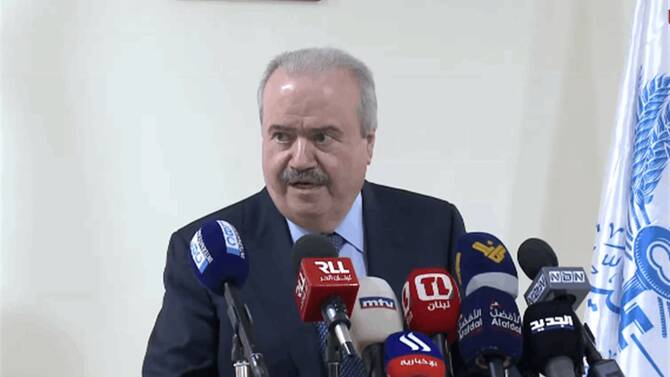
Speaking to reporters in Kuwait, where he is attending meetings of Arab financial institutions, Jaber said: ‘My expectation is that it will pass—if not tomorrow, then the day after... it will definitely be approved.’
Short Url
Updated 09 April 2025
Follow

Lebanon nears approval of banking secrecy law, finance minister confirms

KUWAIT CITY: Lebanon’s Finance Minister Yassine Jaber told Reuters that he expected a banking secrecy law to be passed in parliament within days.

Speaking to reporters in Kuwait, where he is attending meetings of Arab financial institutions, Jaber said: “My expectation is that it will pass—if not tomorrow, then the day after... it will definitely be approved.”

Jaber also criticized certain Lebanese officials for using banking secrecy laws as a pretext to withhold information, particularly pointing to former Central Bank Gov. Riad Salameh.

He clarified that the law has already been approved by the government and is not entirely new, emphasizing that banking secrecy was largely lifted in 2022. The current objective is to amend a single clause to provide the Banking Control Commission with broader access to account information.

Additionally, Jaber revealed that Lebanon is in negotiations with the World Bank for several loans, including one to create a fund for rebuilding infrastructure in affected areas. He highlighted that the World Bank has allocated $250 million as initial capital for the fund.

He further explained that the only condition set by the World Bank is “reform.”

“Reform, reform – that’s our program. These aren’t harsh conditions; we need them,” he added.

Jaber stressed that small depositors, those with balances under $100,000, make up 84 percent of all depositors in Lebanon, totaling around $20 billion.

He confirmed that the government is working on a plan to address the depositor issue, stating: “Naturally, it will start with small depositors.”

When asked about potential Gulf aid, Jaber replied: “The Gulf states have supported Lebanon, and today they are advising us to address our situation.”

He concluded: “In past years, our performance wasn’t good and we need to focus on improving it.”

Saudi Arabia’s cultural sector is a new economic engine between Riyadh and Paris, says ambassador

Updated 25 January 2026
Follow

Saudi Arabia’s cultural sector is a new economic engine between Riyadh and Paris, says ambassador

RIYADH: Culture has become a fundamental pillar in bilateral relations between France and Saudi Arabia, according to the French Ambassador to the Kingdom, Patrick Maisonnave.

Maisonnave noted its connection to the entertainment and tourism sectors, which makes it a new engine for economic cooperation between Riyadh and Paris.

He told Al-Eqtisadiah during the opening ceremony of La Fabrique in the Jax district of Diriyah that cultural cooperation with Saudi Arabia is an important element for its attractiveness in the coming decades.

La Fabrique is a space dedicated to artistic creativity and cultural exchange, launched as part of a partnership between the Riyadh Art program and the French Institute in Riyadh. 

Running from Jan. 22 until Feb 14, the initiative will provide an open workspace that allows artists to develop and work on their ideas within a collaborative framework.

Launching La Fabrique as a space dedicated to artistic creativity

The ambassador highlighted that the transformation journey in the Kingdom under Vision 2030 has contributed to the emergence of a new generation of young artists and creators, alongside a growing desire in Saudi society to connect with culture and to embrace what is happening globally. 

He affirmed that the relationship between the two countries is “profound, even cultural par excellence,” with interest from the Saudi side in French culture, matched by increasing interest from the French public and cultural institutions unfolding in the Kingdom.

Latest estimates indicate that the culture-based economy represents about 2.3 percent of France’s gross domestic product, equivalent to more than 90 billion euros ($106.4 billion) in annual revenues, according to government data. The sector directly employs more than 600,000 people, making it one of the largest job-creating sectors in the fields of creativity, publishing, cinema, and visual arts.

Saudi Arabia benefiting from French experience in the cultural field

Maisonnave explained that France possesses established cultural institutions, while Saudi Arabia is building a strong cultural sector, which opens the door for cooperation opportunities.

This comes as an extension of the signing of 10 major cultural agreements a year ago between French and Saudi institutions, aiming to enhance cooperation and transfer French expertise and knowledge to contribute to the development of the cultural system in the Kingdom.

He added that experiences like La Fabrique provide an opportunity to meet the new generation of Saudi creators, who have expressed interest in connecting with French institutions and artists in Paris and France.

La Fabrique encompasses a space for multiple contemporary artistic practices, including performance arts, digital and interactive arts, photography, music, and cinema, while providing the public with an opportunity to witness the stages of producing artistic works and interact with the creative process.