NEW DELHI: Indian authorities are readying for the extradition from the United States of a man that New Delhi accuses of helping plan the 2008 Mumbai siege that killed 166 people.
Tahawwur Hussain Rana, 64, a Canadian citizen born in Pakistan, is due to be extradited “shortly” to face trial, Indian media said, reporting that New Delhi had sent a multi-agency team of security officials to collect him.
India accuses him of being a member of the Pakistan-based Lashkar-e-Taiba (LeT) group, designated by the United Nations as a terrorist organization, and of aiding planning the attacks. Pakistan has always denied official complicity.
US President Donald Trump announced in February that Washington would extradite Rana, whom he called “one of the very evil people in the world.”
The US Supreme Court this month rejected his bid to remain in the United States, where he is serving a sentence for a planning role in another LeT-linked attack.
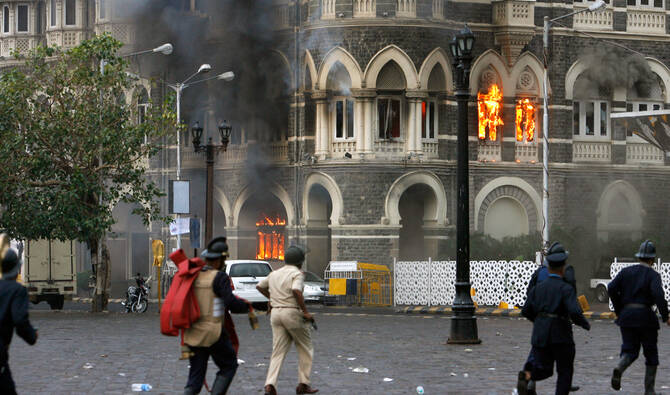
New Delhi blames the LeT group — as well as intelligence officials from New Delhi’s arch-enemy Pakistan — for the Mumbai attacks in November 2008, when 10 gunmen carried out a multi-day slaughter in the country’s financial capital.
India accuses Rana of helping his long-term friend, David Coleman Headley, who was sentenced by a US court in 2013 to 35 years in prison after pleading guilty to aiding LeT militants, including by scouting target locations in Mumbai.
Rana, a former military medic who served in Pakistan’s army, emigrated to Canada in 1997, before moving to the United States and setting up businesses in Chicago, including a law firm and a slaughterhouse.
He was arrested by US police in 2009.
A US court in 2013 acquitted Rana of conspiracy to provide material support to the Mumbai attacks. But the same court convicted him of backing LeT to provide material support to a plot to commit murder in Denmark.
Rana was sentenced to 14 years for his involvement in a conspiracy to attack the offices of the Jyllands-Posten newspaper, which had published cartoons depicting the Prophet Muhammad that angered Muslims around the globe.
But India maintains Rana is one of the key plotters of the Mumbai attacks along with the convicted Headley — and the authorities have welcomed his expected extradition.
In February, Devendra Fadnavis, chief minister of Maharashtra state which includes the megacity Mumbai, said that “finally, the long wait is over and justice will be done.”
Devika Rotawan, a survivor of the Mumbai attacks, said she believed the extradition of Rana would be a “big win for India.”
“I will never be able to forget the attack,” she told broadcaster NDTV on Wednesday.
Counterterrorism experts however suggest Rana’s involvement was peripheral compared to Headley, a US citizen, who India also wants extradited.
“They gave us a small fish but kept David Headley, so the essential outcome is going to be symbolic,” said Ajay Sahni, head of the Institute for Conflict Management, a New Delhi-based think tank.
Rana knew Headley, 64, from their days together at boarding school in Pakistan.
Headley, who testified as a government witness at Rana’s trial, said he had used his friend’s Chicago-based immigration services firm as a cover to scout targets in India, by opening a branch in Mumbai.
Rana has said he visited Mumbai ahead of the attacks — and stayed at the luxury Taj Mahal Palace Hotel that would become the epicenter of the bloody siege — but denied involvement in the conspiracy.
Sahni said that more than 16 years after the attacks, Rana’s extradition is of “historical importance” rather than a source of any “live intelligence.”
But he added that handing him over has “a chilling effect” on others abroad who India seeks to put on trial.


India readies for US extradition of Pakistan-born suspect in Mumbai attacks
https://arab.news/n7shm
India readies for US extradition of Pakistan-born suspect in Mumbai attacks

- Tahawwur Hussain Rana, Canadian citizen born in Pakistan, due to be extradited “shortly” to face trial, Indian media says
- India accuses Rana of being member of Pakistan-based LeT group designated by the UN as a ‘terrorist’ organization

World not ready for rise in extreme heat, scientists say
- In a new study, they looked at different global warming scenarios to project how often people in the future might experience temperatures considered uncomfortably hot or cold
PARIS: Nearly 3.8 billion people could face extreme heat by 2050, and while tropical countries will bear the brunt, cooler regions will also need to adapt, scientists said Monday.
Demand for cooling will “drastically” increase in large countries like Brazil, Indonesia, and Nigeria, where hundreds of millions of people lack air conditioning or other means to beat the heat.
But even a moderate increase in hotter days could have a “severe impact” in nations not accustomed to such conditions, such as Canada, Russia, and Finland, said scientists from the University of Oxford.
In a new study, they looked at different global warming scenarios to project how often people in the future might experience temperatures considered uncomfortably hot or cold.
They found “that the population experiencing extreme heat conditions is projected to nearly double” by 2050 if global average temperatures rise 2°C above preindustrial times.
But most of the impact would be felt this decade as the world fast approaches the 1.5°C mark, said the study’s lead author Jesus Lizana.
“The key takeaway from this is that the need for adaptation to extreme heat is more urgent than previously known,” said Lizana, an environmental scientist.
“New infrastructure, such as sustainable air conditioning or passive cooling, needs to be built out within the next few years to ensure people can cope with dangerous heat.”
Prolonged exposure to extreme heat can overwhelm the body’s natural cooling systems, causing symptoms ranging from dizziness and headaches to organ failure and death.
It is often called a silent killer because most heat deaths occur gradually as high temperatures and other environmental factors work together to undermine the body’s internal thermostat.
Climate change is making heatwaves longer and stronger, and access to cooling — especially air conditioning — will be vital in the future.
The study, published in the journal Nature Sustainability, projected that 3.79 billion people worldwide could be exposed to extreme heat by mid century.
This would “drastically” increase energy demand for cooling in developing nations where the gravest health consequences would be felt. India, the Philippines, and Bangladesh would be among the countries with the largest populations affected.
The most significant change in “cooling degree days” — temperatures hot enough to require cooling, such as air conditioning or fans — was projected in tropical or equatorial countries, particularly in Africa.
Central African Republic, Nigeria, South Sudan, Laos, and Brazil saw the biggest rise in dangerously hot temperatures.
“Put simply, the most disadvantaged people are the ones who will bear the brunt of this trend, our study shows for ever hotter days,” said urban climate scientist and research co-author Radhika Khosla.
But wealthier countries in traditionally cooler climates also “face a major problem — even if many do not realize it yet,” she added.
Countries like Canada, Russia, and Finland may experience steep drops in “heating degree days” — temperatures low enough to require indoor heating — under a 2°C scenario.
But even a moderate rise in hotter temperatures would be felt more acutely in countries not designed to withstand heat, the authors said.
In these countries, homes and buildings are usually built to maximize sunlight and minimize ventilation, and public transport runs without air conditioning.
Some cold-climate nations may see a drop in heating bills, Lizana said, but over time these savings would likely be replaced by cooling costs, including in Europe, where air conditioning is still rare.
“Wealthier countries cannot sit back and assume they will be OK — in many cases, they are dangerously underprepared for the heat that is coming over the next few years,” he said.


