

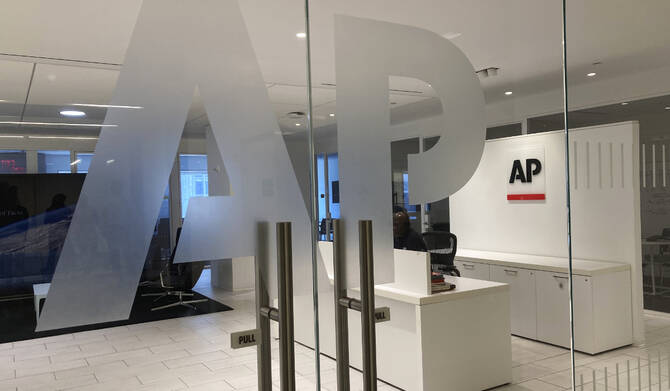

WASHINGTON: A federal judge ordered the White House on Tuesday to restore The Associated Press’ full access to cover presidential events, ruling on a case that touched at the heart of the First Amendment and affirming that the government cannot punish the news organization for the content of its speech.
US. District Judge Trevor N. McFadden, an appointee of President Donald Trump, ruled that the government can’t retaliate against the AP’s decision not to follow Trump’s executive order to rename the Gulf of Mexico. The decision handed the AP a major victory at a time the White House has been challenging the press on several levels.
“Under the First Amendment, if the Government opens its doors to some journalists — be it to the Oval Office, the East Room, or elsewher — it cannot then shut those doors to other journalists because of their viewpoints,” McFadden wrote. “The Constitution requires no less.”
It was unclear whether the White House would move immediately to put McFadden’s ruling into effect. McFadden held off on implementing his order for a week, giving the government time to respond or appeal.
The AP has been blocked since Feb. 11 from being among the small group of journalists to cover Trump in the Oval Office or aboard Air Force One, with sporadic ability to cover him at events in East Room.
The organization had asked McFadden to rule that Trump had violated AP’s constitutional right to free speech by taking the action because he disagreed with the words that its journalists use. He had earlier declined AP’s request to reverse the changes through an injunction.
Trump came out and said why he made the move
While there was little dispute in a March 27 court hearing about why Trump struck back at the AP – the president said as much – the administration said it was up to its own discretion, and not White House correspondents or longstanding tradition, to determine who gets to question the president and when.
Since the dispute with AP began, the White House has taken steps to control who gets to cover the president at smaller events and even where journalists sit during press secretary Karoline Leavitt’s briefings, saying both need to better reflect changes in how people get information.
The AP’s decisions on what terminology to use are followed by journalists and other writers around the world through its influential stylebook. The outlet said it would continue to use Gulf of Mexico, as the body of water has been known for hundreds of years, while also noting Trump’s decision to rename it the Gulf of America. Different outlets have used different approaches, some skirting it by calling it the “Gulf.”
“For anyone who thinks The Associated Press’ lawsuit against President Trump’s White House is about the name of a body of water, think bigger,” Julie Pace, the AP’s executive editor, wrote in a Wall Street Journal op-ed. “It’s really about whether the government can control what you say.”
Trump has dismissed the AP, which was established in 1846, as a group of “radical left lunatics” and said that “we’re going to keep them out until such time as they agree it’s the Gulf of America.”
Testimony revealed AP’s coverage has been impeded
For a news organization that relies on speed as a major selling point, the AP brought its chief White House correspondent and photographer to testify before McFadden about how its absence from covering certain events has delayed its transmission of words and images. Its lawyer, Charles Tobin, said AP has already lost a $150,000 advertising contract from a client concerned about the ban.
The government’s lawyer, Brian Hudak, showed how AP has been able to use livestreams or photos from other agencies to get news out, and pointed out that AP regularly attends Leavitt’s daily briefings.
As a service whose product is delivered to thousands of newspapers, websites and broadcasters across the nation and world, the AP has been part of small text and photo “pools” that have covered presidents of both parties for decades. The administration has sought to give more prominence to new – and in many cases, Trump-friendly – outlets.
In its action filed on Feb. 21, the AP sued Leavitt, White House chief of staff Susie Wiles and deputy chief of staff Taylor Budowich.
Trump has moved aggressively against the media on several fronts since taking office again. The Federal Communications Commission has open lawsuits against ABC, CBS and NBC News. The administration has sought to cut off funding for government-run news services like Voice of America and is threatening public funding for public broadcasters PBS and NPR for allegedly being too liberal in news coverage.


