

Shashai Studio group exhibition shines light on Saudi creativity

1 / 5
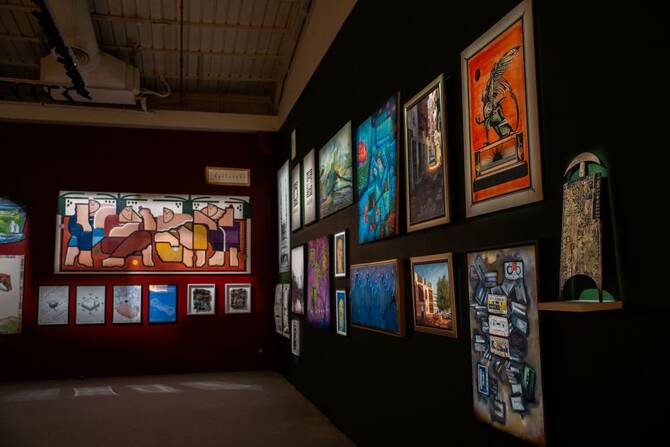
The Annual Salon at Shashai Studio is presenting a tapestry of perspectives and artworks. (AN Photo/Huda Bashatah)
2 / 5
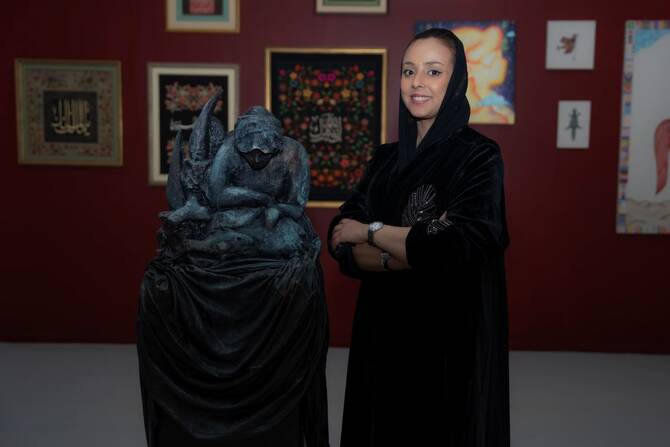
Artist Mona Bashatah with her artwork in Shashai studio. (AN Photo/Huda Bashatah)
3 / 5
Artist Mona Bashatah with her artwork in Shashai studio. (AN Photo/Huda Bashatah)
4 / 5
The Annual Salon at Shashai Studio is presenting a tapestry of perspectives and artworks. (AN Photo/Huda Bashatah)
5 / 5
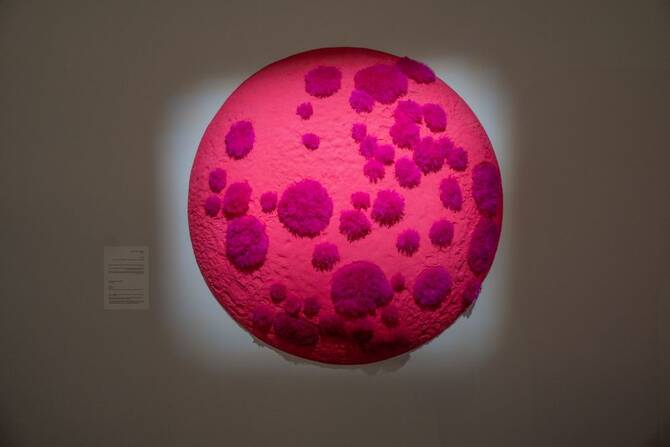
Princess Al-Johara Saud Al-Saud’s artwork entitled The Moon symbolises the enduring strength and presence of women throughout history. (AN Photo/Huda Bashatah)
Short Url
Updated 10 April 2025
Follow

Shashai Studio group exhibition shines light on Saudi creativity

  • Art Week Riyadh positions the Kingdom’s capital as a global cultural destination
  • Princess Al-Johara Saud Al-Saud: This piece reflects on how women have nurtured families and communities while holding societal roles that are often overlooked

RIYADH: Art Week Riyadh’s group exhibition in JAX District brings together a range of artists to celebrate heritage, spark conversations, and showcase the wealth of Saudi creativity, on view through April 13.

The Annual Salon at Shashai Studio is presenting a stunning tapestry of perspectives and artworks to celebrate individual artists and the art community under one roof.

The visual feast encapsulates the spirit of experimentation, encouraging conversations around identity, culture, and the dynamic interplay between tradition and modernity.   

Visitors can get a look at the narratives woven through each piece of artwork.   

Among the standout pieces on display, Princess Al-Johara Saud Al-Saud’s artwork entitled “The Moon” symbolises the enduring strength and presence of women throughout history.

“This piece reflects on how women have nurtured families and communities while holding societal roles that are often overlooked,” she told Arab News. 

Utilizing natural sheep wool as a medium, the artwork underscores the ancestral skills of women in weaving and home-building.

“Women have always been the backbone of our society, supporting families, cultures, and traditions,” Princess Al-Johara explained. This tribute to women serves as a reminder of their multifaceted roles — from caretakers to creators, their contributions are invaluable.

Mona Bashatah, whose works explore ancient crafts of the Arabian Peninsula, discussed her recent project that depicts a fisherman — a character symbolizing the deep-rooted traditions of coastal life. 

“My art stems from the rich history of our region, focusing on the stories that need to be shared with the new generations,” she explained. Her pieces were not only visually stunning but also served as a medium for storytelling, connecting the past with the present.

“I chose to draw inspiration from mulberry bark paper from East Asia, bridging historical trade routes that linked our ancestors to lands far and wide,” she added. 

Her sketches present a narrative intertwined with themes of environmental pollution and cultural identity. The illustrations recount tales of shepherds and sailors who served as vital connections between Eastern and Western worlds.

They represent memories that modern generations may overlook, making her work both a celebration of heritage and a call for awareness.   

The artist also incorporated texts from poet Khalil Gibran, merging literature with art to deepen the emotional impact of her pieces. “My intention is to evoke a sense of belonging and pride in our history,” Bashatah noted. 


Rashed Al-Shashai is the founder and curator of Shashai Studio. (Supplied)

Studio founder and curator Rashed Al-Shashai spoke to Arab News on the significance of the exhibition and the importance of showcasing both emerging and established artists within the Saudi art community.

“We have cultivated an environment of cultural and artistic dialogue at Shashai Studio. This exhibition featured various artists, each with distinct techniques and narratives,” he said.

“This exhibition marks the culmination of a year’s worth of experimentation and collaboration.”

Visitors encountered pieces from notable artists such as Mazin Andijani an Arabic calligrapher, and Fatima Al-Attas, an innovative contemporary artist. 

The inaugural Art Week Riyadh is celebrating Saudi Arabia’s vibrant art scene, bringing together leading local and international galleries, cultural institutions, and arts entities under the overarching theme, “At The Edge.”

The week-long event is fostering exchange, dialogue, and collaboration, inviting art enthusiasts to explore themes of thresholds, liminality, and transitions in art and culture.

The program includes curated gallery exhibitions, rare displays of private collections, as well as talks, workshops, and performances.   

Organized by the Visual Arts Commission under the Ministry of Culture, Art Week Riyadh is a non-commercial platform designed to nurture, celebrate, and position Riyadh as a global cultural destination.

Drawing on the past and present as points of departure, it reimagines an interconnected global arts ecosystem that contributes to the Kingdom’s creative economy while inspiring the preservation of art collecting and patronage. 


From historic desert landscapes to sound stages: AlUla’s bid to become the region’s film capital

Updated 07 February 2026
Follow

From historic desert landscapes to sound stages: AlUla’s bid to become the region’s film capital

DUBAI: AlUla is positioning itself as the center of cinema for the MENA region, turning its dramatic desert landscapes, heritage sites and newly built studio infrastructure into jobs, tourism and long‑term economic opportunity.

In a wide‑ranging interview, Zaid Shaker, executive director of Film AlUla, and Philip J. Jones, chief tourism officer for the Royal Commission for AlUla, laid out an ambitious plan to train local talent, attract a diverse slate of productions and use film as a catalyst for year‑round tourism.

“We are building something that is both cultural and economic,” said Shaker. “Film AlUla is not just about hosting productions. It’s about creating an entire ecosystem where local people can come into sustained careers. We invested heavily in facilities and training because we want AlUla to be a place where filmmakers can find everything they need — technical skill, production infrastructure and a landscape that offers limitless variety. When a director sees a location and says, ‘I can shoot five different looks in 20 minutes,’ that changes the calculus for choosing a destination.”

At the core of the strategy are state‑of‑the‑art studios operated in partnership with the MBS Group, which comprises Manhattan Beach Studios — home to James Cameron’s “Avatar” sequels. “We have created the infrastructure to compete regionally and internationally,” said Jones. “Combine those studios with AlUla’s natural settings and you get a proposition that’s extremely attractive to producers; controlled environment and unmatched exterior vistas within a short drive. That versatility is a real selling point. We’re not a one‑note destination.”

The slate’s flagship project, the romantic comedy “Chasing Red,” was chosen deliberately to showcase that range. “After a number of war films and heavy dramas shot here, we wanted a rom‑com to demonstrate the breadth of what AlUla offers,” said Shaker. “‘Chasing Red’ uses both our studio resources and multiple on‑location settings. It’s a story that could have been shot anywhere — but by choosing AlUla we’re showing how a comical, intimate genre can also be elevated by our horizons, our textures, our light.

“This film is also our first under a broader slate contract — so it’s a proof point. If ‘Chasing Red’ succeeds, it opens the door for very different kinds of storytelling to come here.”

Training and workforce development are central pillars of the program. Film AlUla has engaged more than 180 young Saudis in training since the start of the year, with 50 already slated to join ongoing productions. “We’re building from the bottom up,” said Shaker. “We start with production assistant training because that’s often how careers begin. From there we provide camera, lighting, rigging and data-wrangling instruction, and we’ve even launched soft‑skill offerings like film appreciation— courses that teach critique, composition and the difference between art cinema and commercial cinema. That combination of technical and intellectual training changes behavior and opens up real career pathways.”

Jones emphasized the practical benefits of a trained local workforce. “One of the smartest strategies for attracting productions is cost efficiency,” he said. “If a production can hire local, trained production assistants and extras instead of flying in scores of entry‑level staff, that’s a major saving. It’s a competitive advantage. We’ve already seen results: AlUla hosted 85 productions this year, well above our initial target. That momentum is what we now aim to convert into long‑term growth.”

Gender inclusion has been a standout outcome. “Female participation in our training programs is north of 55 percent,” said Shaker. “That’s huge. It’s not only socially transformative, giving young Saudi women opportunities in an industry that’s historically male-dominated, but it’s also shaping the industry culture here. Women are showing up, learning, and stepping into roles on set.”

Looking to 2026, their targets are aggressive; convert the production pipeline into five to six feature films and exceed 100 total productions across film, commercials and other projects. “We want private-sector partners to invest in more sound stages so multiple productions can run concurrently,” said Jones. “That’s how you become a regional hub.”

The tourism case is both immediate and aspirational. “In the short term, productions bring crews who fill hotels, eat in restaurants and hire local tradespeople,” said Shaker. “In the long term, films act as postcards — cinematic invitations that make people want to experience a place in person.”

Jones echoed that vision: “A successful film industry here doesn’t just create jobs; it broadcasts AlUla’s beauty and builds global awareness. That multiplies the tourism impact.”

As “Chasing Red” moves into production, Shaker and Jones believe AlUla can move from an emerging production destination to the region’s filmmaking epicenter. “We’re planting seeds for a cultural sector that will bear economic fruit for decades,” said Shaker. “If we get the talent, the infrastructure and the stories right, the world will come to AlUla to film. And to visit.”