US discusses tariffs, critical minerals, immigration with Pakistan

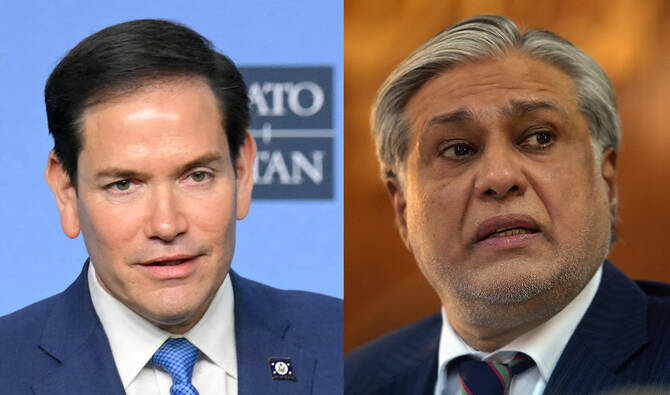
A collage of images created on April 8, 2024, shows US Secretary of State Marco Rubio (left) and Pakistan's Deputy Prime Minister and Foreign Minister Ishaq Dar. (AFP/File)
Short Url
Updated 08 April 2025
Follow

US discusses tariffs, critical minerals, immigration with Pakistan

  • US Secretary of State Marco Rubio speaks to Pakistan’s Foreign Minister Ishaq Dar over telephone
  • Both discussed making progress toward a “fair and balanced” trade relationship, says State Department

WASHINGTON: US Secretary of State Marco Rubio spoke to Pakistani Foreign Minister Ishaq Dar on Monday about tariffs, trade relations, immigration and prospects for engagement on critical minerals, the State Department and Pakistan’s foreign ministry said in separate statements.

President Donald Trump said last week that he would impose a 10 percent baseline tariff on all imports to the US and higher duties on dozens of other countries, including some of Washington’s biggest trading partners, rattling global markets and bewildering US allies. The Trump administration imposed a 29 percent tariff on Pakistan.

“They (Rubio and Dar) discussed US reciprocal tariffs on Pakistan and how to make progress toward a fair and balanced trade relationship,” the State Department said.

The US goods trade deficit with Pakistan was $3 billion in 2024, a 5.2  percent increase over 2023, according to the Office of the US Trade Representative.

“The Secretary raised prospects for engagement on critical minerals and expressed interest in expanding commercial opportunities for US companies.”

Pakistan’s foreign ministry said Rubio “reciprocated the desire to collaborate with Pakistan in trade and investment in various sectors, especially critical minerals.”

The Trump administration has also used prospects of engagement over critical minerals with other countries.

For example, it is attempting to strike an agreement over critical minerals with Ukraine as part of talks related to the Russia-Ukraine war. Washington has also said it is open to exploring critical minerals partnerships with Congo and help end a conflict raging in the African country’s east.

In the call with Dar, Rubio emphasized the importance of Pakistan’s cooperation with the US on law enforcement and addressing illegal immigration, the State Department said.

Last month, Pakistan highlighted its cooperation with Washington on countering extremism after the arrest of Mohammad Sharifullah, whom the US blames for a 2021 attack on its troops at Kabul airport, in a military operation along the border with Afghanistan.

The Pakistan foreign ministry said Rubio and Dar discussed the situation in Afghanistan.


In Peshawar, 76-year-old artist struggles to keep near-extinct Mughal wax art alive

Updated 4 sec ago
Follow

In Peshawar, 76-year-old artist struggles to keep near-extinct Mughal wax art alive

  • Craft involves intricate process using heated wax, oil, pigments, limestone to create textured, miniature artworks
  • Riaz Ahmad, who has trained his son in wax art, says he hopes to train more people to preserve traditional craft 

PESHAWAR: Riaz Ahmad, 76, stirs wax in a small plastic can with a long chopstick, takes it out on the palm of his left hand and adds natural color before drawing designs on a piece of cloth.

Surrounded by several such pieces of black cloth with unique art, Ahmad strives every passing day to keep the 500-year-old, Mughal-era wax art alive at his home near the Lahori Gate in the northwestern Pakistani city of Peshawar.

Ahmad comes from a well-known family of wax artists who were based in Shillong and Darjeeling in present-day India and had migrated to Peshawar during the 1947 partition of the sub-continent.

His work remains rooted in tradition, faithfully repeating patterns passed down through generations and winning Ahmad several awards both at home and abroad in recognition of his dedication.

“I have been making the same Mughal era designs that my forefathers used to make,” he told Arab News last week.


“I went to India in 2004, where I received the UNESCO Seal of Excellence [for Handicrafts] award... On 23 March, 2012, the Government of Pakistan awarded me the Tamgha-i-Imtiaz.”

The near-extinct traditional craft, which is believed to have originated in Central Asia and refined under the Mughal patronage, particularly in Peshawar, involves an intricate process using heated wax, linseed oil, powdered pigments, and limestone to create detailed, textured and often colorful miniature artworks by hand.

Ahmad learnt wax art from his father, Miran Bakhsh, nearly six decades ago.

“My parents used to do this work in Shillong and Darjeeling [in present-day India]. They had a shop there, and after the Partition, they migrated to Peshawar, Pakistan,” he said. “When they came here, they started doing the same work.”

A basic piece of his work costs around Rs3,000 ($10.7). A larger piece made on order can fetch between Rs5,000 and Rs15,000 ($17-$53), but such orders are rare.

“Wax and colors have become expensive. When I sell a piece for Rs3,000, around Rs1,000 goes into expenses, and Rs2,000 is my daily wage,” Ahmad said.

But the 76-year-old worries more about the future of the art form, which he insists cannot be learned quickly and requires “love and dedication.”

“Some people say they want to come, some from Karachi and some from Lahore, but it becomes difficult for me to go there or for them to come here,” he said.

Most wax artists in Peshawar have abandoned the art due to a lack of institutional support, according to Ahmad, who relies primarily on exhibitions to earn a living.

“The reason [for the decline of this art form] is that the government does not pay attention. They are caught in their own conflicts, and the culture is suffering,” Ahmad said.

“Other artists have left this art. Some are selling rice and some are driving rickshaws,” he added. “I have been doing this work inside my house. If there is any event, we go there and sell our art.”

Saad Bin Awais, a spokesperson for the Khyber Pakhtunkhwa Culture and Tourism Authority (KPCTA), said the government has engaged artisans in several projects. He said some of these projects have come to an end while others are ongoing.

“Riaz Ahmad is the only wax artist in Khyber Pakhtunkhwa and the authority is serious about facilitating him,” he said, adding that the KPCTA facilitates Ahmad’s participation in exhibitions across the country to showcase his art.

“We have also been collecting data of artists in Khyber Pakhtunkhwa for an upcoming project to facilitate them in any way possible.”

Ahmad has trained his son, Fayyaz, in wax art who now practices it in Islamabad. The septuagenarian says he wishes to train more people to preserve the dying art form.

“I cannot leave this work,” he said. “I will continue this art even though my hands shake.”