LONDON: Hezbollah and all militias in Lebanon must be disarmed “as soon as possible,” US Deputy Special Envoy for the Middle East Morgan Ortagus has told the Lebanese broadcaster LBCI.
Ortagus, who was speaking to LBCI’s Toni Mrad in an interview aired on Sunday, emphasized President Donald Trump’s firm position that only by disarming militant groups could the Lebanese people be “free from foreign influence, free from terrorism, free from the fears that have been so pervasive in society.”
Speaking during her second visit to Lebanon, where she has held “fantastic meetings” with President Joseph Aoun and Prime Minister Nawaf Salam, Ortagus also reiterated Washington’s continued support for Lebanon’s sovereignty, while stressing that disarmament remained a central pillar of any meaningful recovery.
“We, of course, always bring up disarming Hezbollah, but not just Hezbollah, all militias in this country,” Ortagus said.
“President Aoun said clearly in his inaugural speech that he wanted the state to have the monopoly of force, he wanted the state to be the one with the weapons. That is a position that we support,” she added.
When asked to outline a timeline on disarming the Iran-backed group, Ortagus said there was “not necessarily a timetable,” but that it should happen “as soon as possible.”
She continued that the US had been providing aid and assistance, training, funding, and equipment to the LAF (Lebanese Armed Forces) for decades.
“That’s a very important American priority. Now that we’re in this new era — where the LAF is really able, under President Aoun’s leadership, to exert more authority over the state — we want to help them move toward those goals. Those goals are real; they’re clear,” she said.
Ortagus, who served as spokesperson for the State Department during the first Trump administration, said she was “very encouraged” by Lebanon’s new cabinet, describing its ministers as “real patriots” with a clear vision for reforms. This was in stark contrast to what she described as the “depressing” conditions of the past decade.
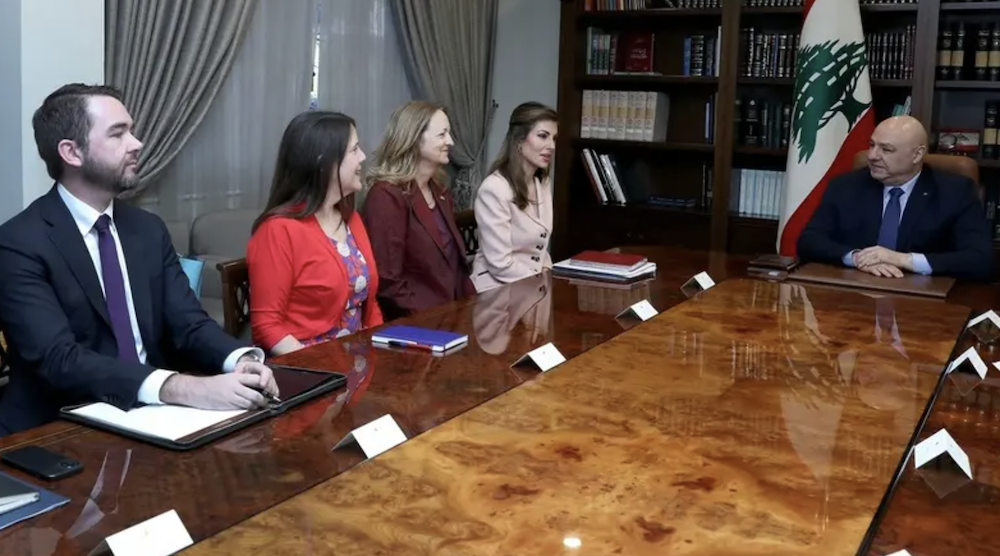
Handout photo provided by Lebanese Presidency on April 5, 2025, shows Lebanon’s President Aoun (R) meeting with Ortagus (2nd-R) and members of her delegation at the Presidential Palace in Baabda. (AFP)
When asked whether Hezbollah could play a political role in Lebanon if disarmed, Ortagus responded by reframing the question in terms of broader US policy under Trump.
“I don’t come here as a US official representing the Trump administration to make demands: ‘You must do X, you must do Y.’ Rather, I encourage and say: If you want continued partnership with the United States, you have to meet certain goals and criteria,” she said.
“When I came here the first time, it was important to me that Nawaf Salam did not have Hezbollah represented among his ministers, just as important was that there not be corrupt ministers; corruption has eroded society’s confidence.
“If (Lebanon’s leaders) choose to work together and partner with the US government to disarm Hezbollah, to fulfil the cessation of hostilities, to end endemic corruption, we’re going to be a wonderful partner and friend. And there will be more of that to come.
“But if the government and the leaders choose to slow-walk that or not be part of that vision for Lebanon that we share, that’s a choice they can make. But they shouldn’t expect partnership if they’re not achieving these goals,” she added.
Addressing speculation over potential Lebanese normalization with Israel, Ortagus dismissed the issue as premature.
“I didn’t have a single conversation about that topic here in Lebanon. What we’re focused on now is implementing the cessation of hostilities. We’re focused on disarming Hezbollah. We’re focused on economic reforms,” she said. “You have to crawl before you run; we’re still at the crawling stage.”
On Lebanon’s deepening economic crisis, Ortagus said US support would hinge on reforms, echoing positions taken by the International Monetary Fund and World Bank.
“Lebanon must get off things like the FATF (Financial Action Task Force) gray list. It must move beyond a cash-based economy. It must return to having a sophisticated financial sector, the one Lebanon used to be known for,” she said.
Ortagus revealed she was struck by a billboard in Beirut that read “Make Lebanon Great Again,” saying she took a photo of it to show Trump.
“I loved that sign,” she said. “If you want to make Lebanon great again, you must implement these reforms. It’s tough, but Lebanon is in one of the worst financial conditions I’ve seen in the past 20 or 30 years.”
Calling the situation “devastating,” she warned that radical change was required to avoid collapse. “To rescue yourselves, you’ll need reforms, and some of them radical, to save the country.”
Ortagus also called for an overhaul of the traditional donor-aid approach to post-conflict reconstruction, advocating instead for increased private-sector investment and innovation.
“Our vision for Lebanon is not just as a donor country always asking for donations,” she told Mrad. “How do we think of a better way to rebuild southern Lebanon? We want people to have jobs. We want them to have hope for the future.”
Pointing to the regional devastation in Gaza, Syria, and Lebanon, she said the world must “look differently at these war-torn regions” and empower their youth to participate in shaping a more prosperous future.

keywords