SPIN BOLDAK, Afghanistan: Thousands of Afghans have crossed the border from Pakistan in recent days, the United Nations and Taliban officials said, as Islamabad ramped up pressure for them to return to Afghanistan.
Pakistan last month set an early April deadline for some 800,000 Afghans carrying Afghan Citizen Cards (ACC) issued by Pakistan authorities to leave the country, another phase in Islamabad’s campaign in recent years to repatriate Afghans.
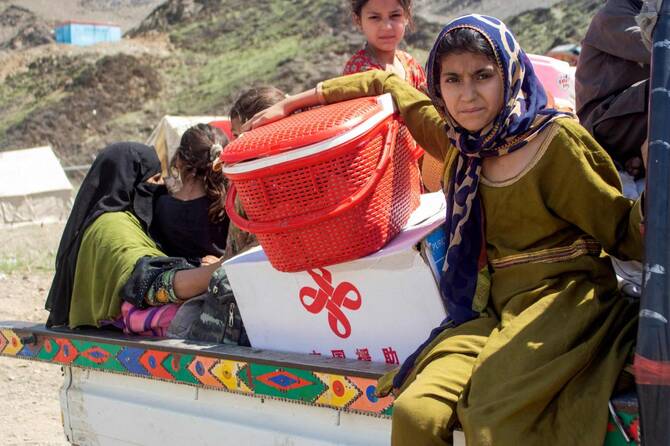
Families with their belongings in tow lined up at the key border crossings of Torkham in the north and Spin Boldak in the south, recalling similar scenes in 2023 when tens of thousands of Afghans fled deportation threats in Pakistan.
“In the last 2 days, 8,025 undocumented & ACC holders returned via Torkham & Spin Boldak crossings,” the UN International Organization for Migration (IOM) said in a post on social media platform X on Monday.
“IOM stands ready to scale up its response at key border points with forced returns expected to surge in the coming days,” it said.
Taliban officials also said thousands of people had crossed the border, but at lower rates than the IOM reported.
Refugee ministry spokesman Abdul Mutalib Haqqani told AFP that 6,000-7,000 Afghans had returned since the start of April, saying “more than a million Afghans might return.”
“We are urging Pakistan authorities not to deport them (Afghans) forcefully — there should be a proper mechanism with an agreement between both countries, and they must be returned with dignity,” he said.
Fleeing successive conflicts
The UN says nearly three million Afghans live in Pakistan, many having lived there for decades after fleeing successive conflicts in their country and after the Taliban’s return to power in Kabul in 2021.
“We were forced to return. Two days ago I was stopped and asked for documentation when they were searching houses,” 38-year-old Abdul Rahman told AFP after passing the Spin Boldak crossing with his family from Quetta, in Pakistan’s southwest, where they lived for six years.
“They didn’t even gave me an hour (to leave), I sold a carpet and my phone to make some money to come here, all my other belongings we left behind,” he said.
Human rights activists have been reporting for months the harassment and extortion of Afghans in Pakistan, a country mired in political and economic chaos.
More than 1.3 million Afghans who hold Proof of Registration cards from the UN refugee agency, UNHCR, have also been told to move outside the capital Islamabad and the neighboring city of Rawalpindi.
Human Rights Watch has slammed “abusive tactics” used to pressure Afghans to return to their country, “where they risk persecution by the Taliban and face dire economic conditions.”
Ties between the neighboring countries have frayed since the Taliban takeover in Afghanistan.
Islamabad has accused Kabul’s rulers of failing to root out militants sheltering on its soil, a charge that the Taliban government denies, as Pakistan has seen a sharp rise in violence in border regions with Afghanistan.


Thousands of Afghans depart Pakistan under repatriation pressure
https://arab.news/9jb63
Thousands of Afghans depart Pakistan under repatriation pressure

- Thousands of Afghans have crossed the border from Pakistan in recent days as Islamabad ramped up pressure for them to return to Afghanistan
- Families with their belongings in tow lined up at the key border crossings of Torkham in the north and Spin Boldak in the south


In rare overlap, Chinese Muslims observe Ramadan with Lunar New Year
- Lunar New Year started on Feb. 17 and is celebrated for another two weeks
- Chinese Indonesians make up about 3 percent of the Indonesian population
JAKARTA: Every year, on the first day of Lunar New Year, Febriani visits relatives and gathers for a feast with her Chinese Muslim family, part of a long-standing tradition honoring their ethnic heritage.
But this year, as Thursday marks the beginning of Ramadan, she is celebrating two important occasions within the same week, in a rare overlap that last took place in 1995.
“I’m very happy and grateful that Lunar New Year and Ramadan are celebrated so closely. I observe both every year, so it’s truly special,” she told Arab News.
Widely observed across Asia, the Lunar New Year or Chinese New Year festival is believed to date back to the 14th century B.C., to the times of the Shang Dynasty, China’s earliest ruling dynasty, when people celebrated good harvests.
In 2026, it started on Feb. 17 and is celebrated for another two weeks. For many, celebrations typically involve elaborate feasts, giving children pocket money in red envelopes, and watching dragon dance parades.
In Indonesia, Chinese-descent citizens make up an estimated 3 percent of the country’s Muslim-majority population of more than 280 million. While most are either Buddhists or Christians, a small minority professes Islam.
For 25-year-old Febriani, both Lunar New Year and Ramadan are equally meaningful.
“The two celebrations teach us to strengthen bonds, to share with one another, and to become closer to family,” she said.
“They are both important to me because they happen only once every year and they’re always an occasion to gather with the extended family. It is also a chance to self-reflect and strengthen relationships with your loved ones.”
For Naga Kunadi, whose family lives in Central Java’s Cepu district, Chinese New Year is all about embracing his ethnic identity.
Earlier in the week, his family was busy preparing for the new year’s feast, which was a fusion of Chinese and Indonesian dishes, such as claypot tofu, meatball soup and shumai, or steamed dumplings.
“To celebrate Chinese New Year, we prepared halal Chinese food at home. It’s also a way to introduce to my children the traditions from our Chinese side, but there’s a bit of a fusion because my wife is Javanese,” Kunadi told Arab News.
Kunadi, an Islamic teacher at the Lautze Mosque in Jakarta, sees both Chinese New Year and Ramadan as opportunities to teach important life values for his two children.
Upholding Chinese New Year traditions with his family is for him a way of preserving his ethnic heritage.
“We want to preserve cultural values as long as it does not clash with our religion,” he said.
“If we leave our culture behind, we might lose our identity, so this is something I want to teach my children.”
The fasting month of Ramadan, on the other hand, gives him a chance to teach and practice honesty.
“I want to focus on the religious and moral aspects during the holy month of Ramadan, when we practice honesty on a personal level,” Kunadi said.
“There’s always an opportunity to eat or snack in secret without anybody knowing, but we train ourselves not to do that. For me, Ramadan is a time for everyone to put honesty into practice, including myself and my children.”


