

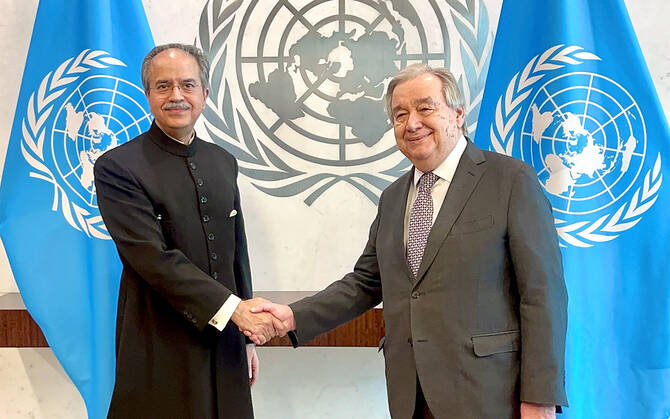
Pakistan’s new envoy to UN presents credentials to world body chief

Pakistan’s Permanent Representative to the United Nations, Ambassador Asim Iftikhar Ahmad (left), presents his credentials to UN Secretary-General Antonio Guterres, in New York, US, on April 2, 2025. (@PakistanUN_NY/X)
Short Url
Updated 03 April 2025
Follow

Pakistan’s new envoy to UN presents credentials to world body chief

  • Ambassador Asim Iftikhar Ahmad has built a distinguished three-decade foreign service career
  • He takes over at a time when Pakistan holds a non-permanent seat on the UN Security Council

ISLAMABAD: Pakistan’s Permanent Representative to the United Nations, Ambassador Asim Iftikhar Ahmad, presented his credentials to UN Secretary-General Antonio Guterres, state media reported on Thursday.

Ahmad, a seasoned diplomat, joined the Foreign Service of Pakistan in 1993 and has built a distinguished three-decade career, serving in Europe, Africa, Asia and at the UN.

He succeeds Ambassador Munir Akram, who concluded his tenure as the top diplomat at the country’s UN mission on Mar. 31 this year, according to the Associated Press of Pakistan (APP).

“The UN chief congratulated him on his new role and extended his best wishes for a successful tenure,” the APP said. “Ambassador Asim reaffirmed Pakistan’s steadfast commitment to multilateralism and the principles of the UN Charter.”

State media reported that Ahmad served as Ambassador to France and Monaco and Permanent Delegate to UNESCO from November 2022 to December 2024 before his current appointment.

He also held key roles in Pakistan’s Foreign Ministry, including as a spokesperson, and served as Ambassador to Thailand and Permanent Representative to ESCAP from 2017 to 2021.

According to APP, Ahmad’s previous experience at the UN includes being part of Pakistan’s Security Council delegations in 2003-2004 and 2012-2013.

He takes over at a time when Pakistan holds a non-permanent seat on the UN Security Council, participating in major global debates, including the volatile situation and ongoing conflicts in the Middle East.


Pakistan says defense pact with Saudi Arabia elevated brotherly ties to ‘new heights’

Updated 25 February 2026
Follow

Pakistan says defense pact with Saudi Arabia elevated brotherly ties to ‘new heights’

  • Pakistan, Saudi Arabia signed strategic defense pact last year pledging aggression against one will be treated as attack on both
  • Deputy PM Ishaq Dar says enduring bonds with Islamic and Arab nations form vital pillar of Pakistan’s foreign policy 

ISLAMABAD: Deputy Prime Minister Ishaq Dar said on Wednesday that Pakistan’s defense pact with Saudi Arabia elevated its brotherly ties with the Kingdom to “new heights,” stressing that close ties with Arab and Islamic nations form a key pillar of Islamabad’s foreign policy. 

Pakistan and Saudi Arabia signed a Strategic Mutual Defense Agreement on Sept. 17 last year, pledging that aggression against one country would be treated as an attack on both, enhancing joint deterrence and formalizing decades of military and security cooperation.

Both nations agreed in October 2025 to launch an economic cooperation framework to strengthen trade and investment ties. 

“In the Middle East, our landmark Strategic Mutual Defense Agreement with Saudi Arabia has elevated our brotherly ties to new heights,” Dar said while speaking at the Pakistan Governance Forum 2026 event in Islamabad. 

The Pakistani deputy prime minister was speaking on the topic “Navigating International Relations Amidst Changing Geo-Politics.”

Dar noted that Pakistan has reinforced partnerships with other Middle Eastern nations such as the UAE, Qatar, Jordan, Oman, Egypt and Bahrain. He said these partnerships have yielded “concrete agreements” in investment, agriculture, infrastructure, and energy sectors. 

“Our enduring bonds with Islamic and Arab nations form a vital pillar of our foreign policy, and we will continue to expand our partnerships across Asia, Latin America, and Africa,” he said. 

Dar pointed out that the presidents of Kazakhstan, Uzbekistan and Kyrgyzstan have undertaken visits to Pakistan in recent months, reflecting Central Asian nations’ desire to boost cooperation with Islamabad.

On South Asia, the Pakistani deputy PM said Pakistan has successfully transformed its fraternal ties with Bangladesh into “a substantive partnership.”

“Similarly, the trilateral mechanism involving China, Pakistan, and Bangladesh has been launched with a view to expanding and deepening regional cooperation and synergy,” the Pakistani minister said. 

He said Islamabad has strengthened its “all-weather” partnership with China via the second phase of the multi-billion-dollar China-Pakistan Economic Corridor agreement and “unwavering support” from both sides for each other’s core interests. 

Dar said Pakistan had also reinvigorated its partnership with the US, advancing cooperation in trade, technology, investment, and regional stability. 

“This calibrated approach has enhanced our ability to navigate complexity with skill and confidence, ensuring that our national interests are served without compromising our core foreign policy principles,” he said.