SAN JOSE: Former Costa Rican President and Nobel Prize winner Oscar Arias said on Tuesday that the US had revoked his visa to enter the country, weeks after he criticized US President Donald Trump on social media saying he was behaving like “a Roman emperor.”
Arias, 84, was president between 1986 and 1990 and again between 2006 and 2010. A self-declared pacifist, he won the 1987 Nobel Peace Prize for his role in brokering peace during the Central American conflicts of the 1980s.
Arias also promoted a free trade agreement with the US during his last term and in 2007 established diplomatic ties with China.
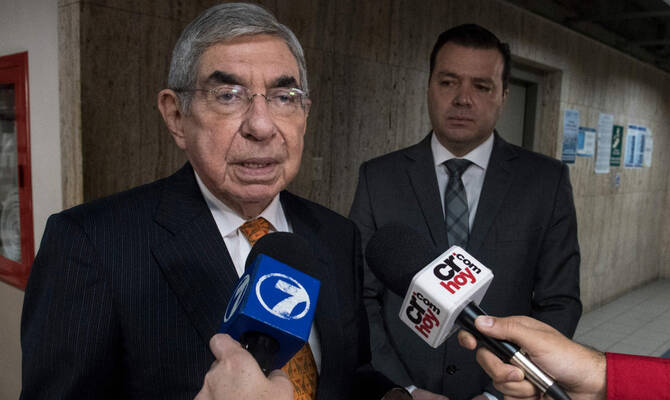
“I received an email from the US government informing me that they have suspended the visa I have in my passport. The communication was very terse, it does not give reasons. One could have conjectures,” Arias told reporters outside his home, without elaborating on his suspicions.
In February, Arias had on social media accused the current government of President Rodrigo Chaves of giving in to US pressure, as the US has sought to oppose China’s influence in the region and deported migrants from third countries into Central America.
“It has never been easy for a small country to disagree with the US government, and even less so, when its president behaves like a Roman emperor, telling the rest of the world what to do,” he said on social media in February.
His statements came after the US withdrew visas from three Costa Rican lawmakers who opposed Chaves’ decision to exclude Chinese firms from participating in the development of 5G in the country, following US demands. On Tuesday, another opposition lawmaker was also stripped of her US visa.
US Secretary of State Marco Rubio had in early February visited Costa Rica and offered to help Chaves “punish” Costa Rican officials who collaborate with “foreign actors who pose a threat to the country’s cybersecurity.”


Costa Rican former President Oscar Arias says US revoked his visa
https://arab.news/c7xy5
Costa Rican former President Oscar Arias says US revoked his visa

- “It has never been easy for a small country to disagree with the US government, and even less so, when its president behaves like a Roman emperor, telling the rest of the world what to do,” he said on social media in February


US lawmaker Fine criticized by rights advocates, Democrats after anti-Muslim remarks
- Fine’s past comments include calling for the mass expulsion of all Muslims from the US, labeling of Muslims as “terrorists” and the mocking of the starvation and killing of Palestinians in Gaza, among others
WASHINGTON: Rights advocates and multiple Democrats on Tuesday condemned anti-Muslim comments by Republican US Representative Randy Fine who said on Sunday that “the choice between dogs and Muslims is not a difficult one.”
Fine, whose comments against Muslims have often sparked outrage, has dismissed the criticism and since doubled down on his remarks on social media. The Council on American-Islamic Relations designated the Republican US lawmaker from Florida as an anti-Muslim extremist last year.
“If they force us to choose, the choice between dogs and Muslims is not a difficult one,” Fine said on X on Sunday in a post that had over 40 million views as of Tuesday afternoon.
Some high-profile Democrats including California Governor Gavin Newsom called for him to resign while House of Representatives Minority Leader Hakeem Jeffries called Fine an “Islamophobic, disgusting and unrepentant bigot.”
Jeffries also called for Republicans — who hold a majority in both chambers of Congress — to hold Fine accountable.
“To ignore this is to accept and normalize it,” Democratic US Representative Alexandria Ocasio-Cortez said. Fine’s past comments include calling for the mass expulsion of all Muslims from the US, labeling of Muslims as “terrorists” and the mocking of the starvation and killing of Palestinians in Gaza, among others. Rights advocates have noted a rise in Islamophobia in the US in recent years due to a range of factors including hard-line immigration policies and white-supremacist rhetoric, as well as the fallout of Israel’s war in Gaza on American society.


