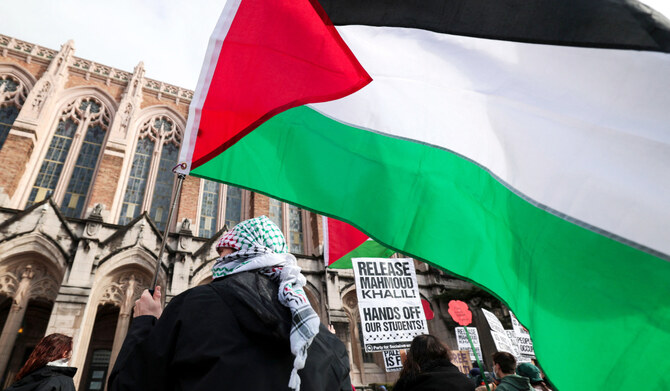
NEW YORK: A Columbia University student arrested and threatened with deportation for his role in campus protests against Israel gave his first public statement Tuesday, saying that his detention is indicative of “anti-Palestinian racism” demonstrated by both the Trump and Biden administrations.
In a letter dictated from a Louisiana immigration lockup and released by his attorney, the student, Mahmoud Khalil, said he is being targeted as part of a larger effort to repress Palestinian voices.
“My unjust detention is indicative of the anti-Palestinian racism that both the Biden and Trump administrations have demonstrated over the past 16 months as the US has continued to supply Israel with weapons to kill Palestinians and prevented international intervention,” he said.
“For decades, anti-Palestinian racism has driven efforts to expand US laws and practices that are used to violently repress Palestinians, Arab Americans, and other communities. That is precisely why I am being targeted.”
Khalil and the federal government have been sparring in court over the Trump administration’s move to ship him halfway across the country to the lockup in Louisiana.
The government says he could not be detained at an immigration facility near where he was originally arrested in part because of a bedbug infestation, so they sent him to Louisiana. Khalil says there was no such discussion of bedbugs and he feared he was being immediately deported.
Khalil said in a declaration filed in Manhattan federal court Monday that while he was held overnight at a detention center in Elizabeth, New Jersey, “I did not hear anyone mention bedbugs.”
In court papers over the weekend, lawyers for the Justice Department also blamed his move on overcrowded facilities in the Northeast.
Khalil made the statement about bedbugs in an exhibit attached to court papers in which his lawyers asked that he be freed on bail while the courts decide whether his arrest violated the First Amendment.
The lawyers have also asked a judge to widen the effect of any order to stop the US government from “arresting, detaining, and removing noncitizens who engage in constitutionally protected expressive activity in the United States in support of Palestinian rights or critical of Israel.”
Khalil said in court records that he was put in a van when he was taken away from the Elizabeth facility and he asked if he was being returned to FBI headquarters in Manhattan, where he was taken immediately after his arrest.
“I was told, ‘no, we are going to JFK Airport.’ I was afraid they were trying to deport me,” he recalled.
Of his time spent at the Elizabeth facility, he wrote: “I was in a waiting room with about ten other people. We slept on the ground. Even though it was cold inside the room, there were no beds, mattresses, or blankets.”
Khalil, in the letter released by his attorney on Tuesday, said “I see in my circumstances similarities to Israel’s use of administrative detention – imprisonment without trial or charge – to strip Palestinians of their rights.”
“For Palestinians, imprisonment without due process is commonplace,” he said.
In the weekend court papers, lawyers for the Justice Department gave a detailed description of Khalil’s March 8 arrest and his transport from Manhattan to Elizabeth and then to Kennedy International Airport in New York the next day for his transfer to Louisiana, where he has been held since.
“Khalil could not be housed at Elizabeth Detention Facility long-term due to a bedbug issue, so he remained there until his flight to Louisiana,” the lawyers wrote. They said he was at the facility from 2:20 a.m. until 11:30 a.m. on March 9.
The lawyers have asked that legal issues be addressed by federal judges in New Jersey or Louisiana rather than New York. A Manhattan federal judge has not yet ruled on the request.
Khalil’s lawyers, who oppose transferring the case, wrote in a submission Monday that the transfer to Louisiana was “predetermined and carried out for improper motives” rather than because of a bedbug infestation.
Despite the bedbug claim, the Elizabeth Detention accepted at least four individuals for detention from March 6 through last Thursday and Khalil himself saw men being processed for detention while he was there, they wrote.
Khalil, in the letter released by his attorney on Tuesday, also referenced a wave of Israeli strikes across Gaza — ending the ceasefire on Monday night — and called it a “moral imperative” to continue push for freedom for Palestinians.
“With January’s ceasefire now broken, parents in Gaza are once again cradling too-small shrouds, and families are forced to weigh starvation and displacement against bombs,” he said. “It is our moral imperative to persist in the struggle for their complete freedom.”


![]()

Columbia University student says his detention is indicative of anti-Palestinian racism in US
Short Url
https://arab.news/8uktq
Columbia University student says his detention is indicative of anti-Palestinian racism in US
- Khalil, in the letter released by his attorney on Tuesday, said “I see in my circumstances similarities to Israel’s use of administrative detention – imprisonment without trial or charge – to strip Palestinians of their rights”
- Khalil and the federal government have been sparring in court over the Trump administration’s move to ship him halfway across the country to the lockup in Louisiana


Latest updates


© 2026 SAUDI RESEARCH & PUBLISHING COMPANY, All Rights Reserved And subject to Terms of Use Agreement.