Oceanic ‘peace’ pact signed in Costa Rica ahead of 2025 UN talks

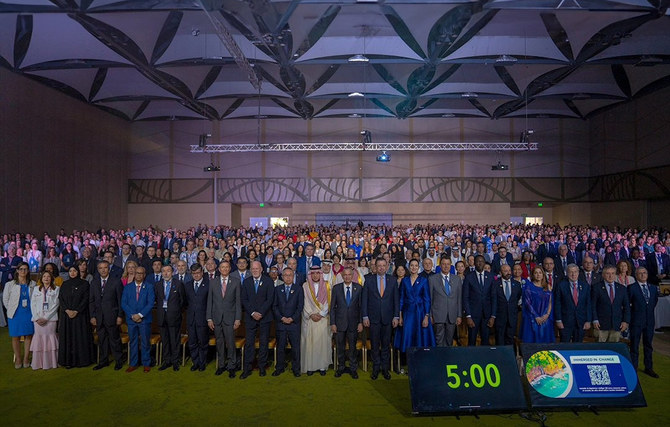
Family picture of the participants to the ‘Ocean Action: Immersed in Change’ event held in San Jose, Costa Rica, on Jun 7 and 8, 2024. (X: @MoCCaEUAE
Short Url
Updated 09 June 2024
Follow

Oceanic ‘peace’ pact signed in Costa Rica ahead of 2025 UN talks

  • The peace declaration includes a call for twelve “Ocean Actions,” notably the implementation of several ocean-related international accords agreed to last year

SAN JOSE, Costa Rica: Over two dozen countries signed a wishful “declaration of peace with the ocean” on Saturday in Costa Rica, as a multi-day meeting to prepare for a major UN conference next year wrapped up.
Among the signatories were Germany, Spain, Sweden, Canada, Colombia, Chile, Israel and South Korea, as well as Costa Rica and France, co-hosts of the third UN Ocean Conference to be held next June in the French city of Nice.
“We are committed to scaling up transformative ocean actions to support nature-positive economies based on the best available science and scientific information, traditional knowledge and innovation,” the document said.
About a year out from the major meeting, national representatives, scientists and international experts gathered this week in San Jose for two days of discussions to prepare for the conference.
“The ocean can no longer endure our mistreatment and indifference. That is why we in Costa Rica have decided that it is time for us to declare peace,” said Costa Rican Foreign Minister Arnoldo Andre Tinoco during the event.
United Nations Under-Secretary-General for Social Affairs Li Junhua also said at the start of the “Immersed in Change” meeting that protecting the ocean was “not an option but an imperative.”
The peace declaration includes a call for twelve “Ocean Actions,” notably the implementation of several ocean-related international accords agreed to last year.
Those include a landmark high seas treaty that allows for the creation of marine protected areas outside of countries’ exclusive economic zones.
The treaty was adopted after more than 15 years of discussions to extend environmental protections to international waters which make up more than 60 percent of the world’s oceans.



Italian PM pledges to deepen cooperation with African states

Updated 4 sec ago
Follow

Italian PM pledges to deepen cooperation with African states

  • The plan, launched in 2024, aims to promote investment-led cooperation rather than traditional aid

ADDIS ABABA: Italy pledged to deepen cooperation with African countries at its second Italy-Africa summit, the first held on African soil, to review projects launched in critical sectors such as energy and infrastructure during Italy’s first phase of the Mattei Plan for Africa.

The plan, launched in 2024, aims to promote investment-led cooperation rather than traditional aid.

Italy’s Prime Minister Giorgia Meloni addressed dozens of African heads of state and governments in Ethiopia’s capital, Addis Ababa, and reiterated that a successful partnership would depend on Italy’s “ability to draw from African wisdom” and ensure lessons are learned.

“We want to build things together,” she told African heads of state.  “We want to be more consistent with the needs of the countries involved.”

Ethiopian Prime Minister Abiy Ahmed said Italy had provided Africa with a gateway to Europe through these partnerships.

“This is a moment to move from dialogue to action,” he said. 

“By combining Africa’s energetic and creative population with Europe’s experience, technology, and capital, we can build solutions that deliver prosperity to our continents and beyond.”

After the Italy-Africa summit concluded, African leaders remained in Addis Ababa for the annual African Union Summit.

Kenyan writer and political analyst Nanjala Nyabola said tangible results from such summits depend on preparations made by countries.

African governments often focus on “optics instead of actually making summits a meaningful engagement,” she said.

Instead of waiting for a list of demands, countries should “present the conclusions of an extended period of mapping the national needs” and engage in dialogue to determine how those needs can be met.

Since it was launched two years ago, the Mattei Plan has directly involved 14 African nations and has launched or advanced around 100 projects in crucial sectors, including energy and climate transition, agriculture and food security, physical and digital infrastructure, healthcare, water, culture and education, training, and the development of artificial intelligence, according to the Italian government.