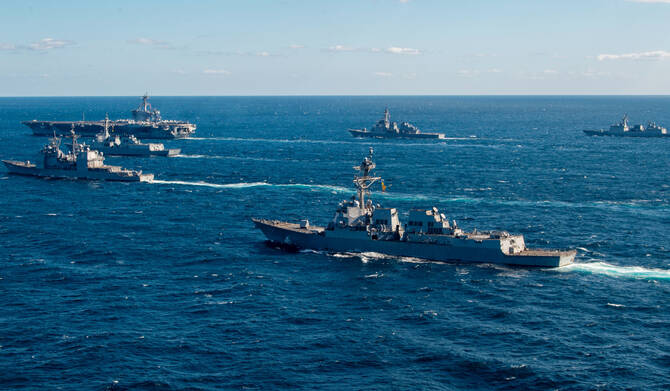

WASHINGTON: The United States is increasing the number of aircraft carriers deployed in the Middle East to two, keeping one that is already there and sending another from the Indo-Pacific, the Pentagon said Tuesday.
The announcement comes as US forces hammer Yemen’s Houthi militia with near-daily air strikes in a campaign aimed at ending the threat they pose to civilian shipping and military vessels in the region.
The Carl Vinson will join the Harry S. Truman in the Middle East “to continue promoting regional stability, deter aggression, and protect the free flow of commerce in the region,” Pentagon spokesman Sean Parnell said in a statement.
FASTFACT
The Carl Vinson will join the Harry S. Truman in the Middle East to continue promoting regional stability, deter aggression, and protect the free flow of commerce in the region.
“To complement the CENTCOM maritime posture, the secretary also ordered the deployment of additional squadrons and other air assets that will further reinforce our defensive air-support capabilities,” Parnell said, referring to the US military command responsible for the region.
“The United States and its partners remain committed to regional security in the CENTCOM (area of responsibility) and are prepared to respond to any state or non-state actor seeking to broaden or escalate conflict in the region,” he added.
The Houthis began targeting shipping in the Red Sea and Gulf of Aden after the start of the Gaza war in 2023, claiming solidarity with Palestinians.
Houthi attacks have prevented ships from passing through the Suez Canal, a vital route that normally carries about 12 percent of world shipping traffic. Ongoing attacks are forcing many companies into a costly detour around the tip of southern Africa.
A day before the carrier announcement, US President Donald Trump vowed that strikes on Yemen’s Houthis would continue until they are no longer a threat to shipping.
“The choice for the Houthis is clear: Stop shooting at US ships, and we will stop shooting at you. Otherwise, we have only just begun, and the real pain is yet to come, for both the Houthis and their sponsors in Iran,” Trump said on his Truth Social platform.
Trump added that the Houthis had been “decimated” by “relentless” strikes since March 15, saying that US forces “hit them every day and night — Harder and harder.”
He has also ramped up rhetoric toward Tehran, with the president threatening that “there will be bombing” if Iran does not reach a deal on its nuclear program.
Trump’s threats come as his administration battles a scandal over the accidental leak of a secret group chat by senior security officials on the Yemen strikes.
The Atlantic magazine revealed last week that its editor — a well-known US journalist — was inadvertently included in a chat on the commercially available Signal app where top officials were discussing the strikes.
The officials, including Trump’s National Security Adviser Mike Waltz and Defense Secretary Pete Hegseth, discussed details of air strike timings and intelligence — unaware that the highly sensitive information was being simultaneously read by a member of the media.