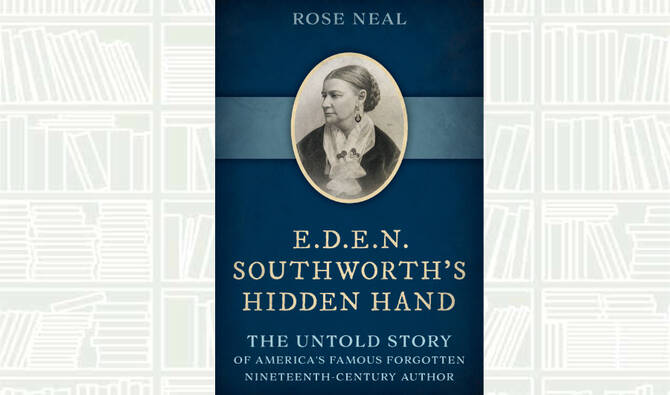
What We Are Reading Today: ‘E.D.E.N. Southworth’s Hidden Hand’

Photo/Supplied
Short Url
Updated 31 March 2025
Follow

What We Are Reading Today: ‘E.D.E.N. Southworth’s Hidden Hand’

  • Southworth’s fiction tackled issues that were often considered taboo, including domestic violence, poverty and capital punishment

In her upcoming book, “E.D.E.N. Southworth’s Hidden Hand: The Untold Story of America’s Famous Forgotten Nineteenth-Century Author,” Rose Neal, who has a Ph.D. in English, revives the legacy of a now-obscure novelist who was once a household name.

Born in 1819, Emma Dorothy Eliza Nevitte, Southworth — better known by her initials, E.D.E.N. — was one of the most prolific and widely read American writers of the 19th century.

Christened with a long name, Southworth once joked: “When I was born, my family was too poor to give anything else, so they gave me all those names.”

She would later shorten it to the distinctive E.D.E.N., under which she built her literary empire.

With more novels to her name than Nathaniel Hawthorne, Herman Melville, and Mark Twain combined, Southworth once captivated audiences with feisty heroines who rode horses, fired pistols, and even became sea captains.

Her most famous novel, “The Hidden Hand,” was so popular that readers named their daughters after its fearless protagonist, Capitola.

“Despite being one of the most beloved and well-known writers of the 19th century, as domestic sensational fiction declined in popularity, Southworth was entirely forgotten, as was an entire generation of women writers,” Neal writes. “For Southworth, it was partly because she had done so well at hiding her own progressive ideas. Nevertheless, she should be rediscovered and given her rightful place in American history.”

Southworth’s fiction tackled issues that were often considered taboo, including domestic violence, poverty and capital punishment.

Although she was raised in a slave-owning family, she wrote for The National Era, an abolitionist magazine, and encouraged her longtime friend Harriet Beecher Stowe to publish “Uncle Tom’s Cabin.”

She also supported the early women’s rights movement and advocated for better education and living conditions for those in poverty.

Neal’s journey to uncover Southworth’s story began unexpectedly as she pursued her master’s degree. She asked her colleagues whether they were familiar with this author she had unearthed. “They had never heard of Southworth or any of her novels,” she writes.

“How did a novelist as popular as Southworth slip into the dustbin of history?” she wonders.

With this biography, Neal pieces together Southworth’s story through her novels, letters and other documents, setting the record straight on a woman whose influence was far greater than history has acknowledged. Like her heroines, Southworth was bold, determined and ahead of her time.

The book comes out in May and is available for pre-order.


What We Are Reading Today: ‘Talking As Fast as I Can’

Photo/Supplied
Updated 16 January 2026
Follow

What We Are Reading Today: ‘Talking As Fast as I Can’

  • Graham writes the same way she talks; similar to her signature linguistic sing-song banter on the show; her witty and pun-filled rapid-fire dialogue, mostly written by the show’s creator, Amy Sherman-Palladino

Author: Lauren Graham

Did you recently rewatch “Gilmore Girls” now that the winter weather is upon us?

If you are the type who goes down the rabbit hole looking up the actors after binging a show, this book is for you. It is written by none other than the original but fictional Gilmore “girl,” Lorelai, played by actress Lauren Graham.

In her 2016 release, “Talking as Fast as I Can: From Gilmore Girls to Gilmore Girls (and Everything in Between),” Graham celebrates the show — and the character — she is best known for.

Graham writes the same way she talks; similar to her signature linguistic sing-song banter on the show; her witty and pun-filled rapid-fire dialogue, mostly written by the show’s creator, Amy Sherman-Palladino.

But this is Graham’s voice.

Like many others of said demographic, I decided to recently rewatch the show that aired between 2000 and 2007 and was revived in a four-part Netflix special a decade later. It stands the test of time. And it also does not. Both can be true.

Published just days after the 2016 Netflix special, “Gilmore Girls: A Year in the Life,” the overall story in this book is fascinating.

I particularly liked the insider insights on Graham’s journey, from being born in Hawaii (seemingly random) to living part of her childhood in Japan (super kawaii, or cute). It was clear her family was one of adventurers and her zigzagging around the globe as a youngster propelled her into a space in Hollywood and the immense fame that followed her.

She does mention some of her other acting and life roles she acquired, such as a real college student in New York and waitress-waiting-to-make-it, to being a star in another hit show, “Parenthood,” which ran from 2010-2015 (also now available on Netflix).

But, let us face it, she will forever be known as Lorelai. And she seems to be fine with that.

As a young viewer, I used to identify with the character Rory, played by her daughter on the series, Alexis Bledel, who went on to become an aspiring journalist in the show and in the series. As time passed, and the older and wiser I became, I identified more with Lorelai’s mother, Emily. I sort of skipped Lorelai as being my favorite Gilmore “girl” and that is perhaps by design.

Lorelai became a single mother at 16, deciding to run away from her affluent life and “overbearing parents” and into the warm embrace of a tiny town, the fictional Stars Hollow.

At the series start, Lorelai is a stubborn and resourceful 32-year-old with the perfect child, Rory, who is 16 — the same age she was when she birthed her. But somehow, through circumstance and happenstance, Lorelai is forced to flock back to parts of her old life, bringing Rory, and all of us with her.

In 2026, it is 26 years after the original show’s premiere and a decade after the special. Now that both are on Netflix MENA, viewers young and young-at-heart can easily access the Stars Hollow-sphere.

Viewers of this aforementioned demographic will instantly recognize the iconic and airy “la la la…” and while many may not know the composer of those incidental music and vocal interludes embedded throughout the episodes, Sam Phillips, one would certainly recognize the face and voice of Lorelai.

Now you can read all about her in book form.