

The science behind the powerful earthquake in Myanmar and Thailand

Short Url
Updated 30 March 2025
Follow

The science behind the powerful earthquake in Myanmar and Thailand

  • Myanmar lies on boundary between two tectonic plates, is one of world’s most seismically active countries
  • Friday’s event was “probably the biggest” to hit Myanmar’s mainland in three quarters of a century, experts said 

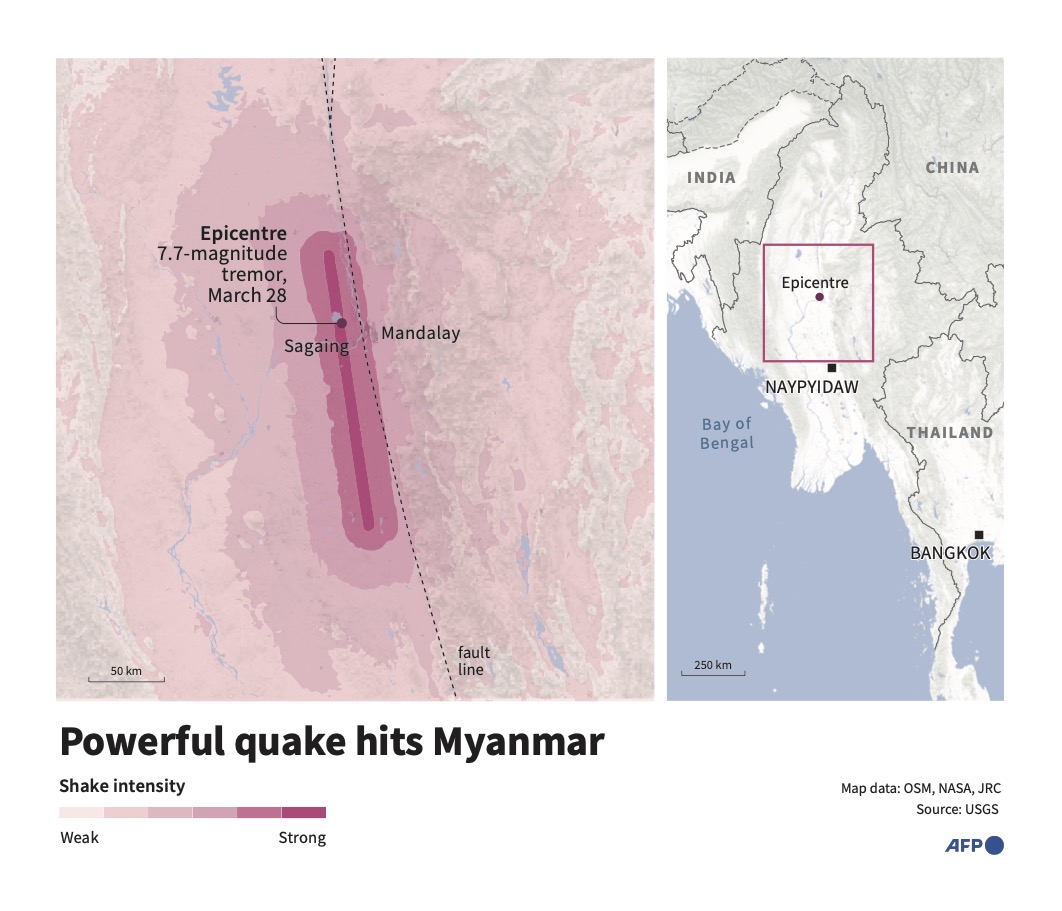
SINGAPORE: A powerful earthquake of magnitude 7.7 centered in the Sagaing region near the Myanmar city of Mandalay caused extensive damage in that country and also shook neighboring Thailand on Friday.

How vulnerable is Myanmar to earthquakes?

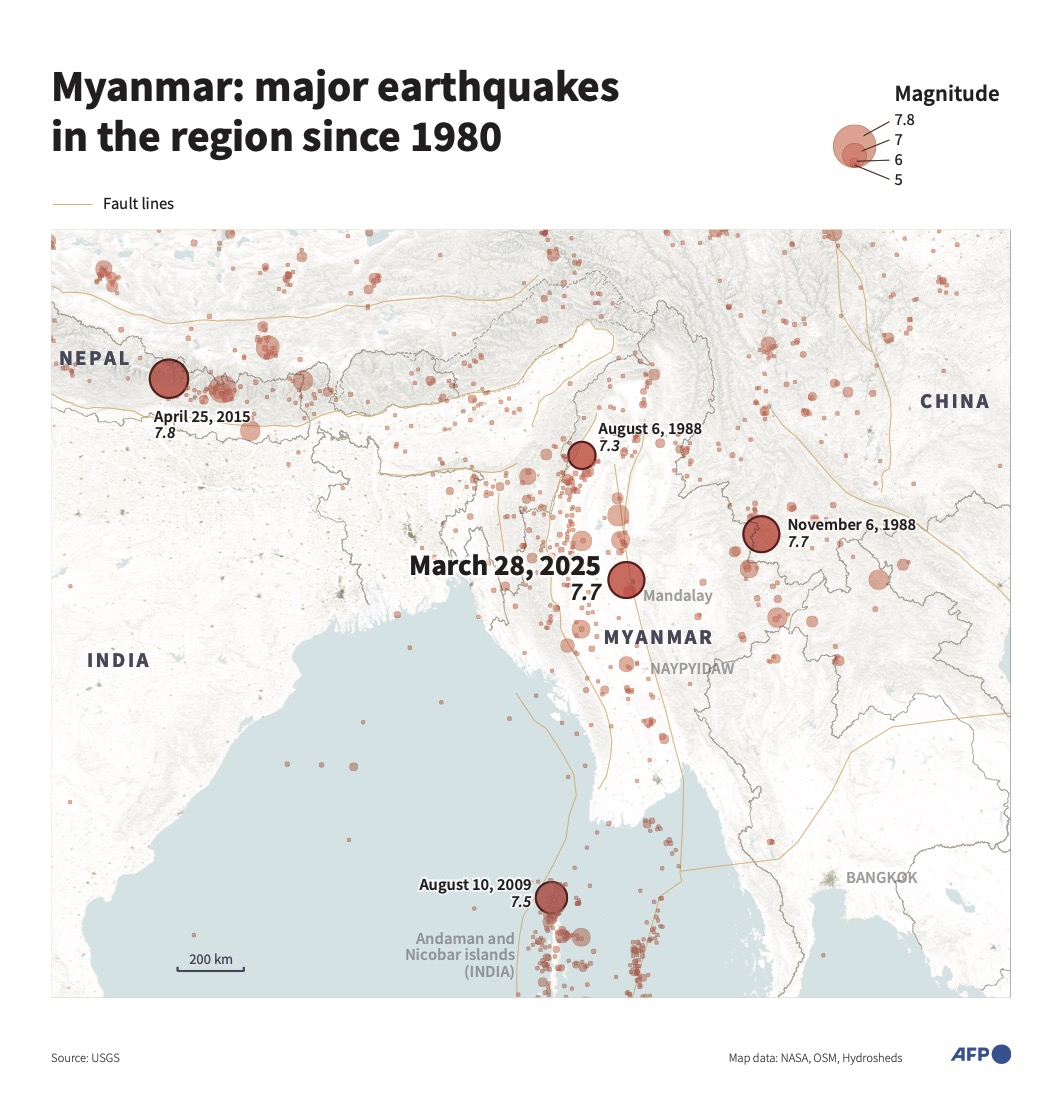
Myanmar lies on the boundary between two tectonic plates and is one of the world’s most seismically active countries, although large and destructive earthquakes have been relatively rare in the Sagaing region.

“The plate boundary between the India Plate and Eurasia Plate runs approximately north-south, cutting through the middle of the country,” said Joanna Faure Walker, a professor and earthquake expert at University College London.
She said the plates move past each other horizontally at different speeds. While this causes “strike slip” quakes that are normally less powerful than those seen in “subduction zones” like Sumatra, where one plate slides under another, they can still reach magnitudes of 7 to 8.
Why was Friday’s quake so damaging?
Sagaing has been hit by several quakes in recent years, with a 6.8 magnitude event causing at least 26 deaths and dozens of injuries in late 2012.
But Friday’s event was “probably the biggest” to hit Myanmar’s mainland in three quarters of a century, said Bill McGuire, another earthquake expert at UCL.
Roger Musson, honorary research fellow at the British Geological Survey, told Reuters that the shallow depth of the quake meant the damage would be more severe. The quake’s epicenter was at a depth of just 10 km (6.2 miles), according to the United States Geological Survey.
“This is very damaging because it has occurred at a shallow depth, so the shockwaves are not dissipated as they go from the focus of the earthquake up to the surface. The buildings received the full force of the shaking.”
“It’s important not to be focused on epicenters because the seismic waves don’t radiate out from the epicenter — they radiate out from the whole line of the fault,” he added.
How prepared was Myanmar?

The USGS Earthquake Hazards Program said on Friday that fatalities could be between 10,000 and 100,000 people, and the economic impact could be as high as 70 percent of Myanmar’s GDP.
Musson said such forecasts are based on data from past earthquakes and on Myanmar’s size, location and overall quake readiness.
The relative rarity of large seismic events in the Sagaing region — which is close to heavily populated Mandalay — means that infrastructure had not been built to withstand them. That means the damage could end up being far worse.
Musson said that the last major quake to hit the region was in 1956, and homes are unlikely to have been built to withstand seismic forces as powerful as those that hit on Friday.
“Most of the seismicity in Myanmar is further to the west whereas this is running down the center of the country,” he said.


Germany says UN rights rapporteur for Palestinian territories should quit

German Foreign Minister Johann Wadephul speaks with media prior to a meeting with Foreign Ministers of Central Asian countries.
Updated 12 February 2026
Follow

Germany says UN rights rapporteur for Palestinian territories should quit

  • Albanese has said that her comments are being falsely portrayed
  • “I have never, ever, ever said ‘Israel is the common enemy of humanity’,” Albanese said

BERLIN: German Foreign Minister Johann Wadephul on Thursday called for the resignation of the UN special rapporteur for the Palestinian territories, Francesca Albanese, over comments she made allegedly targeting Israel at a conference.
“I respect the UN system of independent rapporteurs. However, Ms Albanese has made numerous inappropriate remarks in the past. I condemn her recent statements about Israel. She is untenable in her position,” Wadephul wrote on X.
Albanese has said that her comments are being falsely portrayed. She denounced what she called “completely false accusations” and “manipulation” of her words in an interview with broadcaster France 24 on Wednesday.
Speaking via videoconference at a forum in Doha on Saturday organized by the Al Jazeera network, Albanese referred to a “common enemy of humanity” after criticizing “most of the world” and much of Western media for enabling the “genocide” in Gaza.
“And this is a challenge — the fact that instead of stopping Israel, most of the world has armed, given Israel political excuses, political sheltering, economic and financial support,” she said.
Albanese said that “international law has been stabbed in the heart” but added that there is an opportunity since “we now see that we as a humanity have a common enemy.”
Wadephul’s French counterpart Jean-Noel Barrot on Wednesday made the same call for Albanese to resign over the comments.
“France unreservedly condemns the outrageous and reprehensible remarks made by Ms Francesca Albanese, which are directed not at the Israeli government, whose policies may be criticized, but at Israel as a people and as a nation, which is absolutely unacceptable,” Barrot told French lawmakers.
Albanese posted video of her comments to X on Monday, writing in the post that “the common enemy of humanity is THE SYSTEM that has enabled the genocide in Palestine, including the financial capital that funds it, the algorithms that obscure it and the weapons that enable it.”
In her interview with France 24, which was recorded before Barrot’s statement, she contended that her comments were being misrepresented.
“I have never, ever, ever said ‘Israel is the common enemy of humanity’,” Albanese told the broadcaster.