

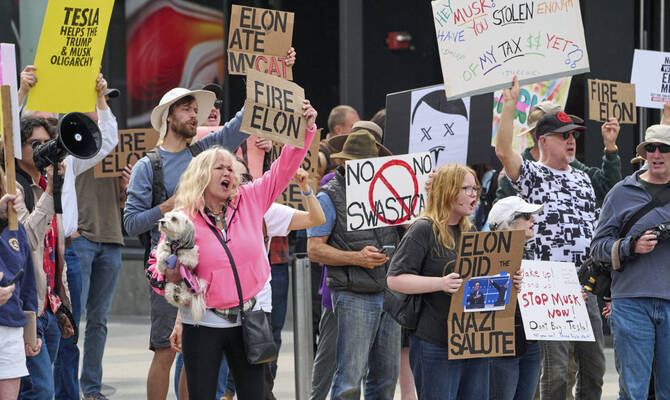

SAN FRANCISCO: Crowds protesting billionaire Elon Musk’s purge of the US government under President Donald Trump began amassing outside Tesla dealerships throughout the US and in some cities in Europe on Saturday in the latest attempt to dent the fortune of the world’s richest man.
The protesters are trying to escalate a movement targeting Tesla dealerships and vehicles in opposition to Musk’s role as the head of the newly created Department of of Government Efficiency, or DOGE, where he has gained access to sensitive data and shuttered entire agencies as he attempts to slash government spending. The biggest portion of Musk’s estimated $340 billion fortune consists of his stock in the electric vehicle company, which continues to run while also working alongside Trump.
After earlier demonstrations that were somewhat sporadic, Saturday marked the first attempt to surround all 277 of the automaker’s showrooms and service centers in the US in hopes of deepening a recent decline in the company’s sales.
By early afternoon crowds ranging from a few dozen to hundreds of protesters had flocked to Tesla locations in New Jersey, Massachusetts, Connecticut, New York, Maryland, Minnesota and the automaker’s home state of Texas. Pictures posted on social media showed protesters brandishing signs such as ” Honk if you hate Elon ” and ” Fight the billionaire broligarchy.”
As the day progressed, the protests cascaded around the country outside Tesla locations in major cities such as Washington, Chicago, Indianapolis, Cincinnati and Seattle, as well as towns in Virginia, Pennsylvania and Colorado. Smaller groups of counterprotesters also showed up at some sites.
“Hey, hey, ho, ho, Elon Musk has got to go!” several dozen people chanted outside a showroom in Dublin, California, about 35 miles (60 miles) east of San Francisco, while a smaller cluster of Trump supporters waved American flags across the street.
A much larger crowd circled another showroom in nearby Berkeley, chanting slogans to the beat of drums.
“We’re living in a fascist state,” said Dennis Fagaly, a retired high school teacher from neighboring Oakland, “and we need to stop this or we’ll lose our whole country and everything that is good about the United States.”
Anti-Musk sentiment extends beyond the US
The Tesla Takedown movement also hoped to rally protesters at more than 230 locations in other parts of the world. Although the turnouts in Europe were not as large, the anti-Musk sentiment was similar.
About two dozen people held signs lambasting the billionaire outside a dealership in London as passing cars and trucks tooted horns in support.
One sign displayed depicted Musk next to an image of Adolf Hitler making the Nazi salute — a gesture that Musk has been accused of reprising shortly after Trump’s Jan. 20 inauguration. A person in a Tyrannosaurus rex costume held another sign with a picture of Musk’s straight-arm gesture that said, “You thought the Nazis were extinct. Don’t buy a Swasticar.”
“We just want to get loud, make noise, make people aware of the problems that we’re facing,” said Cam Whitten, an American who showed up at the London protest.
Tesla Takedown was organized by a group of supporters that included disillusioned owners of the automaker’s vehicles, celebrities such as actor John Cusack, and at least one Democratic Party lawmaker, Rep. Jasmine Crockett from Dallas.
“I’m going to keep screaming in the halls of Congress. I just need you all to make sure you all keep screaming in the streets,” Crockett said during an organizing call this month.
Another Democratic lawmaker, Rep. Pramila Jaypal, showed up at a protest in Seattle, which she represents in Congress.
Musk backlash has included some vandalism
Some people have gone beyond protest, setting Tesla vehicles on fire or committing other acts of vandalism that US Attorney General Pam Bondi has decried as domestic terrorism. In a March 20 company meeting, Musk indicated that he was dumbfounded by the attacks and said the vandals should “stop acting psycho.”
Crockett and other Tesla Takedown supporters have been stressing the importance of Saturday’s protests remaining peaceful.
But police were investigating a fire that destroyed seven Teslas in northwestern Germany in the early morning. It was not immediately clear if the blaze, which was extinguished by firefighters, was related to the protests.
In Watertown, Massachusetts, local police reported that the side mirror of a black pickup struck two people at a protest outside a Tesla service center, according to the Boston Herald. The suspect was promptly identified by police at the scene, who said there were no serious injuries.
Musk maintains that the company’s future remains bright
A growing number of consumers who bought Tesla vehicles before Musk took over DOGE have been looking to sell or trade them in, while others have slapped on bumper stickers seeking to distance themselves from him.
But Musk did not appear concerned about an extended slump in new sales in the March meeting, during which he reassured the workers that the company’s Model Y would remain “the best-selling car on Earth again this year.” He also predicted that Tesla will have sold more than 10 million cars worldwide by next year, up from about 7 million currently.
“There are times when there are rocky moments, where there is stormy weather, but what I am here to tell you is that the future is incredibly bright and exciting,” Musk said.
After Trump was elected last November, investors initially saw Musk’s alliance with the president as a positive development for Tesla and its long-running efforts to launch a network of self-driving cars.
That optimism helped lift Tesla’s stock by 70 percent between the election and Trump’s Jan. 20 inauguration, creating an additional $560 billion in shareholder wealth. But virtually all those gains have evaporated amid investor worries about the backlash, lagging sales in the US, Europe and China, and Musk spending time overseeing DOGE.
“This continues to be a moment of truth for Musk to navigate this brand tornado crisis moment and get onto the other side of this dark chapter for Tesla,” Wedbush Securities analyst Dan Ives said in a recent research note.


