

Pakistan restores train services from Quetta after deadly hijacking

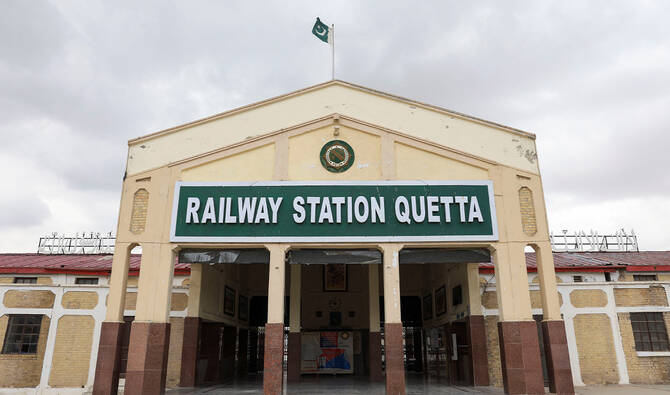
A view shows the railway station, after the train service is halted following the attack on a train by separatist militants in Bolan, in Quetta, Balochistan, Pakistan on March 14, 2025. (Reuters)
Short Url
Updated 28 March 2025
Follow

Pakistan restores train services from Quetta after deadly hijacking

  • 31 soldiers, staff and civilians killed as BLA separatists hijacked Jaffar Express train in Balochistan earlier this month
  • BLA is largest and strongest of several ethnic Baloch groups fighting for decades to win independence for Balochistan

QUETTA: Train operations from the Quetta Railway Station were restored on Friday, over two weeks after they were suspended following a deadly hijacking by militants in which 31 soldiers, staff and civilians were killed in the southwestern Balochistan province.

The separatist Baloch Liberation Army claimed responsibility for the Mar. 11 attack on the Quetta-Peshawar Jaffar Express, during which they blew up train tracks and held passengers hostage in a day-long standoff with security services in a remote mountain pass.

MP Jamal Shah Kakar and Divisional Superintendent Pakistan Railways Imran Hayat inaugurated the train service in a televised ceremony. The train departed with 400 passengers from Quetta for Peshawar in the northwestern Khyber Pakhtunkhwa province under strict security measures. 

The Jaffar Express had started services yesterday, Thursday.

“Although we don’t have enough strength of Railway Police Forces, many stations require fencing and other security equipment,” Railways Minister Hanif Abbasi told reporters earlier this week, admitting that railways facilities in the province faced security challenges. 

“We are recruiting 500 soldiers in the Pakistan Railway Police and 70 percent of the recruitment would be for Balochistan,” the minister added. “We have planned new security strategies with the frontier corps and other law enforcing agencies.” 

He also announced a special Eid train from Quetta Railway station with fool-proof security for passengers. 

“We are very much optimistic about better security to the railway’s passengers in Balochistan,” Abbasi said.

“We have repaired all damaged carriages of the attacked Jaffar Express, and new rack of carriages would be included in the train operations from Balochistan.” 

The BLA is the largest and strongest of several ethnic Baloch insurgent groups which have been fighting for decades to win independence for the mineral-rich province, home to major China-led projects including a port and gold and copper mines.


Pakistan’s OGDC ramps up unconventional gas plans

Updated 4 sec ago
Follow

Pakistan’s OGDC ramps up unconventional gas plans

  • Pakistan has long been viewed as having potential in tight and shale gas but commercial output has yet to be proved
  • OGDC says has tripled tight-gas study area to 4,500 square km after new seismic, reservoir analysis indicates potential

ISLAMABAD: Pakistan’s state-run Oil & Gas Development Company is planning a major expansion of unconventional gas developments from early next year, aiming to boost production and reduce reliance on imported liquefied natural gas.

Pakistan has long been viewed as having potential in both tight and shale gas, which are trapped in rock and can only be released with specialized drilling, but commercial output has yet to be proved.

Managing Director Ahmed Lak told Reuters that OGDC had tripled its tight-gas study area to 4,500 square kilometers (1,737 square miles) after new seismic and reservoir analysis indicated larger potential. Phase two of a technical evaluation will finish by end-January, followed by full development plans.

The renewed push comes after US President Donald Trump said Pakistan held “massive” oil reserves in July, a statement analysts said lacked credible geological evidence, but which prompted Islamabad to underscore that it is pursuing its own efforts to unlock unconventional resources.

“We started with 85 wells, but the footprint has expanded massively,” Lak said, adding that OGDC’s next five-year plan would look “drastically different.”

Early results point to a “significant” resource across parts of Sindh and Balochistan, where multiple reservoirs show tight-gas characteristics, he said.

SHALE PILOT RAMPS UP

OGDC is also fast-tracking its shale program, shifting from a single test well to a five- to six-well plan in 2026–27, with expected flows of 3–4 million standard cubic feet per day (mmcfd) per well.

If successful, the development could scale to hundreds or even more than 1,000 wells, Lak said.

He said shale alone could eventually add 600 mmcfd to 1 billion standard cubic feet per day of incremental supply, though partners would be needed if the pilot proves viable.

The company is open to partners “on a reciprocal basis,” potentially exchanging acreage abroad for participation in Pakistan, he said.

A 2015 US Energy Information Administration study estimated Pakistan had 9.1 billion barrels of technically recoverable shale oil, the largest such resource outside China and the United States.

A 2022 assessment found parts of the Indus Basin geologically comparable to North American shale plays, though analysts say commercial viability still hinges on better geomechanical data, expanded fracking capacity and water availability.

OGDC plans to begin drilling a deep-water offshore well in the Indus Basin, known as the Deepal prospect, in the fourth quarter of 2026, Lak said. In October, Turkiye’s TPAO with PPL and its consortium partners, including OGDC, were awarded a block for offshore exploration.

A combination of weak gas demand, rising solar uptake and a rigid LNG import schedule has created a surplus of gas that forced OGDC to curb output and pushed Pakistan to divert cargoes from Italy’s ENI and seek revised terms with Qatar.