

REVIEW: ‘The Residence’ — gloriously silly and wonderfully fun

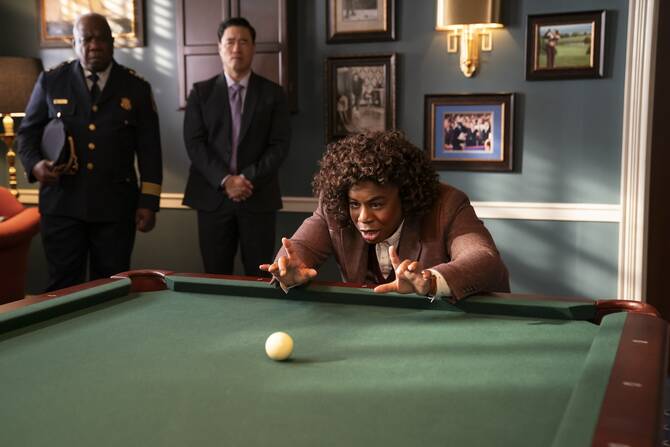
(L to R) Isiah Whitlock Jr, Randall Park and Uzo Aduba in 'The Residence.' (Supplied)
Short Url
Updated 28 March 2025
Follow

REVIEW: ‘The Residence’ — gloriously silly and wonderfully fun

  • Netflix’s latest Shondaland series is a brilliant whodunnit for the streaming generation

LONDON: There’s a common thread running through most of the year’s best TV so far — one that looks sure to continue through the upcoming shows expected to dominate the next awards season: they have tended to be high-brow, high-production affairs shows with Very Serious subject matter and Very Serious performances.

And they’ve been Very Good to watch, it’s true. But sometimes you need something that’s just a bit more… fun.

Step forward “The Residence,” the latest show in Netflix’s megadeal with Shonda Rhimes’ production company. This eight-part whodunnit is set in a fictionalized version of the White House and is a typically screwball murder mystery with an array of eccentric characters and a charismatic lead detective. But, more importantly, “The Residence” is wonderfully, absurdly, stupendously fun. In an era of serious TV, it’s a glorious palette cleanser, a rollicking, twist-riddled romp through the most famous house in history.

During a state dinner for the visiting Australian prime minister, the US president receives the shocking news that a murder has been committed on the grounds. With hundreds of guests (including the odd cameo from real-world figures) and staff in attendance, the whole house is locked down so that legendary detective Cordelia Cupp can swoop in and solve the crime.

The masterstroke here is casting Uzo Aduba (“Orange is the New Black”) as Cupp — a character as brilliantly deductive as she is hilariously deadpan. The writing is snappy and concise, sure, but it’s Aduba who brings it to life across a show that could have been, at eight episodes, a couple hours too long to sustain a sole mystery.

Thankfully, with comic chops as accomplished as these — and a supporting cast that includes excellent turns from Giancarlo Esposito, Jason Lee and others — there’s little sense of lag, even as audiences are treated to the umpteenth plot twist. And yes, all of the most obvious mystery tropes are shamelessly mined, and Cupp’s abrasively, frustratingly brilliantly detective feels like an homage to many of those who have come before (even Benoit Blanc gets a namecheck), but when a show is this much fun, you won’t care. Bingeworthy escapism at its finest.


Cairo book fair breaks visitor records

Updated 03 February 2026
Follow

Cairo book fair breaks visitor records

  • Strong Saudi participation underscores KSA’s prominent role in Arab cultural landscape
  • Egyptian writer Naguib Mahfouz, who was awarded the Nobel Prize in Literature in 1988, was selected as the fair’s featured personality

CAIRO: The 57th edition of the Cairo International Book Fair has attracted record public attendance, with the number of visits reaching nearly 6 million, up from a reported 5.5 million previously.

Egypt’s Minister of Culture Ahmed Fouad Hanou said: “This strong turnout reflects the public’s eagerness across all age groups to engage with the exhibition’s diverse cultural and intellectual offerings.”

Hanou said the event included “literary and intellectual activities, meetings with thinkers and creative figures, and thousands of titles spanning various fields of knowledge.”

The Egyptian writer Naguib Mahfouz, who was awarded the Nobel Prize in Literature in 1988, was selected as the fair’s featured personality, coinciding with the 20th anniversary of his death.

The exhibition’s official poster features a famous quote by Mahfouz: “Who stops reading for an hour falls centuries behind.”

A total of 1,457 publishing houses from 83 countries participated in the fair. Mahfouz’s novels occupied a special place, as Egypt’s Diwan Library showcased the author’s complete works, about 54 books.

“The pavilion of the Egyptian National Library and Archives witnessed exceptionally high attendance throughout the fair, showcasing a collection of rare and significant books.

Among the highlights was the book “Mosques of Egypt” in Arabic and English, Dr. Sherif Saleh, head of financial and administrative affairs at the Egyptian National Library and Archives, told Arab News.

The fair ended on Tuesday with a closing ceremony that featured a cultural performance titled “Here is Cairo.”

The event included the announcement of the winners of the fair’s awards, as well as the recipient of the Naguib Mahfouz Award for Arabic Fiction.

Organizers described this year’s edition as having a celebratory and cultural character, bringing together literature, art, and cinema.

Romania was the guest of honor this year, coinciding with the 120th anniversary of Egyptian-Romanian relations.

At the Saudi pavilion, visitors were welcomed with traditional coffee. It showcased diverse aspects of Saudi culture, offering a rich experience of the Kingdom’s heritage and creativity.

There was significant participation from Saudi Arabia at the event, highlighting the Kingdom’s prominent role in the Arab cultural arena.

Saudi Arabia’s participation aimed to showcase its literary and intellectual output, in alignment with the objectives of Vision 2030.

The Kingdom’s delegation was led by Saudi Arabia’s Ambassador to Egypt Saleh bin Eid Al-Hussaini. Also in attendance were Dr. Abdul Latif Abdulaziz Al-Wasel, CEO of the Literature, Publishing and Translation Commission, and Dr. Hilah Al-Khalaf, the commission’s director-general.

The King Abdulaziz Public Library placed the Encyclopedia of Saudi Arabia in a prominent position at the pavilion. The encyclopedia, consisting of 20 volumes, is organized according to the Kingdom’s culturally diverse regions.

Founded in 1980 by King Abdullah, the library was established to facilitate access to knowledge and preserve heritage collections. Over the years, it has grown into one of the Kingdom’s most important cultural institutions.

Internationally, the library has strengthened ties between Saudi Arabia and China, including the opening of a branch at Peking University and receiving the Crown Prince Mohammed bin Salman Award for Cultural Cooperation between the two nations.

Regionally, the library has played a pivotal role in the Arab world through the creation of the Unified Arabic Cataloging Project, one of the most important initiatives contributing to knowledge accessibility and alignment with global standards.