


Court frees Pakistani journalist charged under controversial cybercrime law

1 / 2
The photo taken on March 28, 2025, shows Pakistani journalist Waheed Murad speaking on a mobile phone after a local court approved his bail, in Islamabad, Pakistan. (Photo Courtesy: Farhan Khan)
2 / 2
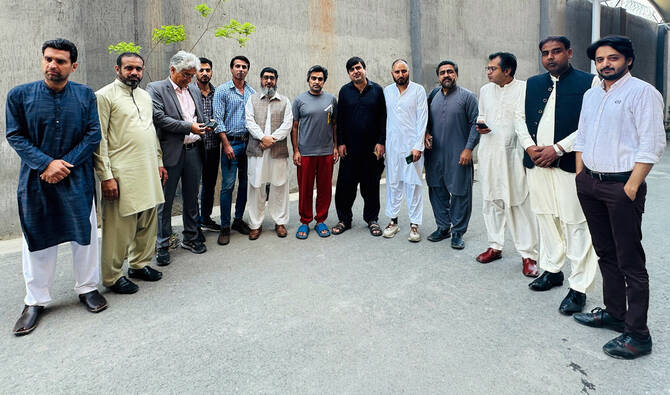
Pakistani journalist Waheed Murad (center) poses for a picture along with a group of journalists after a local court approved his bail, in Islamabad, Pakistan on March 28, 2025. (Photo Courtesy: Farhan Khan)
Short Url
Updated 28 March 2025
Follow

Court frees Pakistani journalist charged under controversial cybercrime law

  • Waheed Murad, who works for Urdu News, was taken from home by masked men Wednesday morning, his family said
  • Criminalization of online disinformation has spread fear in Pakistan, with journalists among those worried about new law

KARACHI: A judicial magistrate had approved bail and freed Pakistani journalist Waheed Murad, charged earlier this week under a controversial cybercrime law, his lawyer said on Friday.

Murad, who works with the international digital media outlet Urdu News, was taken from his home by masked men early Wednesday morning, according to his family, provoking an outcry from the local media community and international journalists’ rights bodies. 

A new cybercrime law, PECA, under which Murad has been charged, carries a prison term of up to three years and unleashed journalist protests when it was approved in January.

“Judicial Magistrate has approved the bail of journalist Waheed Murad and ordered his release,” Murad’s lawyer Imaan Zainab Mazari-Hazir told Arab News.
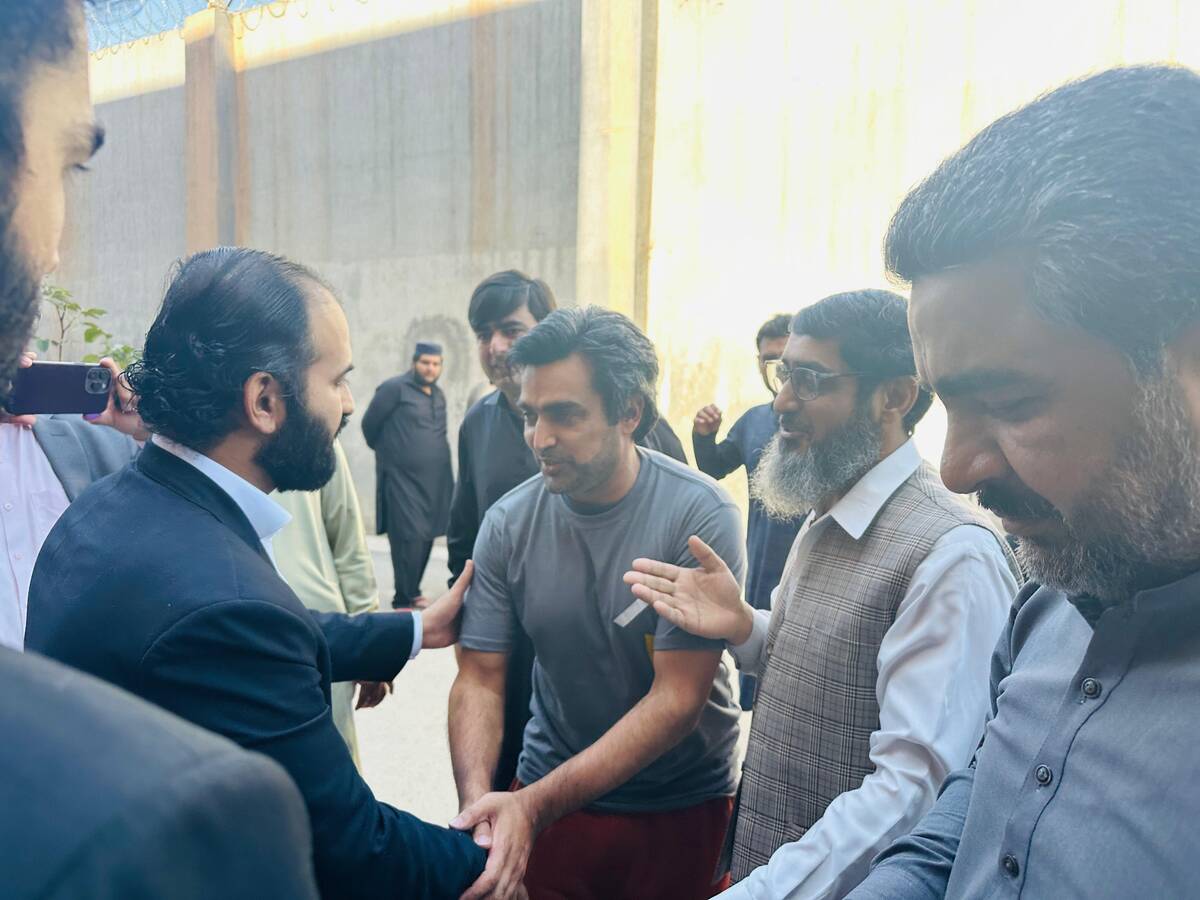


Pakistani journalist Waheed Murad greets his lawyer outside court in Islamabad, Pakistan, on March 28, 2025. (AN Photo)

The journalist was subsequently freed, with pictures widely shared on social media showing him leaving the lock-up.

The charge sheet against Murad by the Federal Investigation Agency (FIA) accuses him of sharing “misleading” information on social media, causing “hatred” against government functionaries.

“Accused Muhammad Waheed s/o Bara Khan is found sharing highly intimidating content/post on social media/Facebook and X Corp. on Wednesday, 12-03-2025 at 07:33 p.m. and 10:21 pm, in which the alleged profile has knowingly disseminated/propagated, fake, false, misleading and misinterpreted information leading to hatred against the government functionaries by stating therein that,” a copy of the complaint seen by Arab News said. 

The complaint said a case against the journalist has been registered under the Prevention of Electronic Crimes Act (PECA).

Murad’s arrest came just days after the disappearance of the brothers of exiled journalist Ahmad Noorani following the publishing of a controversial report about Pakistani army chief General Asim Munir on Noorani’s website.

On March 20, the Federal Investigation Agency also arrested Karachi-based journalist Farhan Mallick, founder of the digital media platform Raftar, on allegations of airing “anti-state” content on his YouTube channel.

International rights organizations, including the Committee to Protect Journalists, have expressed increasing concern over the deteriorating climate for press freedom. Rights defenders say the pattern reflects a shrinking space for democratic discourse in Pakistan, where journalists critical of state policies or security agencies are frequently subjected to intimidation tactics.

The criminalization of online disinformation has in particular spread fear in Pakistan, with journalists among those worried about the potentially wide reach of laws like PECA.

Pakistan is ranked 152 out of 180 countries in a press freedom index compiled by Reporters Without Borders.

Islamabad has long been criticized by watchdogs for restricting Internet access, including temporary bans on YouTube and TikTok, while X has been officially blocked since February last year. 


Pakistan, China to sign multiple MoUs at major agriculture investment conference today

Updated 18 January 2026
Follow

Pakistan, China to sign multiple MoUs at major agriculture investment conference today

  • Hundreds of Chinese and Pakistani firms to attend Islamabad event
  • Conference seen as part of expanding CPEC ties into agriculture, trade

KARACHI: Islamabad and Beijing are set to sign multiple memorandums of understanding (MoUs) to boost agricultural investment and cooperation at a major conference taking place in the capital today, Monday, with hundreds of Chinese and Pakistani companies expected to participate.

The conference is being billed by Pakistan’s Ministry of National Food Security and Research as a platform for deepening bilateral agricultural ties and supporting broader economic engagement between the two countries.

“Multiple memorandums of understanding will be signed at the Pakistan–China Agricultural Conference,” the Ministry of National Food Security said in a statement. “115 Chinese and 165 Pakistani companies will participate.”

The conference reflects a growing emphasis on expanding Pakistan-China economic cooperation beyond the transport and energy foundations of the flagship China-Pakistan Economic Corridor (CPEC) into agriculture, industry and technology.

Under its first phase launched in 2015, CPEC, a core component of China’s Belt and Road Initiative, focused primarily on transportation infrastructure, energy generation and connectivity projects linking western China to the Arabian Sea via Pakistan. That phase included motorways, power plants and the development of the Gwadar Port in the country's southwest, aimed at helping Pakistan address chronic power shortages and enhance transport connectivity.

In recent years, both governments have formally moved toward a “CPEC 2.0” phase aimed at diversifying the corridor’s impact into areas such as special economic zones, innovation, digital cooperation and agriculture. Second-phase discussions have highlighted Pakistan’s goal of modernizing its agricultural sector, attracting Chinese technology and investment, and boosting export potential, with high-level talks taking place between planning officials and investors in Beijing.

Agri-sector cooperation has also seen practical collaboration, with joint initiatives examining technology transfer, export protocols and value-chain development, including partnerships in livestock, mechanization and horticulture.

Organizers say the Islamabad conference will bring together government policymakers, private sector investors, industry associations and multinational agribusiness firms from both nations. Discussions will center on investment opportunities, technology adoption, export expansion and building linkages with global buyers within the framework of Pakistan-China economic cooperation.