

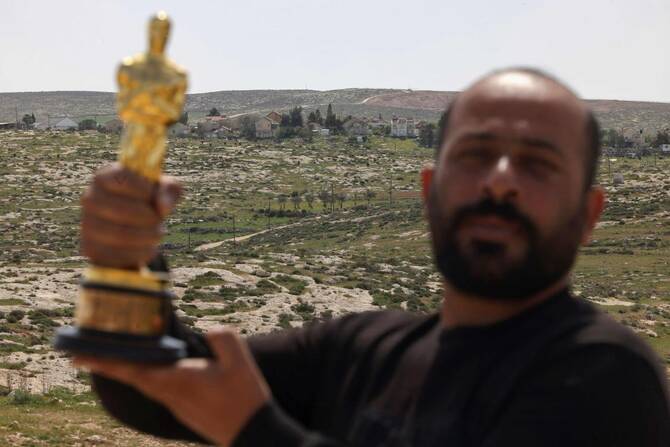

SUSYA, Palestinian Territories: Oscar-winning Palestinian filmmaker Hamdan Ballal said Wednesday that he was attacked by Israeli settlers for winning the prestigious award, calling the “brutality” life-threatening.
Israeli police released Ballal on Tuesday after detaining him the day before for allegedly “hurling rocks” following what activists described as an attack by settlers in the Israeli-occupied West Bank.
Ballal co-directed “No Other Land,” which won Best Documentary at this year’s Academy Awards.
The film chronicles the forced displacement of Palestinians by Israeli troops and settlers in Masafer Yatta — an area Israel declared a restricted military zone in the 1980s.
Ballal said he had been attacked by settlers while soldiers pointed their weapons at him.
“I felt that these were the last moments of my life, that I would lose it due to the severity of the beating,” he told AFP in a video interview.
“My head was trapped between the settler’s foot, the door and the wall, as if it were a football.”
The “brutality” of the attack, he said, “made me feel it was because I won the Oscar.”
During his detention at an Israeli military center, Ballal noticed soldiers mentioning his name alongside the word “Oscar” during shift changes.
“While I couldn’t understand everything they said, I clearly recognized my name and the word ‘Oscar’, as those words don’t change in Hebrew,” he said.
According to the Israeli military, three Palestinians were apprehended on Monday for “hurling rocks” during a confrontation between Israelis and Palestinians in the southern West Bank village of Susya.
The village is located near Masafer Yatta, a grouping of hamlets south of Hebron city where “No Other Land” is set.
Yuval Abraham, who co-directed the documentary, criticized the US Academy for its silence over the issue.
“Sadly, the US Academy, which awarded us an Oscar three weeks ago, declined to publicly support Hamdan Ballal while he was beaten and tortured by Israeli soldiers and settlers,” Abraham said on X.
“While Hamdan was clearly targeted for making No Other Land... he was also targeted for being Palestinian — like countless others every day who are disregarded.”
“This, it seems, gave the Academy an excuse to remain silent when a filmmaker they honored, living under Israeli occupation, needed them the most,” Abraham added.
Israel’s military said in a statement that “claims that the detainees were beaten during the night at an IDF detention facility were found to be entirely baseless.”
“IDF (military) forces facilitated medical treatment for the detainees... and throughout the night, the detainees remained in a military detention facility while handcuffed in accordance with operational protocol,” it said, adding they were released on bail after questioning.
Activists from the anti-occupation group Center for Jewish Nonviolence said they witnessed the violence in Susya.
Foreign activists regularly stay in Masafer Yatta’s communities to accompany Palestinians as they tend to their crops or shepherd their sheep, and document instances of settler violence.
Rights groups have said that since the start of the Israel-Hamas war in Gaza — a separate Palestinian territory — there has been a spike in attacks by Israeli settlers in the West Bank.
Occupied by Israel since 1967, the West Bank is home to around three million Palestinians, as well as nearly half a million Israelis who live in settlements that are illegal under international law.


