


BEIRUT: Lebanese Prime Minister Nawaf Salam emphasized the need to control “the border with Syria … combating smuggling through a new security plan that must be swiftly implemented.”
Salam’s statement from the northern city of Tripoli comes on the eve of the first official visit by a minister from his government to Syria to meet officials there. On Wednesday, the minister of defense is scheduled to visit Damascus to discuss “ways to control the border and prevent violations and transgressions,” Salam said.
Defense Minister Michel Menassa will be accompanied by General Security Director-General Maj. Gen. Hassan Choucair, and the director of Lebanese Army Intelligence, Brig. Gen. Tony Kahwaji. The discussions are expected to focus on enhancing security cooperation between Beirut and Damascus, with the delegation carrying security files related to “combating smuggling, controlling illegal crossings, and reducing border tensions.”
FASTFACTS
• Salam inspected President Rene Mouawad Airport in Qlayaat, which is not used for civilian flights.
• He announced the conclusion of an agreement with Dar Al-Handasah to conduct a free study for operating Qlayaat Airport.
• Within three months, an initial proposal for a guiding plan to initiate operations at this facility will be presented.
Earlier this month, Lebanese President Joseph Aoun and his Syrian counterpart Ahmed Al-Sharaa agreed, on the sidelines of a meeting in Cairo, to organize border management between the two countries. However, clashes erupted in the border town of Hawsh Al-Sayyid Ali over a dispute between smugglers using illegal crossings. The situation escalated into violent confrontations between armed Lebanese tribesmen and Syrian forces, which were eventually contained through communications and an agreement reached between the Lebanese and Syrian defense ministers.
During his first visit to Tripoli since the formation of his government, Salam, accompanied by several ministers, held meetings with local officials in Tripoli and Akkar. They discussed the conditions and needs of the regions, as well as the security situation in Tripoli, particularly in light of the recent security disturbances and the influx of Syrian refugees from the coastal area of Syria.
Salam emphasized that “the government is committed to ensuring security, especially following the challenging period that Tripoli experienced due to the recent security instability, and to protecting the lives of citizens and ensuring their stability.”
During a meeting with the city’s security officials, Salam said that “there will be no protection for anyone undermining security” and called for “strict measures to combat violations, drug trafficking, and its promotion.”
He also urged the development of “a national plan to confiscate weapons from civilians and to address encroachments on both public and private properties.” He firmly rejected any pressure “to release those who disrupt security.”
Interior Minister Ahmad Al-Hajjar, who accompanied Salam, said that “the security agencies possess comprehensive information regarding the crimes occurring in Tripoli.” He urged these agencies to adopt “a strict stance against those disrupting public order and to resist any political protection that may be extended to these offenders.”
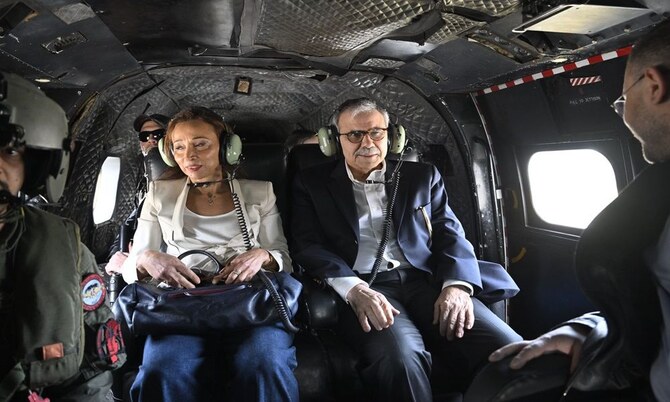
Salam inspected President Rene Mouawad Airport in the northern town of Qlayaat, which is not used for civilian flights. He announced “the conclusion of an agreement with Dar Al-Handasah to conduct a free study for operating Qlayaat Airport. Within three months, an initial proposal for a guiding plan to initiate operations at this facility will be presented.”
Minister of Public Works and Transport Fayez Rasamani explained that “we can benefit from the strategic geographical location of Qlayaat Airport to attract more investors. We can also think of transforming it into a cargo service airport, leveraging its proximity to the Port of Tripoli, in addition to creating a free zone and an aircraft maintenance facility at the airport.”
In southern Lebanon, the Israeli army confirmed on Tuesday morning that it had killed “the commander of Hezbollah’s southern front anti-tank missile unit.”
On Monday night, an Israeli drone struck a car in Qaaqaaiyet El-Jisr, killing Hassan Kamal Halawi. The party did not disclose Halawi’s military rank.
The Israeli army claimed that Halawi “was responsible for numerous terrorist attacks against the State of Israel. He facilitated the movement of operatives and weapons into southern Lebanon.”
In recent days, Israel assassinated two other Hezbollah members, Hassan Al-Zein and Radwan Awada.
Since Saturday, the Israeli army has conducted dozens of raids on southern Lebanon and the Bekaa, resulting in seven deaths and 40 injuries, according to the Lebanese Ministry of Health. These raids followed the launch of six rockets of unknown origin from southern Lebanon toward the Israeli town of Metula. Hezbollah denied any involvement in the rocket attack.


