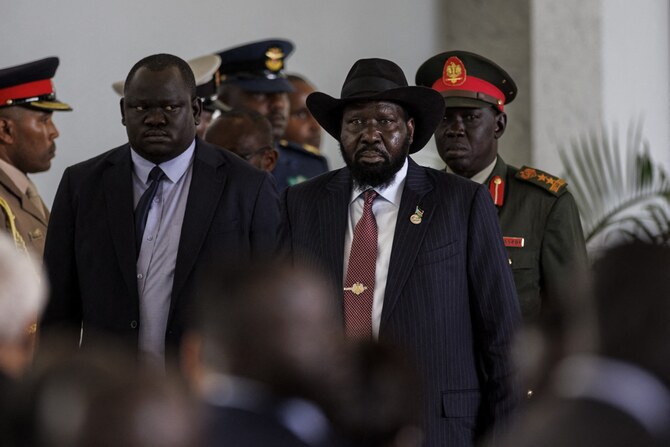
UNITED NATIONS: South Sudan is teetering on the edge of renewed civil war, the top UN official in the world’s youngest nation warned on Monday, lamenting the government’s sudden postponement of the latest peace effort.
Calling the situation unfolding in the country “dire,” Nicholas Haysom said international efforts to broker a peaceful solution can only succeed if President Salva Kiir and his rival-turned-vice president, Riek Machar, are willing to engage “and put the interests of their people ahead of their own.”
There were high hopes when oil-rich South Sudan gained independence from Sudan in 2011 after a long conflict. But the country slid into a civil war in December 2013 largely based on ethnic divisions when forces loyal to Kiir, an ethnic Dinka, battled those loyal to Machar, an ethnic Nuer.
More than 400,000 people were killed in the war, which ended with a 2018 peace agreement that brought Kiir and Machar together in a government of national unity. Under the agreement, elections were supposed to be held in February 2023, but they were postponed until December 2024 — and again until 2026.
The latest tensions stem from fighting in the country’s north between government troops and a rebel militia, known as the White Army, which is widely believed to be allied with Machar.
Earlier this month, a South Sudanese general was among several people killed when a United Nations helicopter on a mission to evacuate government troops from the town of Nasir, the scene of the fighting in Upper Nile state, came under fire. Days earlier on March 4, the White Army overran the military garrison in Nasir and government troops responded by surrounding Machar’s home in the capital, Juba, and arresting several of his key allies.
Haysom said tensions and violence were escalating “particularly as we grow closer to elections and as political competition increases, sharpens between the principal players.”
He said Kiir and Machar don’t trust each other enough to display the leadership needed to implement the 2018 peace deal and move to a future that would see a stable and democratic South Sudan.
“Rampant misinformation, disinformation and hate speech is also ratcheting up tensions and driving ethnic divisions, and fear,” Haysom said.
“Given this grim situation,” he said, “we are left with no other conclusion but to assess that South Sudan is teetering on the edge of a relapse into civil war.”
Haysom, who heads the nearly 18,000-member UN peacekeeping mission in South Sudan, warned that a relapse into open war would lead to the same horrors that ravaged the country, especially in 2013 and 2016.
He said the UN takes the threat of the “ethnic transformation” of the conflict very seriously.
To try to prevent a new civil war, the UN special envoy said the peacekeeping mission is engaging in intense shuttle diplomacy with international and regional partners, including the African Union.
Haysom said the collective message of the regional and international community is for Kiir and Machar to meet to resolve their differences, return to the 2018 peace deal, adhere to the ceasefire, release detained officials and resolve tensions “through dialogue rather than military confrontation.”

South Sudan is teetering on the edge of renewed civil war, UN envoy says
Short Url
https://arab.news/bt4xz
South Sudan is teetering on the edge of renewed civil war, UN envoy says
- The country slid into a civil war in December 2013 largely based on ethnic divisions
- More than 400,000 people were killed in the war, which ended with a 2018 peace agreement
- The latest tensions stem from fighting in the country’s north between government troops and a rebel militia, known as the White Army
Syria Kurds impose curfew in Qamishli ahead of govt forces entry
QAMISHLI: Kurdish forces imposed a curfew on Kurdish-majority Qamishli in northeastern Syria on Tuesday, ahead of the deployment of government troops to the city, an AFP team reported.
The curfew came after Syrian security personnel entered the mixed Kurdish-Arab city of Hasakah and the countryside around the Kurdish town of Kobani on Monday, as part of a comprehensive agreement to gradually integrate the Kurds’ military and civilian institutions into the state.
The Kurds had ceded territory to advancing government forces in recent weeks.
An AFP correspondent saw Kurdish security forces deployed in Qamishli and found the streets empty of civilians and shops closed after the curfew came into effect early on Tuesday.
It will remain in force until 6:00 am (0300 GMT) on Wednesday.
The government convoy is expected to enter the city later on Tuesday and will include a limited number of forces and vehicles, according to Marwan Al-Ali, the Damascus-appointed head of internal security in Hasakah province.
The integration of Kurdish security forces into the interior ministry’s ranks will follow, he added.
Friday’s deal “seeks to unify Syrian territory,” including Kurdish areas, while also maintaining an ongoing ceasefire and introducing the “gradual integration” of Kurdish forces and administrative institutions, according to the text of the agreement.
It was a blow to the Kurds, who had sought to preserve the de facto autonomy they exercised after seizing vast areas of north and northeast Syria in battles against Daesh during the civil war, backed by a US-led coalition.
Mazloum Abdi, head of the Kurdish-led Syrian Democratic Forces (SDF), had previously said the deal would be implemented on the ground from Monday, with both sides to pull forces back from frontline positions in parts of the northeast, and from Kobani in the north.
He added that a “limited internal security force” would enter parts of Hasakah and Qamishli, but that “no military forces will enter any Kurdish city or town.”
The curfew came after Syrian security personnel entered the mixed Kurdish-Arab city of Hasakah and the countryside around the Kurdish town of Kobani on Monday, as part of a comprehensive agreement to gradually integrate the Kurds’ military and civilian institutions into the state.
The Kurds had ceded territory to advancing government forces in recent weeks.
An AFP correspondent saw Kurdish security forces deployed in Qamishli and found the streets empty of civilians and shops closed after the curfew came into effect early on Tuesday.
It will remain in force until 6:00 am (0300 GMT) on Wednesday.
The government convoy is expected to enter the city later on Tuesday and will include a limited number of forces and vehicles, according to Marwan Al-Ali, the Damascus-appointed head of internal security in Hasakah province.
The integration of Kurdish security forces into the interior ministry’s ranks will follow, he added.
Friday’s deal “seeks to unify Syrian territory,” including Kurdish areas, while also maintaining an ongoing ceasefire and introducing the “gradual integration” of Kurdish forces and administrative institutions, according to the text of the agreement.
It was a blow to the Kurds, who had sought to preserve the de facto autonomy they exercised after seizing vast areas of north and northeast Syria in battles against Daesh during the civil war, backed by a US-led coalition.
Mazloum Abdi, head of the Kurdish-led Syrian Democratic Forces (SDF), had previously said the deal would be implemented on the ground from Monday, with both sides to pull forces back from frontline positions in parts of the northeast, and from Kobani in the north.
He added that a “limited internal security force” would enter parts of Hasakah and Qamishli, but that “no military forces will enter any Kurdish city or town.”
© 2026 SAUDI RESEARCH & PUBLISHING COMPANY, All Rights Reserved And subject to Terms of Use Agreement.


