

South Sudan party partially withdraws from peace process

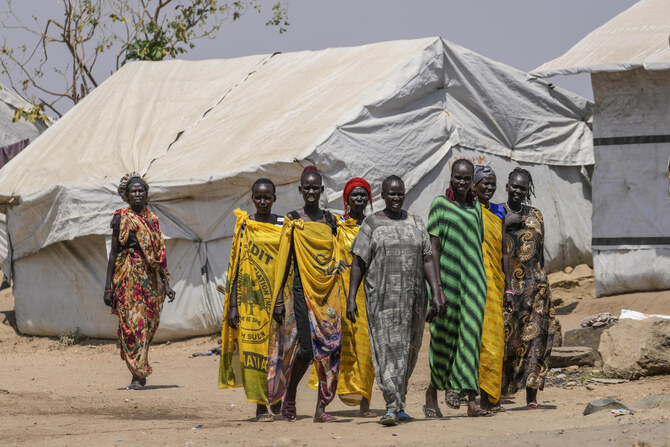
Women walk in the Juba displacement camp, South Sudan, Feb. 12, 2025. (AP)
Short Url
Updated 18 March 2025
Follow

South Sudan party partially withdraws from peace process

  • “The ongoing political witch-hunts continue to threaten the very essence and the existence of the (peace deal),” Pierino said
  • The fighting around Nasir in Upper Nile state has displaced 50,000 people since late February, according to the UN Humanitarian Coordinator

NAIROBI: A major party in South Sudan’s coalition government said on Tuesday it had suspended its role in a key element of a 2018 peace deal as relations between its leader Riek Machar and President Salva Kiir deteriorate amid clashes and arrests.
The agreement ended a five-year war between forces loyal to Kiir and his rival Machar, who now serves as First Vice President leading the SPLM-IO party. But the two men have a fractious relationship, which has worsened in recent weeks following clashes in the country’s east.
Earlier this month security forces rounded up several SPLM-IO officials, including the petroleum minister and the deputy head of the army, after the White Army ethnic militia forced troops to withdraw from the town of Nasir near the Ethiopian border.
The government has accused the SPLM-IO of links with the White Army, which mostly comprises armed ethnic Nuer youths who fought alongside Machar’s forces in the 2013-2018 war against predominantly ethnic Dinka troops loyal to Kiir. The party denies the allegations.
Oyet Nathaniel Pierino, deputy chairman of the SPLM-IO, said on Tuesday the party would not participate in security arrangements tied to the peace process until the detained officials were released.
“The ongoing political witch-hunts continue to threaten the very essence and the existence of the (peace deal),” Pierino said in a statement.
The fighting around Nasir in Upper Nile state has displaced 50,000 people since late February, of which 10,000 have fled to Ethiopia, according to Anita Kiki Gbeho, the United Nations Humanitarian Coordinator in South Sudan.

RAMPANT HATE SPEECH
South Sudan’s United Nations peacekeeping chief Nicholas Haysom said he was concerned the country was “on the brink of relapse into civil war.”
“With the proliferation of mis/disinformation in the public domain, hate speech is now rampant, raising concerns that the conflict could assume an ethnic dimension,” he said in a speech to the African Union.
Analysts say the war in neighboring Sudan has also spurred the breakdown of the peace process, with South Sudan’s oil revenues suspended, escalating regional tensions and arms flooding across the border.
“Already we are seeing the initial stages of spillover fighting in Upper Nile from the Sudan war. It will be difficult to prevent those tensions from spreading to (the capital) Juba,” said Alan Boswell from the International Crisis Group.


Algeria inaugurates strategic railway to giant Sahara mine

President Tebboune attended an inauguration ceremony in Bechar. (AFP file photo)
Updated 02 February 2026
Follow

Algeria inaugurates strategic railway to giant Sahara mine

  • The mine is expected to produce 4 million tons per year during the initial phase, with production projected to triple to 12 million tons per year by 2030
  • The project is financed by the Algerian state and partly built by a Chinese consortium

ALGEIRS: Algerian President Abdelmadjid Tebboune on Sunday inaugurated a nearly 1,000-kilometer (621-mile) desert railway to transport iron ore from a giant mine, a project he called one of the biggest in the country’s history.
The line will bring iron ore from the Gara Djebilet deposit in the south to the city of Bechar located 950 kilometers north, to be taken to a steel production plant near Oran further north.
The project is financed by the Algerian state and partly built by a Chinese consortium.
During the inauguration, Tebboune described it as “one of the largest strategic projects in the history of independent Algeria.”
This project aims to increase Algeria’s iron ore extraction capacity, as the country aspires to become one of Africa’s leading steel producers.
The iron ore deposit is also seen as a key driver of Algeria’s economic diversification as it seeks to reduce its reliance on hydrocarbons, according to experts.
President Tebboune attended an inauguration ceremony in Bechar, welcoming the first passenger train from Tindouf in southern Algeria and sending toward the north a first charge of iron ore, according to footage broadcast on national television.
The mine is expected to produce 4 million tons per year during the initial phase, with production projected to triple to 12 million tons per year by 2030, according to estimates by the state-owned Feraal Group, which manages the site.
It is then expected to reach 50 million tons per year in the long term, it said.
The start of operations at the mine will allow Algeria to drastically reduce its iron ore imports and save $1.2 billion per year, according to Algerian media.