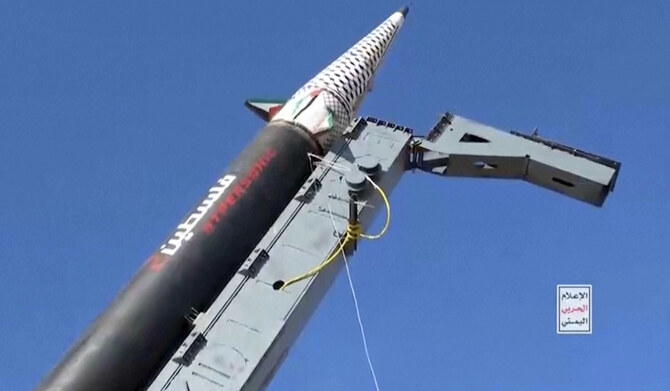
Israeli military intercepts missile launched from Yemen

This image taken from video and released by Ansar Allah Media Office, the media arm of Yemen's Houthi rebels, on Monday, Sept. 16, 2024, claims to show the launch of the ballistic missile that landed in an open area in central Israel Sunday, Sept. 15. (AP)
Short Url
Updated 25 March 2025
Follow

Israeli military intercepts missile launched from Yemen

  • Houthis spokesman Yahya Saree said the group also targeted “the US aircraft carrier Truman, using ballistic and cruise missiles and drones”

SANAA: The Israeli military said it had intercepted a missile over Israel on Monday that had been launched from Yemen, according to a statement.
The Houthis, undeterred by waves of US strikes since March 15, fired two ballistic missiles toward Ben Gurion Airport near Tel Aviv, the group’s military spokesman said in a televised statement early on Tuesday.
US President Donald Trump also threatened to punish Iran over its perceived support for Yemeni Houthi militants.
Earlier, warning sirens sounded in several areas of Israel, including Jerusalem and Tel Aviv.
The Houthis have vowed to escalate attacks, including those targeting Israel, in response to the US campaign.
Houthis spokesman Yahya Saree said the group also targeted “the US aircraft carrier Truman, using ballistic and cruise missiles and drones.”
The Houthis have carried out over 100 attacks on shipping since Israel’s war with Hamas began in late 2023, saying they were acting in solidarity with Gaza’s Palestinians.
The attacks have disrupted global commerce and prompted the US military to launch a costly campaign to intercept missiles.
The Houthis are part of what has been dubbed the “Axis of Resistance” — an anti-Israel and anti-Western alliance of regional militias including Hamas, Lebanon’s Hezbollah and armed groups in Iraq, all backed by Iran.


UN rights chief Shocked by ‘unbearable’ Darfur atrocities

Updated 18 January 2026
Follow

UN rights chief Shocked by ‘unbearable’ Darfur atrocities

  • Mediation efforts have failed to produce a ceasefire, even after international outrage intensified last year with reports of mass killings, rape, and abductions during the RSF’s takeover of El-Fasher in Darfur

PORT SUDAN: Nearly three years of war have put the Sudanese people through “hell,” the UN’s rights chief said on Sunday, blasting the vast sums spent on advanced weaponry at the expense of humanitarian aid and the recruitment of child soldiers.
Since April 2023, Sudan has been gripped by a conflict between the army and the paramilitary Rapid Support Forces that has left tens of thousands of people dead and around 11 million displaced.
Speaking in Port Sudan during his first wartime visit, UN Human Rights commissioner Volker Turk said the population had endured “horror and hell,” calling it “despicable” that funds that “should be used to alleviate the suffering of the population” are instead spent on advanced weapons, particularly drones.
More than 21 million people are facing acute food insecurity, and two-thirds of Sudan’s population is in urgent need of humanitarian aid, according to the UN.
In addition to the world’s largest hunger and displacement crisis, Sudan is also facing “the increasing militarization of society by all parties to the conflict, including through the arming of civilians and recruitment and use of children,” Turk added.
He said he had heard testimony of “unbearable” atrocities from survivors of attacks in Darfur, and warned of similar crimes unfolding in the Kordofan region — the current epicenter of the fighting.
Testimony of these atrocities must be heard by “the commanders of this conflict and those who are arming, funding and profiting from this war,” he said.
Mediation efforts have failed to produce a ceasefire, even after international outrage intensified last year with reports of mass killings, rape, and abductions during the RSF’s takeover of El-Fasher in Darfur.
“We must ensure that the perpetrators of these horrific violations face justice regardless of the affiliation,” Turk said on Sunday, adding that repeated attacks on civilian infrastructure could constitute “war crimes.”
He called on both sides to “cease intolerable attacks against civilian objects that are indispensable to the civilian population, including markets, health facilities, schools and shelters.”
Turk again warned on Sunday that crimes similar to those seen in El-Fasher could recur in volatile Kordofan, where the RSF has advanced, besieging and attacking several key cities.
Hundreds of thousands face starvation across the region, where more than 65,000 people have been displaced since October, according to the latest UN figures.