

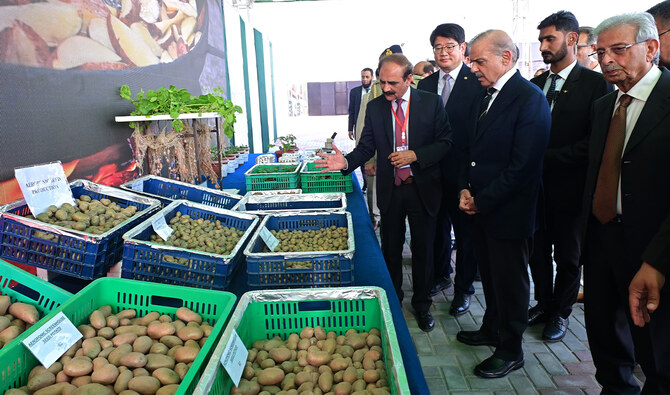

ISLAMABAD: Pakistan has partnered up with South Korea to produce high-quality seed potatoes using aeroponics, a method of cultivation in which plants are grown in an air or mist environment without the use of soil, state media reported on Monday.
This novel method is gaining popularity around the world for its ability to maximize plant growth with minimal water use, making it a sustainable option for urban farming and vertical agriculture.
Pakistan’s agriculture sector is a significant contributor to the economy, accounting for about 23 percent of the GDP and employing around 37.4 percent of the national labor force. According to 2024 data, Pakistan ranks ninth in the world in potato output and has seen its production jump by more than 35 percent in the last three years, from 5.87 million tones in 2020-21 to an estimated 8.01 million tones in 2022-23.
“The best potato seeds will now be produced in Pakistan with the cooperation of South Korea,” Pakistan’s APP news agency reported, after Prime Minister Shehbaz Sharif addressed the inauguration ceremony of modern aeroponic cultivation during his visit to the National Agricultural and Research Center on Monday.
Pakistan has been actively promoting corporate farming, with the government offering farmland to foreign investors to boost agricultural productivity and attract investment.
The latest partnership, the Seed Potato Production and Aeroponics Complex, is a joint project between the Korea Partnership for Innovation in Agriculture (COPIA) and the Pakistan Agricultural Research Council (PARC) for the production of certified potato seeds through advanced aeroponics technology. Seed potatoes are tubers that you can use to grow new potatoes that will be genetically identical to the parent potato.
The infrastructure of the project includes the construction of four aeroponic greenhouses and 35 screen houses, as well as a cold storage facility and a 100-kW solar power system.
According to PARC Chairman Dr. Ghulam Muhammad Ali, traditional potato cultivation produces only five tubers per plant, while the aeroponic system can produce between 50 to 60 tubers per plant.
“These modern technologies will not only help in meeting the local consumption of seed potatoes but will also reduce the heavy import bill,” APP quoted Ali as saying.
“Despite cultivating potatoes on an area of about 850,000 acres, Pakistan depends on importing 6,000 to 12,000 tones of potato seeds annually due to the poor quality of locally produced seeds.”
The aim of the joint initiative is to significantly improve the quality and availability of potato seeds in Pakistan, reduce the cost of potato production and improve production by ensuring the availability of quality seed potatoes at reasonable prices.
“The Prime Minister said that with the establishment of this modern center, the best potato seeds will be provided to the farmers and they will not have to be ordered from outside,” APP reported. “It is expected that this seed will be of the highest quality and this will boost potato production and Pakistan will also be able to export potatoes.”
Addressing the ceremony, RDA Korea Administrator Kwan Jae-han said the goal of the partnership project was to increase the productivity of Pakistan’s agricultural sector, adding that the collaboration with NARC in potato seeds was an “important milestone.”
Earlier on Monday, Sharif also inaugurated the National Institute for Genomics and Advanced Biotechnology, a specialized national institution dedicated to agricultural research in the three domains of plants, animals and microbes, with 28 state-of-the-art labs.


