

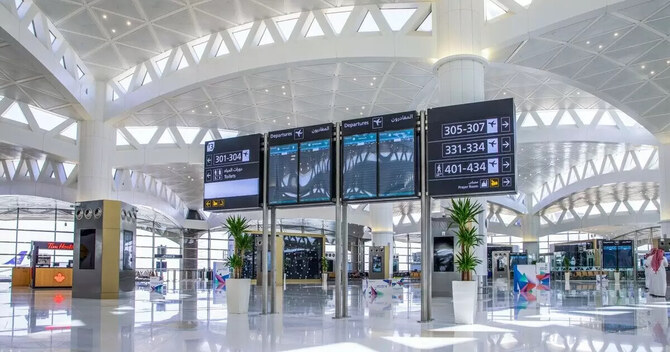
Riyadh’s international airport tops Saudi aviation rankings

The airport, handling over 15 million passengers annually, topped the Kingdom’s largest airport category with an 82 percent compliance rate, according to the General Authority of Civil Aviation’s latest report. 
Short Url
Updated 24 March 2025
Follow

Riyadh’s international airport tops Saudi aviation rankings

JEDDAH: King Khalid International Airport in Riyadh led Saudi Arabia’s aviation performance rankings for February, driven by improved passenger services and faster processing times, official data showed.  

The airport, handling over 15 million passengers annually, topped the Kingdom’s largest airport category with an 82 percent compliance rate, according to the General Authority of Civil Aviation’s latest report.  

It narrowly outperformed King Abdulaziz International Airport in Jeddah, which scored the same but ranked second based on evaluation criteria.  

The report assessed airports across five categories using 11 performance standards, including check-in, security, customs, and services for passengers with limited mobility. This is part of GACA’s efforts to improve transparency and service quality, aiming to enhance the travel experience across the Kingdom’s airports. 

In the second category, for terminals handling 5 to 15 million passengers annually, King Fahd International Airport in Dammam led with a 91 percent compliance rate, followed by Prince Mohammed bin Abdulaziz International Airport in Madinah at 82 percent. 

For airports handling 2 to 5 million passengers in the third category, King Abdullah bin Abdulaziz International Airport in Jazan and Abha International Airport both achieved a perfect 100 percent score. 

Arar International Airport topped the fourth category — international airports with under 2 million passengers — also with 100 percent, standing out for its low wait times on arrivals and departures. 

Gurayat led the fifth category for domestic airports with a 100 percent compliance rate, surpassing others in minimizing wait times. 

Saudi Arabia’s air travel sector posted strong gains in 2024, with total passenger numbers hitting a record 128 million — a 15 percent increase from 2023 and a 25 percent jump from pre-pandemic levels. 

Domestic flights carried 59 million passengers, while international routes accounted for 69 million. 

Flights across the Kingdom’s airports rose 11 percent to 905,000, including 474,000 domestic and 431,000 international flights, according to GACA’s Air Traffic 2024 Report. 

Air connectivity expanded 16 percent, linking Saudi Arabia to more than 170 global destinations, while cargo volumes surged 34 percent to over 1.2 million tonnes. Riyadh, Jeddah, Dammam, and Madinah airports handled 82 percent of total air traffic. 

Saudi Arabia aims to enhance air connectivity to 250 destinations, serving 330 million passengers, and double air cargo capacity to 4.5 million tons by 2030 through its National Aviation Strategy.


Saudi Arabia’s industrial output rises 10.4% in November: GASTAT 

Updated 10 sec ago
Follow

Saudi Arabia’s industrial output rises 10.4% in November: GASTAT 

RIYADH: Saudi Arabia’s industrial output rose at its fastest rate in months, climbing 10.4 percent year on year in November, supported by stronger manufacturing activity and higher oil production, official data showed. 

The Industrial Production Index increased to 114.4, up from 103.6 a year earlier, according to the General Authority for Statistics, though the index slipped 0.7 percent from October.

The latest figures highlight continued momentum in the Kingdom’s industrial sector as Saudi Arabia pursues economic diversification under its Vision 2030 agenda.

In its latest report, GASTAT stated: “Preliminary results indicate an increase of 10.4 percent in the IPI in November 2025 compared to the same month of the previous year, supported by the rise in mining and quarrying activity, manufacturing activity and water supply, sewerage and waste management and remediation activities.”  

The sub-index of mining and quarrying activity increased by 12.6 percent year on year in November, supported by Saudi Arabia’s decision to raise oil production to 10.1 million barrels per day, compared to 8.9 million bpd a year earlier. 

Manufacturing activity rose by 8.1 percent compared to November 2024, driven by a 14.5 percent increase in the production of coke and refined petroleum products. The manufacture of chemical products also recorded a 10.9 percent annual rise.

In contrast, the sub-index of electricity, gas, steam, and air conditioning supply declined by 4.3 percent year on year, while water supply, sewerage and waste management and remediation activities rose by 10.2 percent. 

On a month-on-month basis, the overall IPI fell by 0.7 percent in November. 

Mining and quarrying activity rose by 0.5 percent from October, while manufacturing activity edged up by 0.3 percent.

However, electricity, gas, steam, and air conditioning supply recorded a sharp monthly decline of 28.6 percent. Water supply, sewerage and waste management and remediation activities fell by 3.1 percent over the same period. 

Overall, the index of oil activities advanced by 12.9 percent year on year in November, while non-oil activities increased by 4.4 percent. 

Compared to October, oil activities rose by 0.4 percent, while non-oil activities declined by 3.4 percent. 

The IPI measures changes in industrial output based on the International Standard Industrial Classification framework and covers mining, manufacturing, utilities, and waste management sectors.