

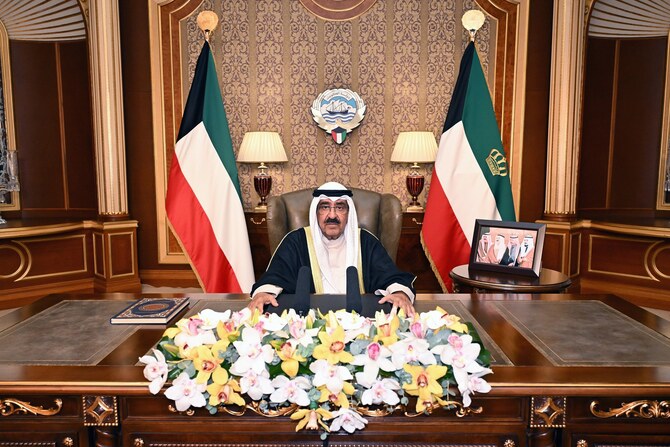
Emir of Kuwait urges nation to unite, adhere to democracy

Sheikh Meshal Al-Ahmad Al-Jaber Al-Sabah, the Emir of Kuwait, addressed the nation in a televised speech on Sunday evening. (KUNA)
Short Url
Updated 24 March 2025
Follow

Emir of Kuwait urges nation to unite, adhere to democracy

  • Sheikh Meshal says national identity ‘top’ priority
  • Commends citizens for loyal response to reforms

LONDON: Sheikh Meshal Al-Ahmad Al-Jaber Al-Sabah, the emir of Kuwait, has urged citizens to remain united and adhere to democratic principles.

In a televised speech on Sunday, he said “national identity is at the top of our priorities. It belongs to every genuine Kuwaiti keen on his country’s progress and the elevation of its status.”

He commended citizens for their positive response to the government’s recent reforms, which included the suspension of some articles of the constitution, the Kuwait News Agency reported.

“I affirm commitment to reforming, strengthening stability, and upholding the country’s supreme interests, continuing to combat corruption and confronting anyone who attempts to tamper with the nation’s security and stability.”

He warned that “advocates of division and the instigators of sedition are trying to confuse matters, spread rumors, and distort statements, to divide the ranks and cause discontent.”

He urged citizens to “work with a spirit of responsibility to preserve the security and stability of the homeland.”

He added that he was monitoring the state’s agencies to ensure accountability and the speedy completion of development projects in health, education and housing.

Sheikh Meshal said he had “great confidence in the authentic Kuwaiti people’s ability to overcome challenges.”

On an international level, he emphasized that Kuwait would continue to work with friendly nations to advance global justice for all people.

Sheikh Meshal said Kuwait would continue to support the Palestinians to achieve all their legitimate rights.


Iran FM criticizes Israel for ‘doctrine of domination’

Updated 07 February 2026
Follow

Iran FM criticizes Israel for ‘doctrine of domination’

  • Doctrine allows Israel to expand its military arsenal while pressuring other countries in the region to disarm
  • His remarks came a day after renewed nuclear talks with Washington in Oman

DOHA: Iran’s Foreign Minister Abbas Araghchi on Saturday criticized what he said was a “doctrine of domination” that allows Israel to expand its military arsenal while pressuring other countries in the region to disarm.
His remarks came a day after renewed nuclear talks with Washington, with previous talks collapsing when Israel launched an unprecedented bombing campaign against Iran last June that triggered a 12-day war.
Araghchi was speaking at the Al Jazeera Forum conference in Qatar but made no reference to Friday’s talks with the United States.
“Israel’s expansionist project requires that neighboring countries be weakened: militarily, technologically, economically and socially,” Araghchi said.
“Under this project Israel is free to expand its military arsenal without limits ... Yet other countries are demanded to disarm. Others are pressured to reduce defensive capacity. Others are punished for scientific progress,” he added.
“This is a doctrine of domination.”
During the 12-day war Israel targeted senior Iranian military officials, nuclear scientists and sites as well as residential areas, with the US later launching its own attacks on key nuclear facilities.
Iran responded at the time with drone and missile attacks on Israel, as well as by targeting the largest US military base in the Middle East, located in Qatar.
On Friday, Araghchi led the Iranian delegation in indirect nuclear talks with US Middle East envoy Steve Witkoff in Muscat.
The top Iranian diplomat later described the atmosphere as having been “very positive,” while US President Donald Trump said the talks were “very good,” with both sides agreeing to proceed with further negotiations.
The talks followed threats from Washington and its recent deployment of an aircraft carrier group to the region following Iran’s deadly crackdown on anti-government protests last month.
The United States has sought to address Iran’s ballistic missile program and its support for militant groups in the region — issues which Israel has pushed to include in the talks, according to media reports.
Tehran has repeatedly rejected expanding the scope of negotiations beyond the nuclear issue.