Under threat from Trump, Canada calls snap elections for April 28

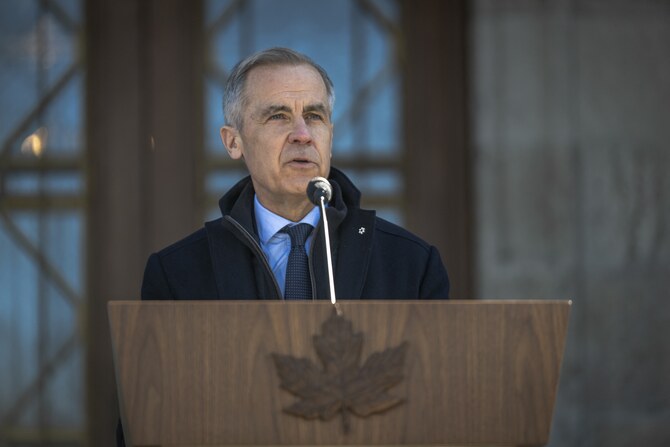
Canadian Prime Minister Mark Carney calls for a snap election after speaking with Mary Simon, the Governor General of Canada, in Ottawa, Mar. 23, 2025. (AFP)
Short Url
Updated 23 March 2025
Follow

Under threat from Trump, Canada calls snap elections for April 28

  • Prime Minister Mark Carney brought parliamentary elections forward several months from October
  • The barrage of threats coming from the US president will be the crux of his election campaign

OTTAWA: Canada’s new Prime Minister Mark Carney on Sunday called early elections for April 28, pledging to defeat Donald Trump’s drive to annex the United States’s huge northern neighbor.
Carney, a former central banker, was chosen by Canada’s centrist Liberal Party to replace Justin Trudeau as prime minister, but he has never faced the country’s broader electorate.
That will now change as Carney brought parliamentary elections forward several months from October, and he made it clear that the barrage of threats coming from the US president will be the crux of his campaign.
“I’ve just requested that the governor general dissolve parliament and call an election for April 28. She has agreed,” Carney said in a speech to the nation, referring to King Charles III’s representative in Canada, a member of the British Commonwealth.
Trump “wants to break us, so America can own us. We will not let that happen,” Carney said.
In power for a decade, the Liberal government had slid into deep unpopularity, but Carney will be hoping to ride a wave of Canadian patriotism to a new majority.
Trump has riled his northern neighbor by repeatedly dismissing its sovereignty and borders as artificial, and urging it to join the United States as the 51st state.
The ominous remarks have been accompanied by Trump’s swirling trade war, with the imposition of tariffs on imports from Canada, which could severely damage its economy.
“In this time of crisis, the government needs a strong and clear mandate,” Carney told supporters on Thursday in a speech in the western city of Edmonton.
'Closely watched election'
Domestic issues such as the cost of living and immigration usually dominate Canadian elections, but this time around, one key topic tops the list: who can best handle Trump.
The president’s open hostility toward his northern neighbor — a NATO ally and historically one of his country’s closest partners — has upended the Canadian political landscape.
Trudeau, who had been in power since 2015, was deeply unpopular when he announced he was stepping down, with Pierre Poilievre’s Conservatives seen as election favorites just weeks ago.
But the polls have narrowed spectacularly in Carney’s favor since he took over the Liberals, and now analysts are calling this race, overshadowed by Trump, too close to call.
“Many consider this to be an existential election, unprecedented,” Felix Mathieu, a political scientist at the University of Winnipeg, told AFP.
“It is impossible at this stage to make predictions, but this will be a closely watched election with a voter turnout that should be on the rise.”
Poilievre, 45, is a career politician, first elected when he was only 25. A veteran tough-talking campaigner, he has sometimes been tagged as a libertarian and a populist.
Carney, 60, has spent his career outside of electoral politics. He spent more than a decade at Goldman Sachs and went on to lead Canada’s central bank, and then the Bank of England.
Smaller opposition parties could suffer if Canadians seek to give a large mandate to one of the big two, to strengthen their hand against Trump.
As for the US leader, he professes not to care, while pushing ahead with plans to further strengthen tariffs against Canada and other major trading partners on April 2.
“I don’t care who wins up there,” Trump said this week.
“But just a little while ago, before I got involved and totally changed the election, which I don’t care about [...] the Conservative was leading by 35 points.”


Hundreds march in silence to honor victims of Swiss bar fire that left 40 dead

Updated 6 sec ago
Follow

Hundreds march in silence to honor victims of Swiss bar fire that left 40 dead

CRANS-MONTANA: Hundreds marched in silence Sunday to honor the victims of the New Year’s Eve fire at a bar in the Swiss Alpine resort of Crans-Montana, which left 40 dead and many severely injured.
Somber mourners, many with reddened eyes, filed silently out of the chapel to organ music after the hourlong Mass at the Chapelle Saint-Christophe in Crans-Montana. Some exchanged hugs, others applauded, before joining the silent march up the hill to Le Constellation bar.
Many hundreds of people, some cradling flower bouquets, walked in the dense snaking procession in the bright sunlight past shuttered stores. Up on the mountain overlooking the town, snow machines sent plumes of white flakes into the air.
At the top of the street, in front of Le Constellation that is still largely shielded from view by white screens, the swelling crowd stood in near total silence, some weeping. Then they broke out into sustained applause — hands in gloves and mittens against the cold — as a stream of mourners and well-wishers deposited flower bouquets at a makeshift memorial piled with flowers, cuddly toys and other tributes.
“We are going through a moment of crushing darkness but we are going through it together,” one speaker said.
During the Mass, the Rev. Gilles Cavin spoke of the “terrible uncertainty” for families unsure if their loved ones are among the dead or still alive among the injured. “We pray for their friends hard hit by misery on this day that was meant to be one of festivities and friendship,” he said.
In the crowded pews, a grieving woman listened intently, her hands clasped tightly and sometimes clasping rosary beads, as speakers delivered readings in German, French and Italian.
Forty people died and 119 were injured in the blaze that broke out around 1:30 a.m. on Thursday at Le Constellation bar. Police have said many of the victims were in their teens to mid-20s.
By Sunday morning, Swiss authorities identified 24 out of the 40 fatalities. They include 18 Swiss citizens aged 14 to 31 years, two Italians 16 years old, one dual citizen of Italy and the United Arab Emirates also 16 years old, an 18-year-old Romanian, a 39-year-old French and a Turkish citizen, 18.
A grieving mother
One of the victims was 16-year old Arthur Brodard, whose mother had been frantically searching for him.
“Our Arthur has now left to party in paradise,” a visibly shaken Laetitia Brodard said in a Facebook story posted on Saturday night, speaking to camera. “We can start our mourning, knowing that he is in peace and in the light.”
Brodard’s frenzied search for her son reflected the desperation of families of the young people disappeared during the fire, who did not know whether their loved ones were dead or in the hospital.
Swiss authorities said the process of identifying victims was particularly hard because of the advanced degree of the burns, requiring the use of DNA samples. Brodard also had given her DNA sample to help in the identification process.
In her Facebook post, Brodard thanked those who “testified their compassion, their love” and to those who shared information as she anxiously searched and waited for news of her son. Other parents and siblings are still waiting in anguish.
Bar managers face a criminal investigation
Swiss authorities have opened a criminal investigation of the bar managers.
The two are suspected of involuntary homicide, involuntary bodily harm and involuntarily causing a fire, the Valais region’s chief prosecutor, Beatrice Pilloud, told reporters Saturday. The announcement of the investigation did not name the managers.
Investigators said Friday they believe sparkling candles atop Champagne bottles ignited the fire when they came too close to the ceiling of the crowded bar.
Authorities planned to look into whether sound-dampening material on the ceiling conformed with regulations and whether the candles were permitted for use in the bar. Officials said they also would look at other safety measures on the premises, including fire extinguishers and escape routes.
Swiss President Guy Parmelin announced a national day of mourning for the victims on Jan. 9.
France’s Health Minister Stéphanie Rist said 17 patients have received care in France, out of a total of 35 transferred from Switzerland to five European countries. Other patients were planned to be transferred to Germany, Italy and Belgium.