

In Pakistani capital, Ramadan night festival showcases over 100 small businesses

Visitors attend ‘Winter Fete Suhoor and Eid Night Bazaar’ event in Islamabad, Pakistan, on March 22, 2025. (AN photo)
Short Url
Updated 23 March 2025
Follow

In Pakistani capital, Ramadan night festival showcases over 100 small businesses

  • ‘Winter Fete Suhoor and Eid Night Bazaar’ event features businesses selling home decor, food, textiles and fashion accessories
  • Entrepreneurs praise festival for helping establish relationships with potential customers, building brand awareness 

ISLAMABAD: A vibrant Ramadan festival held in Pakistan’s capital city Islamabad this week featured over 100 small businesses and their products ranging from handcrafted textiles to homemade food items, bringing together entrepreneurs, food lovers and eager shoppers. 

The ‘Winter Fete Suhoor and Eid Night Bazaar,’ initially conceived as an annual event, has now grown into a bi-monthly tradition. It offers a vital launching pad for startups and home-based businesses to showcase their products. 

The latest edition of the festival was held at founder Sabeen Abdal’s house in Islamabad on Saturday, Mar. 22, from 6:00pm to 1:30am. It featured an eclectic mix of businesses selling home decor, handcrafted textiles, food items and fashion accessories.

“We started this as an opportunity for startups who don’t have storefronts to showcase their products,” Abdal told Arab News. 

“There’s a big shortage of such events in our city, so now we host an event every two months,” she explained. “Many of our vendors are women-led businesses and startups, which makes this even more special.”
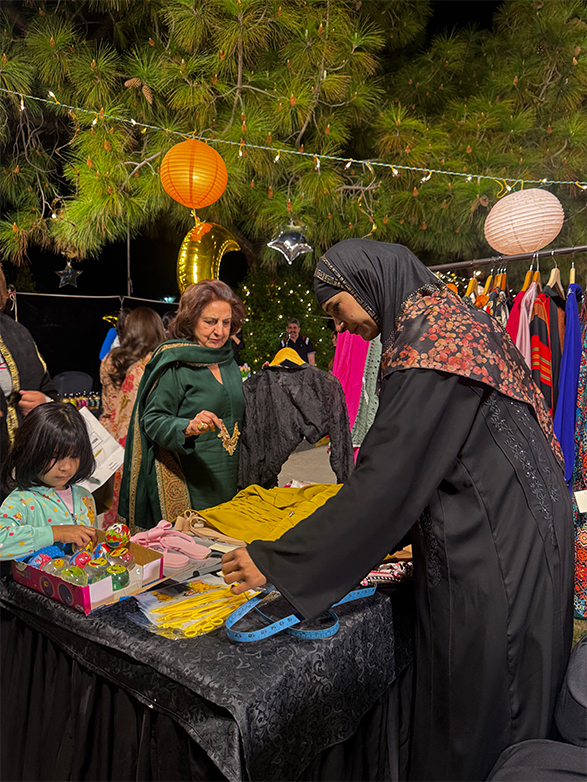


A visitor inspects clothes at ‘Winter Fete Suhoor and Eid Night Bazaar’ event in Islamabad, Pakistan, on March 22, 2025. (AN photo)

Zara Nadeem, an entrepreneur whose business specializes in wardrobes and home decor, agreed. She said the festival was an opportunity for entrepreneurs such as herself to engage with potential customers.

“Events like this help us create brand awareness and consolidate our brand,” Nadeem, who recently opened her first showroom, said. 

“We are trying to shift the mindset that quality only comes from imported products. We want to produce high-quality items locally in Pakistan.”
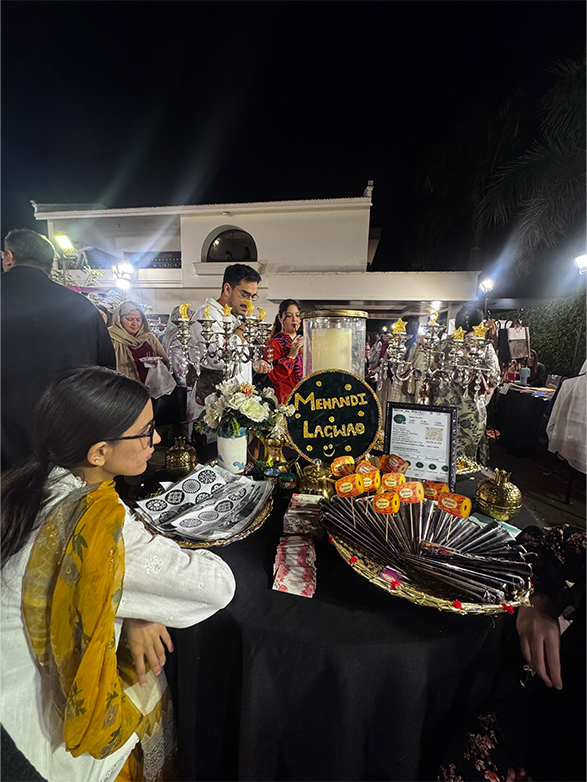


A vendor awaits customers at her mehndi stall at the ‘Winter Fete Suhoor and Eid Night Bazaar’ event in Islamabad, Pakistan, on March 22, 2025. (AN photo)

Jumana Vijlani, an entrepreneur who recently launched her fashion jewelry business, said the festival was proving to be a stepping stone for her to gain much-needed brand exposure.

“We are a new startup, and it has only been a few months since we began,” Vijlani said. “Events like these provide us with much-needed opportunities to advertise and boost our sales.”

Beyond shopping, the festival served as a lively social gathering where visitors connected with friends and family while supporting small businesses. 

The food stalls were a major attraction, offering popular Ramadan treats such as dahi bhallay, chaats, and traditional teas.

Hina Raza, the owner of a home-based food business, shared how such festivals play a crucial role in motivating her to pursue her passion for cooking after leaving her teaching career. 

“A year ago, I left teaching to pursue this full-time, and events like this not only help us financially but also motivate and uplift us,” Raza said. 


Power minister defends solar net-metering overhaul after Pakistan PM orders review

Updated 6 sec ago
Follow

Power minister defends solar net-metering overhaul after Pakistan PM orders review

  • Leghari says 466,000 net-meter users earn up to 50% returns while 35.5 million consumers bear higher costs
  • NEPRA’s new rules require full grid tariffs for usage and lower, market-linked rates for excess solar exports

ISLAMABAD: Pakistan’s power minister on Thursday defended controversial changes to rooftop solar net-metering rules, arguing that generous returns for a small number of users were unfairly burdening millions of other electricity consumers, as Prime Minister Shehbaz Sharif ordered a review a day earlier.

The dispute centers on changes to the net-metering regime, under which households and businesses with rooftop solar panels can sell excess electricity to the national grid. The National Electric Power Regulatory Authority's (NEPRA) new compensation rules require consumers to pay full tariffs for electricity drawn from the grid while receiving a lower, market-linked rate for excess power they export.

Critics have called the revisions “anti-solar” and warned they would undermine renewable energy adoption and hurt household finances.

Power Minister Sardar Owais Ahmed Khan Leghari told the National Assembly that only 6,000-7,000 megawatts of Pakistan’s estimated 22,000 megawatts of installed solar capacity fall under net-metering, covering around 466,000 consumers out of 35.5 million nationwide electricity users.

“If a net-metering consumer earns a 50% return on his investment because of the savings he gets as a meter user, while IPPs [independent power producers] get 17% and bank deposits earn 8%, isn’t a 50% return a good rate,” he asked.

“I generate electricity at Rs. 5 and send it to the grid at Rs. 27,” he continued. “The average price at which we buy electricity from the rest of the grid is Rs. 8.31. Is buying at Rs. 27 justified?”

Leghari said under the revised framework, returns for net-meter users would fall to around 37%, adding that even at that level, rooftop solar power generation remains financially attractive.

He said the changes were aimed at ensuring “fair pricing” and reducing cross-subsidies borne by the broader consumer base.

“Besides them, there are 35.5 million other consumers who do not even use net-metering,” he said, adding that if electricity costs for the wider public fell by up to Rs. 1.50 per unit, the adjustment would be justified.

Leghari's statement follows the prime minister's instructions to file a review in response to the new NEPRA rules, as he directed his administration to protect existing consumer contracts while ensuring the policy does not shift the financial burden onto non-solar electricity users.