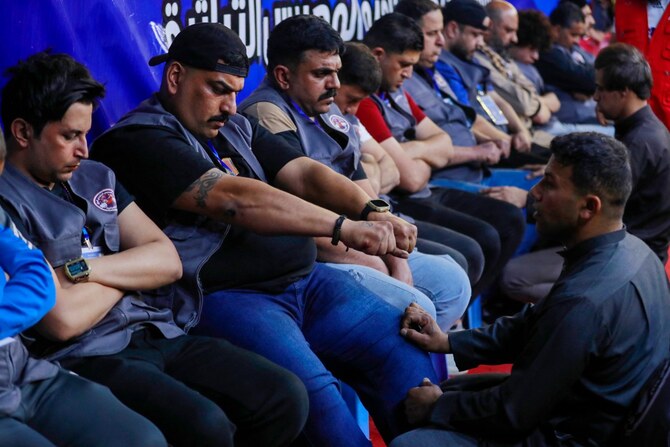
Baghdad: In a Baghdad arena, a crowd cheers to the rhythm of drums, not for a football match but for a fiery centuries-old game enjoyed by Iraqis during Ramadan called “mheibes.”
“It’s a heritage game, the game of our ancestors, which unites all Iraqis,” said Jassem Al-Aswad, a longtime mheibes champion in his early seventies and now president of the game’s national federation.
The game involves members of one team hiding a ring — “mehbis” in Arabic — and the captain of the opposing team trying to guess who has it in the palm of his hand.
And he has to do so within 10 minutes.
Played during the holy Muslim fasting month of Ramadan, the game first appeared as early as the 16th century in Ottoman-era Baghdad, according to Iraqi folklore expert Adel Al-Ardawi.
More than 500 fans and players gathered in the stands and on the field for two matches: the Baghdad neighborhood of Kadhimiya against the southern city of Nasiriyah, and the capital’s Al-Mashtal district versus a team from the port city of Basra.
Everyone watched as the 40 players on one team huddled together under a blanket to avoid prying eyes, and decided who would hide the “mehbis” or signet ring worn by many Iraqi men.
Sitting on the ground or on chairs, the members of the team hiding the ring then adopted serious expressions. Some closed their eyes, while others crossed their arms or even clenched their fists.
The rival team captain carefully read these facial expressions and body language to try and guess who had the ring — before pronouncing the verdict.
When the first team failed to guess correctly, the other team scored a point and the crowd went wild.
'It’s in our blood'
“Iraqis love football the most, but mheibes comes a close second. It’s in our blood,” Kadhimiya captain Baqer Al-Kazimi told AFP.
The clean-shaven 51-year-old, who wears a black robe called a jellaba, said he inherited his love of the game from his father.
Though mheibes was impacted during decades of conflict, including at the peak of the sectarian war between 2006 and 2008 marked by suicide attacks and kidnappings, Kazimi said he and others continued playing even during those dark years.
He said that only the coronavirus pandemic forced players to put their hobby on hold.
“Despite the sectarian violence, we played in cafes,” he said, recalling one game between players from the Sunni neighborhood of Adhamiya and those from Kadhimiya, a predominantly Shiite area.
The two districts were separated by a bridge that had been closed for years because of the violence.
“We played on the bridge. Sunnis and Shiites met,” he said.
Ahmed Maala from Basra recalled a game with a team from Baghdad that lasted all night.
“I learned the game by playing with friends and family,” he said.
“Mheibes will go down in history for its very large fan base throughout Iraq.”
Passion for the game runs so deep that sometimes arguments erupt among players, even escalating into physical violence.
In a country with nearly 400 teams, annual competitions see players from across the nation competing against each other, with 10 teams qualifying in Baghdad alone to represent the city’s different neighborhoods.
Mheibes champion Aswad said he hopes the game will one day expand beyond Iraq’s borders.
“Just as Brazil popularised football, we will transmit this game to the whole world,” he said.


![]()

Iraqis find Ramadan joy in centuries-old ring game
Short Url
https://arab.news/ctd65
Iraqis find Ramadan joy in centuries-old ring game
- The game involves members of one team hiding a ring — “mehbis” in Arabic — and the captain of the opposing team trying to guess who has it in the palm of his hand


Latest updates


© 2026 SAUDI RESEARCH & PUBLISHING COMPANY, All Rights Reserved And subject to Terms of Use Agreement.