US revokes legal status for 500,000 immigrants

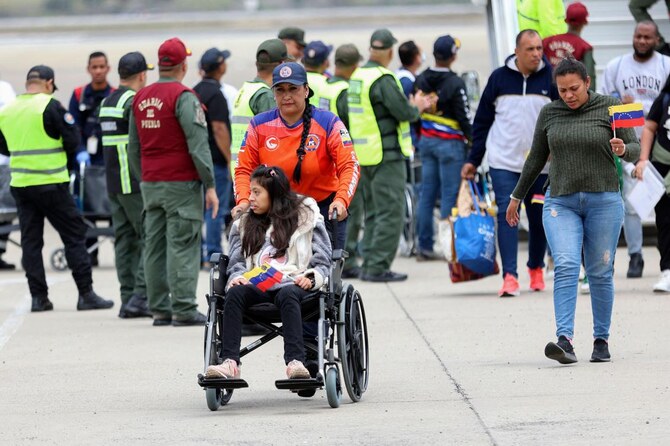
A Venezuelan migrant is wheeled on a wheelchair upon arrival at Simon Bolivar International Airport in Maiquetia, Venezuela on March 20, 2025. (AFP)
Short Url
Updated 22 March 2025
Follow

US revokes legal status for 500,000 immigrants

  • Trump has pledged to carry out the largest deportation campaign in US history and curb immigration, mainly from Latin American nations

WASHINGTON: The United States said Friday it was terminating the legal status of hundreds of thousands of immigrants, giving them weeks to leave the country.
President Donald Trump has pledged to carry out the largest deportation campaign in US history and curb immigration, mainly from Latin American nations.
The order affects around 532,000 Cubans, Haitians, Nicaraguans and Venezuelans who came to the United States under a scheme launched in October 2022 by Trump’s predecessor Joe Biden and expanded in January the following year.
They will lose their legal protection 30 days after the Department of Homeland Security’s order is published in the Federal Register, which is scheduled Tuesday.
That means immigrants sponsored by the program “must depart the United States” by April 24 unless they have secured another immigration status allowing them to remain in the country, the order says.
Welcome.US, which supports people seeking refuge in the United States, urged those affected by the move to “immediately” seek advice from an immigration lawyer.
The Processes for Cubans, Haitians, Nicaraguans, and Venezuelans (CHNV) program, announced in January 2023, allowed entry to the United States for two years for up to 30,000 migrants per month from the four countries, which have grim human rights records.
Biden touted the plan as a “safe and humane” way to ease pressure on the crowded US-Mexico border.
But the Department of Homeland Security stressed Friday that the scheme was “temporary.”
“Parole is inherently temporary, and parole alone is not an underlying basis for obtaining any immigration status, nor does it constitute an admission to the United States,” it said in the order.
Nicolette Glazer, an immigration lawyer in California, said the order would affect the “vast majority” of the half a million immigrants who entered the United States under the CHNV scheme.
“Only 75,000 affirmative asylum applications were filed, so the vast majority of the CHNV parolees will find themselves without status, work permits, and subject to removal,” she posted on X.
“The chaos will be unreal.”
Trump last weekend invoked rare wartime legislation to fly more than 200 alleged members of a Venezuelan gang to El Salvador, which has offered to imprison migrants and even US citizens at a discount.
More than seven million Venezuelans have fled their country over the last decade as the oil-rich country’s economy implodes under leftist leader Nicolas Maduro, a bugbear of Washington who has faced major sanctions.


India accelerates free trade agreements against backdrop of US tariffs

Updated 21 December 2025
Follow

India accelerates free trade agreements against backdrop of US tariffs

  • India signed a CEPA with Oman on Thursday and a CETA with the UK in July 
  • Delhi is also in advanced talks for trade pacts with the EU, New Zealand, Chile 

NEW DELHI: India has accelerated discussions to finalize free trade agreements with several nations, as New Delhi seeks to offset the impact of steep US import tariffs and widen export destinations amid uncertainties in global trade. 

India signed a Comprehensive Economic Partnership Agreement with Oman on Thursday, which allows India to export most of its goods without paying tariffs, covering 98 percent of the total value of India’s exports to the Gulf nation. 

The deal comes less than five months after a multibillion-dollar trade agreement with the UK, which cut tariffs on goods from cars to alcohol, and as Indian trade negotiators are in advanced talks with New Zealand, the EU and Chile for similar partnerships. 

They are part of India’s “ongoing efforts to expand its trade network and liberalize its trade,” said Anupam Manur, professor of economics at the Takshashila Institution. 

“The renewed efforts to sign bilateral FTAs are partly an after-effect of New Delhi realizing the importance of diversifying trade partners, especially after India’s biggest export market, the US, levied tariff rates of up to 50 percent on India.” 

Indian exporters have been hit hard by the hefty tariffs that went into effect in August. 

Months of negotiations with Washington have not clarified when a trade deal to bring down the tariffs would be signed, while the levies have weighed on sectors such as textiles, auto components, metals and labor-intensive manufacturing. 

The FTAs with other nations will “help partially in mitigating the effects of US tariffs,” Manur said. 

In particular, Oman can “act as a gateway to other Gulf countries and even parts of Eastern Europe, Central Asia, and Africa,” and the free trade deal will most likely benefit “labor-intensive sectors in India,” he added. 

The chances of concluding a deal with Washington “will prove to be difficult,” said Arun Kumar, a retired economics professor at the Jawaharlal Nehru University.

“With the US, the chances of coming to (an agreement) are a bit difficult, because they want to get our agriculture market open, which we cannot do. They want us to reduce trade with Russia. That’s also difficult for India to do,” he told Arab News.  

US President Donald Trump has threatened sanctions over India’s historic ties with Moscow and its imports of Russian oil, which Washington says help fund Moscow’s ongoing war with Ukraine.

“President Trump is constantly creating new problems, like with H-1B visa and so on now. So some difficulty or the other is expected. That’s why India is trying to build relationships with other nations,” Kumar said, referring to increased vetting and delays under the Trump administration for foreign workers, who include a large number of Indian nationals. 

“Substituting for the US market is going to be tough. So certainly, I think India should do what it can do in terms of promoting trade with other countries.” 

India has free trade agreements with more than 10 countries, including comprehensive economic partnership agreements with South Korea, Japan, and the UAE.

It is in talks with the EU to conclude an FTA, amid new negotiations launched this year for trade agreements, including with New Zealand and Chile.  

India’s approach to trade partnerships has been “totally transformed,” Commerce and Industry Minister Piyush Goyal said in a press briefing following the signing of the CEPA with Oman, which Indian officials aim to enter into force in three months. 

“Now we don’t do FTAs with other developing nations; our focus is on the developed world, with whom we don’t compete,” he said. “We complement and therefore open up huge opportunities for our industry, for our manufactured goods, for our services.”