US sends migrants from Guantanamo to Venezuela

President Nicolas Maduro’s government has been flying free or subsidized repatriation flights for Venezuelans wishing to return home. (AFP)
Short Url
Updated 21 February 2025
Follow

US sends migrants from Guantanamo to Venezuela

  • A plane left the US base and deposited the 177 people in Honduras, where they were picked up by the Venezuelan government
  • The deportees then left for Venezuela on a flag carrier Conviasa flight that arrived in Maiquetia late Thursday

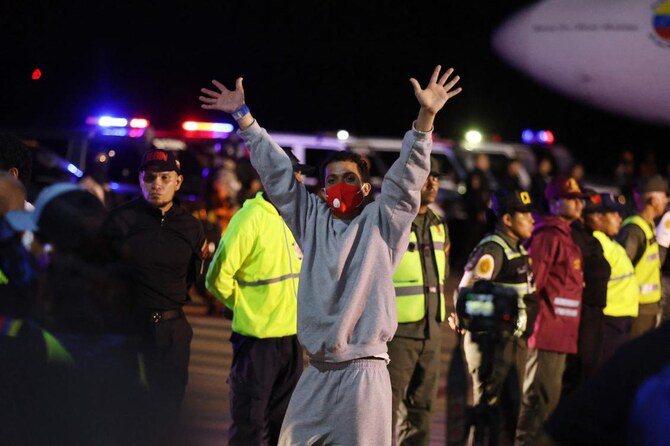
MAIQUETIA, Venezuela: The United States deported 177 migrants from its military base in Guantanamo, Cuba to their homeland in Venezuela Thursday, the latest sign of cooperation between the long-feuding governments.
Officials in Washington and Caracas confirmed that a plane left the US base and deposited the 177 people in Honduras, where they were picked up by the Venezuelan government.
The deportees then left for Venezuela on a flag carrier Conviasa flight that arrived in Maiquetia late Thursday.
Venezuelan Interior Minister Diosdado Cabello received the all-male group of deportees at the airport, telling them: “Welcome to the homeland.”
“Those who returned, in theory, are all Venezuelans who were in Guantanamo,” Cabello told journalists, adding that another deportation flight was expected to arrive at the end of the week.
The carefully choreographed operation would have seemed impossible just weeks ago when the United States accused President Nicolas Maduro of stealing an election.
But since President Donald Trump entered office four weeks ago, relations have thawed, with the White House prioritizing immigration cooperation.
Maduro said the handover was at the “direct request” of his government to that of Trump.
“We have rescued 177 new migrants from Guantanamo,” he said at an official event.
Trump envoy Richard Grenell traveled to Caracas on January 31 and met Maduro, who is the subject of a $25 million US bounty for his arrest.
Grenell brokered the release of six US prisoners. A day later Trump announced Venezuela had agreed to accept illegal migrants deported from the United States.
Venezuela said it had “requested the repatriation of a group of compatriots who were unjustly taken to the Guantanamo naval base.”
“This request has been accepted and the citizens have been transferred to Honduras, from where they will be recovered,” the government said in a statement.
US Immigration and Customs Enforcement confirmed they had transported “177 Venezuelan illegal aliens from Guantanamo Bay to Honduras today for pickup by the Venezuelan government.”
Caracas broke off ties with Washington in January 2019 after The United States recognized then-opposition leader Juan Guaido as “interim president” following 2018 elections that were widely rejected as neither free nor fair.
In October 2023, Maduro allowed US planes with deported migrants to fly into Venezuela but withdrew permission four months later.
His government has been flying free or subsidized repatriation flights for Venezuelans wishing to return home.
Venezuela is keen to end crippling US sanctions and to move beyond the controversy over elections last July that the United States and numerous other countries said were won by the opposition.
The contested election results sparked protests in which at least 28 people were killed and about 200 injured, with 2,400 arrests.
Human rights groups in the United States have sued to gain access to migrants held in Guantanamo after Trump ordered the base to prepare to receive some 30,000 people who entered the United States without papers.
Guantanamo is synonymous with abuses against terror suspects held there after the September 11 attacks.
The United States on Thursday deported another group of 135 migrants of various nationalities – including 65 children – to Costa Rica, from where they will be repatriated to their home countries, including China, Russia, Afghanistan, Ghana and Vietnam, the government in San Jose said.
Costa Rica, along with Panama, is serving as a way station for migrants deported by Trump’s government.


Starvation fears as flood toll passes 900 in Indonesia

Updated 9 sec ago
Follow

Starvation fears as flood toll passes 900 in Indonesia

  • More than 1,790 people have been killed in natural disasters unfolding across Southeast Asia over the past week
  • Floods have swept away roads, smothered houses in silt, and cut off supplies in Indonesia's provinces of Aceh and North Sumatra

More than 1,790 people have been killed in natural disasters unfolding across Southeast Asia over the past week

Floods have swept away roads, smothered houses in silt, and cut off supplies in Indonesia's provinces of Aceh and North Sumatra

BANDA ACEH, Indonesia: Ruinous floods and landslides have killed more than 900 people on Indonesia’s island of Sumatra, the country’s disaster management agency said Saturday, with fears that starvation could send the toll even higher.
A chain of tropical storms and monsoonal rains has pummelled Southeast and South Asia, triggering landslides and flash floods from the Sumatran rainforest to the highland plantations of Sri Lanka.
More than 1,790 people have been killed in natural disasters unfolding across Indonesia, Sri Lanka, Malaysia, Thailand and Vietnam over the past week.
In Indonesia’s provinces of Aceh and North Sumatra, floods have swept away roads, smothered houses in silt, and cut off supplies.
Aceh governor Muzakir Manaf said response teams were still searching for bodies in “waist-deep” mud.
However, starvation was one of the gravest threats now hanging over remote and inaccessible villages.
“Many people need basic necessities. Many areas remain untouched in the remote areas of Aceh,” he told reporters.
“People are not dying from the flood, but from starvation. That’s how it is.”
Entire villages had been washed away in the rainforest-cloaked Aceh Tamiang region, Muzakir said.
“The Aceh Tamiang region is completely destroyed, from the top to the bottom, down to the roads and down to the sea.
“Many villages and sub-districts are now just names,” he said.
Aceh Tamiang flood victim Fachrul Rozi said he had spent the past week crammed into an old shop building with others who had fled the rising waters.
“We ate whatever was available, helping each other with the little supplies each resident had brought,” he told AFP.
“We slept crammed together.”
Aceh resident Munawar Liza Zainal said he felt “betrayed” by the Indonesian government, which has so far shrugged off pressure to declare a national disaster.
“This is an extraordinary disaster that must be faced with extraordinary measures,” he told AFP, echoing frustrations voiced by other flood victims.
“If national disaster status is only declared later, what’s the point?“
Declaring a national disaster would free up resources and help government agencies coordinate their response.
Analysts have suggested Indonesia could be reluctant to declare a disaster — and seek additional foreign aid — because it would show it was not up to the task.
Indonesia’s government this week insisted it could handle the fallout.

Climate calamity

The scale of devastation has only just become clear in other parts of Sumatra as engorged rivers shrink and floodwaters recede.
AFP photos showed muddy villagers salvaging silt-encrusted furniture from flooded houses in Aek Ngadol, North Sumatra.
Humanitarian groups worry that the scale of the calamity could be unprecedented, even for a nation prone to natural disasters.
Indonesia’s death toll rose to 908 on Saturday, according to the disaster management agency, with 410 people missing.
Sri Lanka’s death toll jumped on Friday to 607, as the government warned that fresh rains raised the risk of new landslides.
Thailand has reported 276 deaths and Malaysia two, while at least two people were killed in Vietnam after heavy rains triggered a series of landslides.
Seasonal monsoon rains are a feature of life in Southeast Asia, flooding rice fields and nourishing the growth of other key crops.
However, climate change is making the phenomenon more erratic, unpredictable and deadly throughout the region.
Environmentalists and Indonesia’s government have also suggested that logging and deforestation exacerbated landslides and flooding in Sumatra.