M23 group seizes key town in eastern DR Congo

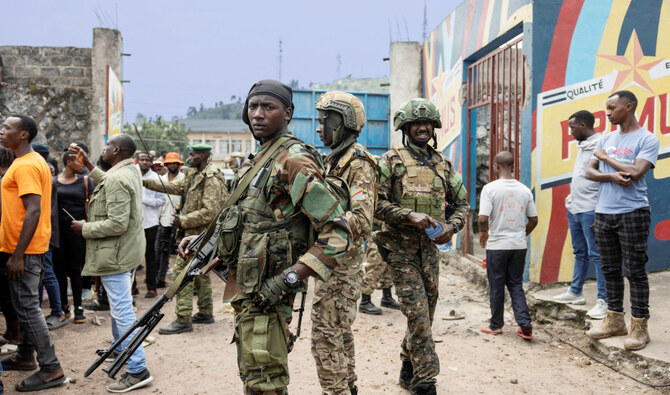
M23 rebels stand guard during a meeting in Goma. (File/Reuters)
Short Url
Updated 21 March 2025
Follow

M23 group seizes key town in eastern DR Congo

  • Capture of Walikale leaves rebels in control of road linking 4 provinces

GOMA: Rwanda-backed M23 rebels have entered the center of the eastern Congo town of Walikale, a local activist and an M23 source said on Thursday, expanding the insurgents’ presence deep into the Congolese interior despite renewed calls for a ceasefire.

Their entry into Walikale, an area rich in minerals including tin, followed fighting on Wednesday with the Democratic Republic of Congo’s army and allied militias on the outskirts of the town.

The town’s capture would leave the rebels, who took eastern Congo’s two largest cities earlier this year, in control of a road linking four eastern Congo provinces and within 400 km of Kisangani, the country’s fourth-biggest city.

“The rebels are now visible in the city’s center,” said Fiston Misona, a civil society activist in Walikale.

“There are at least seven people wounded who are at the general hospital.”

An M23 source said the rebels were in complete control of the town.

A spokesperson for Congo’s army did not respond to requests for comment about the situation in Walikale.

The rebels’ move on Walikale, a town of about 15,000 people, came despite calls on Tuesday by Congo President Felix Tshisekedi and his Rwandan counterpart Paul Kagame for an immediate ceasefire after their first direct talks since M23 stepped up its offensive in January.

The conflict, rooted in the fallout from Rwanda’s 1994 genocide and competition for mineral riches, has quickly become eastern Congo’s worst conflict since a 1998-2003 war that drew in multiple neighboring countries.

Rwanda has been supporting the ethnic Tutsi-led rebels by providing arms and sending troops, according to the UN, Western governments, and independent experts.

Rwanda has denied backing M23 and says its military has been acting in self-defense against Congo’s army and a militia founded by some of the perpetrators of the genocide.


Myanmar, Afghan hopeful scholars mourn UK study visa ban

Updated 4 sec ago
Follow

Myanmar, Afghan hopeful scholars mourn UK study visa ban

  • Myanmar, Afghanistan, Sudan and Cameroon citizens will be barred from obtaining university visas
  • Britain’s travel block is “really painful” for Afghan women hoping to escape to an education abroad, said one female

YANGON, Myanmar: Aspiring students are lamenting Britain’s ban on education visas for their war-weary countries — dashing dreams of bettering themselves and their home nations.
Myanmar, Afghanistan, Sudan and Cameroon citizens will be barred from obtaining university visas, London announced this week, saying asylum applications by visiting students had “rocketed” nearly 500 percent from 2021 to 2025.
“It’s like the country is punishing the weak, the most vulnerable people,” said one woman from Myanmar.
She was preparing for a scholarship interview for a master’s in climate change finance when her plans were upended by Downing Street’s decree on Wednesday.
“I could not focus the whole morning,” the 28-year-old told AFP from Yangon, speaking on condition of anonymity for security reasons in a country riven by civil war since a 2021 military coup.
“I can’t picture my future.”
Like in much of the developed world, immigration has become a divisive issue in Britain.
Efforts to beat back arrivals mirror the sweeping travel bans issued by US President Donald Trump which have shut out citizens of Myanmar, Sudan and Afghanistan.
Since the chaotic military withdrawal of Britain, the United States and other NATO nations in 2021, Afghanistan has been ruled by a resurgent Taliban government which has banned women over age 12 from attending school.
Britain’s travel block is “really painful” for Afghan women hoping to escape to an education abroad, said one female child social worker in Ghazni province, who asked to remain anonymous for security reasons.
She has now canceled her plans to study for a master’s in both the US and the UK.
“Now I am trying to be hopeful, but I think it would also be a mistake,” said the 27-year-old.
In the summer of 2024, Arefa Mohammadi fled to neighboring Pakistan, living in limbo as she applied to universities.
She got an offer to study public health in England but now cannot accept it.
“It was truly shocking for me,” said the 24-year-old.
“This situation put me in a place where I haven’t any goals, because all my goals and all my futures are unpredictable.”

- ‘Cruel and short-sighted’ -
In Kabul, a 39-year-old man faces similar heartbreak.
He was accepted to study specialist subjects related to water management at three universities in England and Scotland.
“When I was a child I witnessed several challenges like flash floods, water scarcity, environmental neglect, inefficient irrigation systems,” he said, asking to remain anonymous for security reasons. “To address these challenges I made my application.”
“I hoped to acquire modern knowledge. It’s impossible to acquire in Afghanistan,” he added.
Some 33 million people in the country face severe water shortages, aid agencies say, a result of compounding multi-year droughts, climate change and infrastructure battered by decades of war.
Britain’s Labour government made the decision to curb visas as the right-wing Reform UK party surges in opinion polls with its hard-line stance against immigration.
The UK Home Office said almost 135,000 asylum seekers had entered the country through legal routes since 2021.
Activist organization Burma Campaign UK called the visa ban “exceptionally cruel and shortsighted.”
“The opportunity to come to the UK to study is life-changing for the individual student but also an investment in the future of Myanmar,” said program director Zoya Phan in a statement.
One exiled Myanmar journalist has been living over the border in Thailand after escaping the military rule which has clamped down on press freedoms.
“When the military coup happened I was just 22, so I had a lot of dreams,” she said. “But over the past five years there have been a lot of struggles — I couldn’t complete my dreams.”
Every year since the junta takeover she applied for further education to buoy her spirits.
But she received an email Thursday morning canceling her place to study for a master’s at a London university.
“Everything is gone,” she said. “My UK dream is all disappeared.”