

M23 group seizes key town in eastern DR Congo

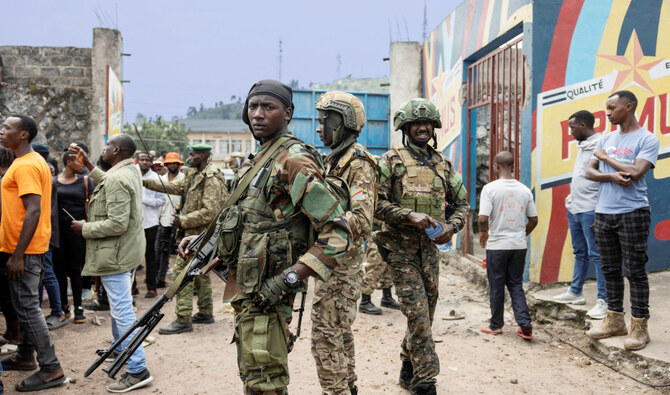
M23 rebels stand guard during a meeting in Goma. (File/Reuters)
Short Url
Updated 21 March 2025
Follow

M23 group seizes key town in eastern DR Congo

  • Capture of Walikale leaves rebels in control of road linking 4 provinces

GOMA: Rwanda-backed M23 rebels have entered the center of the eastern Congo town of Walikale, a local activist and an M23 source said on Thursday, expanding the insurgents’ presence deep into the Congolese interior despite renewed calls for a ceasefire.

Their entry into Walikale, an area rich in minerals including tin, followed fighting on Wednesday with the Democratic Republic of Congo’s army and allied militias on the outskirts of the town.

The town’s capture would leave the rebels, who took eastern Congo’s two largest cities earlier this year, in control of a road linking four eastern Congo provinces and within 400 km of Kisangani, the country’s fourth-biggest city.

“The rebels are now visible in the city’s center,” said Fiston Misona, a civil society activist in Walikale.

“There are at least seven people wounded who are at the general hospital.”

An M23 source said the rebels were in complete control of the town.

A spokesperson for Congo’s army did not respond to requests for comment about the situation in Walikale.

The rebels’ move on Walikale, a town of about 15,000 people, came despite calls on Tuesday by Congo President Felix Tshisekedi and his Rwandan counterpart Paul Kagame for an immediate ceasefire after their first direct talks since M23 stepped up its offensive in January.

The conflict, rooted in the fallout from Rwanda’s 1994 genocide and competition for mineral riches, has quickly become eastern Congo’s worst conflict since a 1998-2003 war that drew in multiple neighboring countries.

Rwanda has been supporting the ethnic Tutsi-led rebels by providing arms and sending troops, according to the UN, Western governments, and independent experts.

Rwanda has denied backing M23 and says its military has been acting in self-defense against Congo’s army and a militia founded by some of the perpetrators of the genocide.


Drone strikes in Ethiopia’s Tigray region kill one, injure another

Updated 6 sec ago
Follow

Drone strikes in Ethiopia’s Tigray region kill one, injure another

  • The senior Tigrayan official said the drone strikes hit two Isuzu trucks near Enticho and Gendebta
  • The Ethiopian National Defense Force launched the strikes but did not provide evidence

ADDIS ABABA: One person was killed and another injured in drone strikes in Ethiopia’s northern Tigray region on Saturday, a senior Tigrayan official and a humanitarian worker said, in another sign of renewed conflict between regional and national forces.
Ethiopia’s national army fought fighters from the Tigray People’s Liberation Front for two years until late 2022, in a war researchers say killed hundreds of thousands through direct violence, the collapse of health care and famine.
Fighting broke out between regional and national forces ⁠in the disputed territory of western Tigray earlier this week, according to diplomatic and government sources.
The senior Tigrayan official said the drone strikes hit two Isuzu trucks near Enticho and Gendebta, two places in Tigray about 20 kilometers apart. A humanitarian worker confirmed the strikes ⁠had happened. Both asked not to be named.
The Tigrayan official said the Ethiopian National Defense Force launched the strikes but did not provide evidence.
A spokesperson for the ENDF did not respond to a request for comment.
It was not immediately clear what the trucks were carrying.
TPLF-affiliated news outlet Dimtsi Weyane posted pictures on Facebook which it said showed the trucks damaged in the strikes. It said the trucks ⁠were transporting food and cooking items.
Pro-government activists posting on social media said the trucks were carrying weapons.
Earlier this week national carrier Ethiopian Airlines canceled flights to Tigray, where residents rushed to try to withdraw cash from banks.
The Tigray war ended with a peace pact in November 2022, but disagreements have continued over a range of issues, including contested territories in western Tigray and the delayed disarmament of Tigray forces.