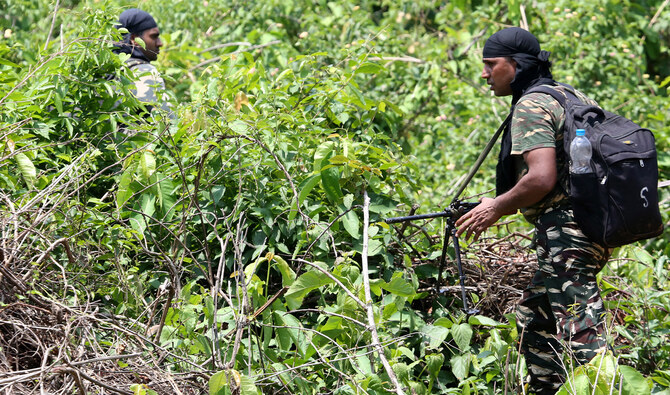
NEW DELHI: Indian forces killed at least 30 Maoist rebels Thursday in one of the deadliest jungle clashes since the government ramped up efforts to crush the long-running insurgency.
More than 10,000 people have been killed in the decades-long “Naxalite” rebellion, whose members say they are fighting for the rights of marginalized people in India’s resource-rich central regions.
An Indian paramilitary soldier was also killed in one of two separate skirmishes that broke out in central Chhattisgarh state, both of which carried on through the day, according to police.
Bastar Inspector General of Police Sundarraj Pattilingam told AFP that the soldier had been killed during a skirmish that broke out in Bijapur district, where 26 guerrillas had also been killed.
Another four rebels were killed in a separate clash in the state’s south.
Searches at both battle sites saw security forces recovering caches of arms and ammunition from both areas.
“The (Narendra) Modi government is moving forward with a ruthless approach against Naxalites and is adopting a zero tolerance policy against those Naxalites who are not surrendering,” interior minister Amit Shah wrote on social media platform X.
The rebels, known as Naxalites after the district where their armed campaign began in 1967, were inspired by the Chinese revolutionary leader Mao Zedong.
Shah has repeatedly vowed that India’s government would crush the remnants of the rebellion by the end of March next year.
A crackdown by security forces killed around 287 rebels last year, an overwhelming majority of them in Chhattisgarh, according to government data.
More than 80 Maoists had already been killed so far this year, according to a tally on Sunday by the Press Trust of India news agency.
The Maoists demand land, jobs and a share of the region’s immense natural resources for local residents.
They made inroads in a number of remote communities across India’s east and south, and the movement gained in strength and numbers until the early 2000s.
New Delhi then deployed tens of thousands of troops in a stretch of territory known as the “Red Corridor.”
The conflict has also seen scores of deadly attacks on government forces. A roadside bomb killed at least nine Indian troops in January.


![]()

Indian forces kill 30 Maoist rebels, one soldier dead
Short Url
https://arab.news/wqxf2
Indian forces kill 30 Maoist rebels, one soldier dead
- An Indian paramilitary soldier was also killed in one of two separate skirmishes
- Another four rebels were killed in a separate clash in the state’s south


Latest updates


Recommended


© 2026 SAUDI RESEARCH & PUBLISHING COMPANY, All Rights Reserved And subject to Terms of Use Agreement.